

Last Updated: July 15, 2026
Table of Contents
Introduction – Cloud Security Services
As increasing number of organizations move their applications, databases and businesses to the cloud, security of digital resources have now become extremely vital. Cloud security services allow organizations to safeguard their sensitive data, thwart cyber attacks, maintain compliance and ensure business continuity.
Security in the cloud is a shared responsibility with your cloud provider. As well as securing the cloud infrastructure, cloud providers will hand over responsibility to secure applications, accounts, configurations and data.
What today‘s cloud security should be much more than just an antivirus and firewall security. Today‘s cloud security should involve Identity Management, Encryption, Detection & Response, Audit & Compliance Monitoring, Workload Protection, Vulnerability Management and 24×7 Security Monitoring. The protection helps the organization to reduce the risk while supporting remote workforces, cloud native applications and digital transformation.
Provides a brief overview of the Cloud security services, examines the major security threats in Cloud computing and reviews the technologies and best practices companies should employ to construct secure Cloud environment.
TECH HUB
This Article Is Part of the Future Tech Trends Hub
Explore AI trends, future innovations, next-generation computing, smart technologies, digital transformation, automation, robotics, emerging devices, and technology predictions shaping tomorrow inside our
Future Tech Trends Hub.
What Are Cloud Security Services?
Security services for the cloud are technologies, policies and managed services to secure the cloud systems, applications and data from intrusion, cyber-attacks, and operational risks.
These services help organizations secure resources hosted in:
- Public clouds
- Private clouds
- Hybrid cloud environments
- Multi-cloud deployments
Cloud security is a combination of many types of security controls, such as identity management, encryption, network security, monitoring of compliance, and threat detection.
Why Cloud Security Matters
Cloud computing provides flexibility and scalability. But it also raises new security issues.
Organizations often store:
- Customer information
- Financial records
- Intellectual property
- Employee data
- Business applications
- Confidential documents
If not properly protected, these assets could be targeted by a cyberattack, exposed accidentally, or accessed by an unauthorized person.
Strong cloud security helps organizations:
- Protect privacy To avoid this, the details about celebrities’ birth dates, mobile phone numbers and addresses are concealed.
- Minimize the cyber dangers
- Retain customer confidence
- Comply with regulatory requirements
- Secure business continuity
Common Cloud Security Threats
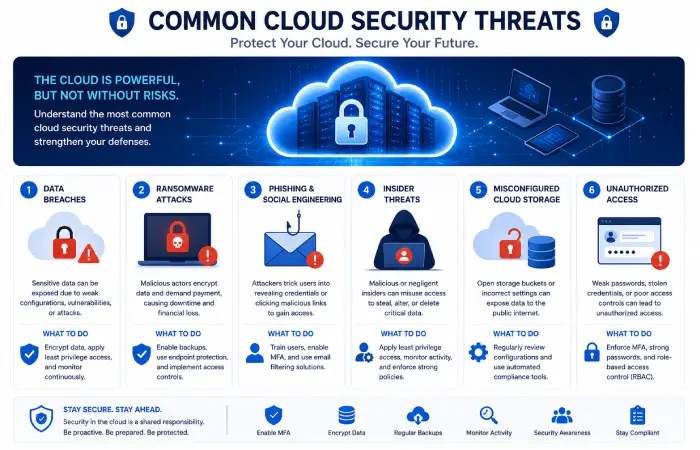
The foundation of a safe cloud environment is knowing at least some of the prevalent threats.
Data Breaches
Unauthorized access to sensitive data is still one of the major risks in secure cloud computing.
Data breaches can occur due to:
- Weak passwords
- Misconfigured storage
- Stolen credentials
- Insider threats
Potential results could include financial loss, legal liability, damage to reputation.
Misconfigured Cloud Resources
Configuration errors constitute one of the most prevalent category of cloud security breaches.
Examples include:
- Publicly accessible Storage buckets
- Open databases
- Incorrect fire wall rules
- Too many user privileges
Reconsidering the configuration on a regular basis mitigates these risks.
Account Hijacking
Cybercriminals may attempt to gain access to cloud accounts through:
- Phishing attacks
- Credential theft
- Password reuse
- Malware
The implementation of powerful authentications drastically diminishes the probability of a hack.
Malware and Ransomware
But if a system connects to the cloud, it may be subject to other threats, such as malware.
Attackers may attempt to:
- Encrypt business data on all servers.
- Steal sensitive files
- Disrupt operations
- Demand ransom payments.
Regular back-ups and security monitoring reduce the effect of these attacks.
Insider Threats
Every security incident is not caused by external sources.
Employees, contractors, and organizations that have been granted too many rights, may inadvertently or on purpose disclose vital data.
Adopting least privilege can help minimize insider threats.
Understanding the Shared Responsibility Model
A fundamental concept in cloud cybersecurity is the shared responsibility model.
Responsibilities are split between the cloud provider and the customers.
Cloud Provider Responsibilities
Most providers are responsible for securing:
- Physical data centers
- Networking infrastructure
- Hardware
- Virtualization platforms
- Core cloud services
Customer Responsibilities
Organizations are typically responsible for protecting:
- User accounts
- Applications
- Operating systems (where applicable)
- Data
- Access permissions
- Security configurations
What the exact roles will be depends on what model the business is using Infrastructure as a Service, Platform as a Service, or Software as a Service.
This model is essential to understand to avoid holes in security if mistaken assumptions are made.
Benefits of Cloud Security Services
Introducing cloud security services can bring great business benefits.
Stronger Data Protection
Encryption, access controls, and monitoring are tools businesses use to protect private business information.
Improved Regulatory Compliance
Most cloud security solutions also enable organizations to meet their industry and regulatory requirements by providing security controls, auditing functions, and policy enforcement.
Better Threat Detection
On-daily security management modern security platforms keep track of malicious activity in the cloud.
This allows for faster detection and response to potential threats.
Business Continuity
Security services often provide backup, disaster recovery and incident response support features that will facilitate a rapid organizational recovery following a cyber incident or system failure.
Increased Customer Trust
Reliable cloud security practices help to ensure customers that their data is protected meaning better business relationships and brand [].
Core Components of Cloud Security
In general, the comprehensive cloud security strategy also includes the followings.
Identity and Access Management (IAM)
Limits on the type and scope of activities that any user is authorized to do in a cloud environment.
Data Encryption
Secures data both at rest and in transit.
Network Security
Uses firewalls, network segregation and secure communication protocols to minimize unauthorized access.
Continuous Monitoring
Monitors cloud activity in real time to Detect Suspicious activity and Security incidents.
Backup and Recovery
Guarantee critical data can be recovered against accidental deletion, hardware failure and cyberattack.
Industries That Benefit from Cloud Security
Cloud security is vital to almost every sector.
Organizations that commonly invest in cloud security services include:
- Healthcare providers
- Financial institutions
- Government agencies
- Educational institutions
- Retail businesses
- Manufacturing companies
- Technology organizations
Each industry has its own specific security and compliance needs.
Essential Cloud Security Solutions
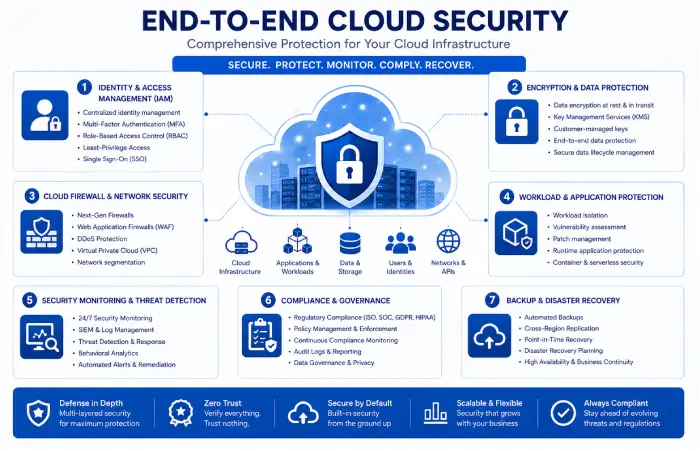
One security tool is no longer sufficient to protect cloud environments. Today’s cloud security solutions integrate several components of security such as identity management, encryption, monitoring, network security and compliance controls to safeguard against ever changing cyber attacks.
These are the essential technologies that every organization needs to be familiar with.
Identity and Access Management (IAM)
The Identity and Access Management (IAM) controls who gets access to the cloud and the types of actions authorized.
Rather than providing unrestricted access to each user, IAM enables businesses to resource permissions according to role and job description.
Key IAM Features
- Role-Based Access Control (RBAC)
- Multi-Factor Authentication (MFA)
- Single Sign-On (SSO)
- Password policies
- Time-sensitive credentials
- User activity logging
Benefits
- Shows up if you not in the right group, showing private information then you are invading their privacy. Shows up if you not in the right group, being inquisitive/authenticating.
- Shielded privileged accounts
- Simplifies managing your users
- Supports Zero Trust security
IAM provides the foundation for any secure cloud.
Data Encryption
Encryption is the process of transforming information such that it is unreadable, unless one has the proper encryption key.
Cloud providers typically offer encryption:
- Rest protects stored data.
- In Transit – securing information while moving over networks.
Encryption helps to prevent that sensitive data will be lost even when it‘s saving system gets broken into.
Best Practices
- 2. Enable encryption by default.
- Protect encryption keys.
- Rotate the keys on a systematic basis.
- Use strong cryptographics.
Cloud Firewalls
Cloud Firewalls monitor and control network traffic entering and leaving cloud environments.
As opposed to hardware firewalls, cloud firewalls are software based, can be scalable with respect to the cloud infrastructure.
They help organizations:
- Block unwelcomed traffic.
- Restrict access
- Identify potentially dangerous behavior
- Prevent network based attacks
Cloud firewalls are essential in safeguarding application services exposed to the internet.
The Cloud Workload Protection
Cloud workloads include:
- Virtual machines
- Containers
- Kubernetes clusters
- Serverless applications
Workload protection solutions continuously monitor these resources for:
- Malware
- Unauthorized changes
- Vulnerabilities
- Misconfigurations
- Runtime attacks
This enables organizations to secure applications throughout their lifecycle.
Security Monitoring and Threat Detection
Today‘s cloud environments produce vast security information.
Security monitoring tools keep a close eye on this data to detect any abnormal activity.
Common monitoring capabilities include:
- Login monitoring
- Network activity analysis
- Threat detection
- File integrity monitoring
- Automated alerts
- Incident investigation
Real-time monitoring enables security teams to identify and react to attacks far quicker.
Vulnerability Management
Cyber criminals will exploit unpatched software and vulnerabilities in the configuration.
Vulnerability management enables organizations to detect and address security issues proactively.
Typical activities include:
- Vulnerability scanning
- Patch management
- Configuration reviews
- Risk assessments
- Security testing
Guided continuous vulnerability assessment results in continuous improvement of security in the cloud.
Cloud Compliance Services
Compliance with regulatory and legal data requirements: numerous industries may need to adhere to regulatory and legal data requirements.
Cloud compliance services help organizations meet these obligations by providing:
- Security assessments
- Compliance monitoring
- Audit logs
- Policy enforcement
- Reporting tools
Common compliance frameworks include:
- ISO 27001
- SOC 2
- PCI DSS
- HIPAA
- GDPR
Full compliance can help a bank to mitigate legal, operational and regulatory risks as well as establishing greater confidence among customers.
Cloud Security Solutions Comparison
The following table outlines a number of the most common cloud security technologies.
| Security Solution | Primary Purpose | Best For |
| Identity & Access Management (IAM) | User authentication and authorisation | All organizations |
| Data Encryption | Secure storage and transfer of data | Sensitive information |
| Cloud Firewall | Protection of the network traffic. | Public-facing applications |
| Workload Protection | Secure Servers and Containers | Cloud-native workloads |
| Security Monitoring | Detect suspicious activity. | Ongoing threat monitoring. |
| Vulnerability Management | Find security vulnerabilities | Risk reduction |
| Compliance Services | The act of meeting regulatory requirements is the practice of ensuring compliance with laws, regulations, guidelines and specifications relevant to the business. | Regulated industries |
This combined approach provides a more comprehensive Defensive-in-Depth strategy rather than a reliance on just one potential point of failure.
Choosing the Right Cloud Security Solution
How much you need depends on who you are.
Small Businesses
Focus on:
- MFA
- Secure backups
- Endpoint protection
- Basic monitoring
- Identity management
Medium-Sized Businesses
Add:
- Cloud firewalls
- Vulnerability scanning
- Compliance reporting
- Security monitoring
Large Enterprises
Typically implement:
- Zero Trust architecture
- Security Information and Event Management (SIEM)
- Cloud Security Posture Management (CSPM)
- 2014 terrorist and threat detection: Detection of threats and dangerous situations.
- Managed security operations
- Ongoing compliance surveillance
Security investments need to be scaled according to the business size, regulation-specific industry requirements and risk appetite.
Building a Layered Cloud Security Strategy
A security tool cannot eliminate every cyber risk.
Organizations should combine multiple layers of protection, including:
- Identity verification
- Encryption
- Network security
- Endpoint protection
- Continuous monitoring
- Periodic review of security
- Employee security awareness training
This technique of layered security on a broad scale results in providing effectiveness for the mitigation and containment of many security events.
Cloud Security Best Practices
Equipping yourself with appropriate security tools is just one dimension of a good cloud security strategy. Your organization should embrace mature operational procedures to mitigate the risks and enhance the resiliency of your infrastructure.
Enable Multi-Factor Authentication (MFA)
Passwords are no longer enough to safeguard cloud accounts.
Enable Multi-Factor Authentication (MFA) for:
- Administrator accounts
- Employee accounts
- Third-party users
- Remote access
This extra step of confirmation will greatly decrease the chances of compromise to the account.
Follow the Principle of Least Privilege
Grant users only those permissions they need to do their jobs.
Review permissions regularly to:
- Purging. Delete users who do not use the account.
- Limit access for administrators
- Limit unlimited privileges
Limiting access reduces the damage that can be done by a compromised account or an insider attacker.
Encrypt Sensitive Data
Protect sensitive information by encrypting data:
- At rest
- In transit
And organizations should have in place secure encryption key management policies and update them periodically.
Keep Systems Updated
Most cloud providers release security patches and new features very frequently.
Organizations should:
- Immediately patch security issues.
- Update operating systems
- Upgrade applications
- Eliminate disable applications
As a means of reducing a potential attack surface.
Monitor Cloud Activity
Proactive monitoring will prevent maliciouss or suspicious behavior event from occurring.
Security teams should monitor:
- User logins
- Configuration changes
- Network traffic
- API activity
- Administrative actions
Automated alerts may also speed up incident response.
Perform Regular Security Assessments
Regular evaluations allow you to see your vulnerabilities at an earlier stage.
Recommended activities include:
- Vulnerability scanning
- Configuration reviews
- Penetration testing
- Risk assessments
- Compliance audits
Proactivity also enhances cloud security by reducing risk.
Train Employees
Human error continues to be one of the leading causes of security breaches.
Organizations should provide regular training on:
- Phishing awareness
- Password management
- Secure file sharing
- Rules about how data should be handled
- Incident reporting procedures.
Informed employees; enhance an organization‘s overall cybersecurity defenses
How to Choose Cloud Security Services
Similarly, when evaluating cloud security services, choose cloud security services according to the the technical and regulatory demands of your organization.
Important evaluation criteria include:
- Identity and access management
- Data encryption
- Threat detection
- Compliance support
- Backups and disaster recovery
- Works seamlessly with existing cloud platforms: Force.com and NetSuite.
- Centralized security monitoring
- Scalability
Rather than picking the best tools by their capabilities, look at how well they will integrate into the rest of your cloud world.
Future Trends in Cloud Security
The evolution of cloud security7. Cloud security is constantly evolving as organizations engage with ‘cloud native’ technologies more directly.
Zero Trust Security
Zero Trust: No User or Device should be trusted indefinitely.
Access is constantly being checked by identity, device health, and risk.
A lot of organizations are moving towards to the Cloud using Zero Trust.
AI-Powered Threat Detection
Artificial intelligence is increasingly used to:
- Identify atypical ‘behavior
- New threats to Analyze:
- Decrease false alarms
- Automate incident response.
And finally, for the security teams, AI enables them to respond more quickly to threats.
Cloud Security Posture Management (CSPM)
CSPM solutions automatically identify:
- Misconfigured cloud resources
- Compliance violations
- Security policy gaps
These tools help organizations maintain secure cloud environments at scale.
Secure Access Service Edge (SASE)
SASE integrates networking and security into a cloud service.
Benefits include:
- User access to data6.1.5 Secure remote access6.1.5 You should provide secure remote access to data and applications. You should use secure virtual private networks (VPNs) or remote-access VPNs as appropriate.
- Easing network administration
- Security policies on a number of principles are to be maintained consistently across all services.
- Enhanced User Experience
With the increasing growth of hybrid work spaces, SASE adoption will see an increase,
Frequently Asked Questions
What is Cloud Security Service?
Cloud security services involves technology and managed services that secure the cloud infrastructure, applications and data against cyber threats. This can include identity management, encryption, workload protection, firewalls, monitoring and compliance.
Why is cloud security paramount?
Cloud Security helps protects your most confidential business information, minimizes cyber risks, maintains compliance with regulations and guarantees that business can keep on running.
If security controls are inadequate, organizations could suffer from data breaches, ransomware or unauthorized access.
What is the shared responsibility model?
The shared responsibility model indicates the division of tasks between provider and customer for a general security responsibility.
The cloud provider is responsible for ensuring security of the cloud infrastructure, while the customer is responsible for the security of their applications, user accounts, configurations and data.
What are the best practices of cloud security?
Some of the most effective practices include:
- Enable Multi-Factor Authentication
- Encryption of sensitive data.
- Following the principle of least privilege accessibility.
- Continuously monitor the cloud environments
- .Periodic security checks.
- 2. Keep the systems updated.
- Educate staff on cybersecurity awareness
Can small business owners take advantage of cloud security services?
Yes.
Cloud security services enable organizations of any size to secure customer data, remain compliant, avoid cyber-attacks, and strengthen business continuity without the financial commitment of heavy on-premises security systems.
Conclusion
As more and more organizations move workloads to the cloud, purchase of cloud security services is becoming unavoidable. Cloud security is an essential part of the overall cloud strategy, as it secures applications, data, users and infrastructure in a way that allows the organizations to grow and comply with regulations.
A broad security strategy across cloud environments would include adoption of technologies like IAM, encryption, cloud firewalls, workload protection, continuous monitoring and compliance services. Adherence to various best practices like implementation of Multi-Factor Authentication, enforce least privilege, security assessments and employee training would add to cloud defenses.
Whether you‘re a start-up venturing into cloud computing for the first time or a large enterprise managing complex multi-cloud environments, selecting the right cloud security solutions minimizes risk, maximizes resiliency, and keeps your critical digital assets protected.
Cloud Computing Services Hub
Discover cloud computing services, deployment models, cloud providers, storage solutions, security services, migration strategies, and managed cloud solutions for businesses and individuals.