
Last Updated: September 15, 2026
AI-Powered Chatbots for Business: Customer Service, Sales, Ecommerce and Automation
AI business chatbots have come a long way since the days of the website pop-up that could only provide answers to a handful of scripted questions.
Current systems can interpret natural language, query business knowledge and summarize conversations, qualify leads, provide recommendations, retrieve information and, in some cases, take actions through integrated business systems.
It represents a much bigger shift from the old chatbot we saw earlier, to the new AI agent that can actually help you get something done.
This is important because customers expect fast responses and companies want to manage costs by answering quickly, attract leads efficiently, and offer multi-channel service.
Customer service, sales and ecommerce: As of 2026, 66% of customer service organizations make use of AI agents (up from 39% in 2026), according to Salesforce global research.
At the same time, organizations are combining conversational AI with information about customers, internal or outside knowledge bases, CRM systems or existing business processes.
What are AI Chatbots for Business, What Can They Do, How Works Best, How to Build or Buy your Own, and what to Look for Before Deployment.
Table of Contents
What Are AI-Powered Chatbots for Business?
An AI business chatbot is a program that interact with the customers or employees over a conversational interface.
Rather than entirely dependent on pre-determined scripts, contemporary systems can use AI models to interpret a user’s request and generate a relevant response.
A business chatbot may operate through:
- A company website A general information page that describes the company.
- Mobile applications
- Customer-support portals
- Social messaging
- Team communication platforms
- Voice channels
The chatbot is capable of integrating with other systems.
For example, a customer asking about an order might receive an answer based on information retrieved from the company’s order-management system rather than a generic response.
This is what makes business chatbots more useful than basic FAQ widgets.
How Business AI Chatbots Work
Usually, a common AI chatbot will have each of these modules.
User conversation
The customer or user poses a query in a natural language.
AI understanding
The system makes sense of the request as the user’s intention.
Memorization or recall knowledge, or data retrieval.
The chatbot can also seek interested responses from valid business content, database, or connected applications.
Response generation
The AI spends a certain amount of time between 300 and 460 milliseconds searching for an answer using the data available.
Action layer
Where supported by the system, may perform an action such as: create a ticket, update a record, schedule an appointment, route a conversation etc.
Human escalation
If the request is about sensitive information, complex, not captured by the system, the conversation can be redirected to a human.
That last bit is crucial.
A good business chatbot won‘t try to deal with every individual situation.
What Can AI Chatbots Do for a Business?
Generally, the most effective chatbot applications are associated with particular workflows from a business.
Answer Customer Questions
Chatbots can answer common questions about:
- Products
- Services
- Pricing
- Policies
- Business hours
- Shipping
- Returns
- Account issues
A properly maintained knowledge base should allow the chatbot to give the same answers over and over again without having one employee monitor every trivial question.
Provide 24/7 Support
Automated chatbots are not a replacement for a conventional support team since they can be accessed outside of working hours.
No, it doesn‘t mean that every problem should be automated.
Allows customers on-line access 24×7 for basic inquiries, with more complex requests held for a staff.
Qualify Leads
A sales chatbot can ask visitors questions to understand:
- What they need
- Company size
- Budget
- Product interest
- Purchase timeline
It can then send qualified leads to the appropriate sales representative.
Schedule Meetings
Some business chatbots can connect to scheduling systems and help prospects book calls or demonstrations.
Recommend Products
Ecommerce chatbots can help shoppers decide what to buy by asking about their preferences, requirements and budget.
Collect Information
The chatbot would also offer a more conversational way of obtaining details, avoiding the necessity of long form filling in by customers.
Route Conversations
A chatbot can determine whether a request belongs to:
- Sales
- Customer service
- Billing
- Technical support
- Returns
- Another department
So it will map the interaction to the correct user. Then it can forward it on to the oracle or reply.
AI Chatbots for Customer Service
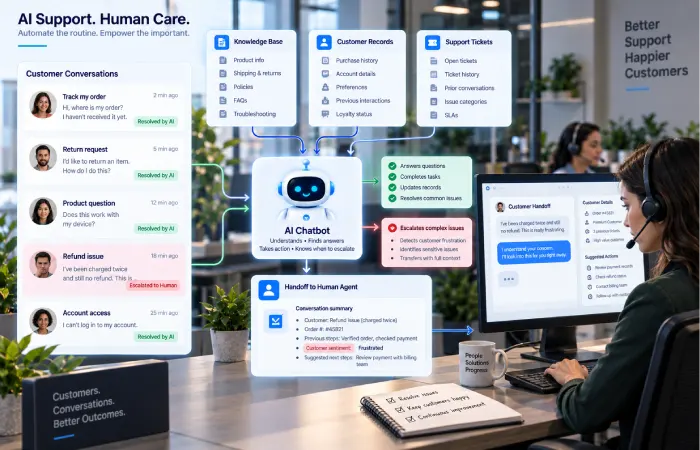
For example, customer service is among the most obvious business use cases of conversational AI.
Most traditional chatbot systems relied on decision trees and canned responses.
Current AI technology is able to understand more natural questions, then be able to search for information from the business content.
According to Salesforce, the progression is from classic chatbots to AI agents that own a sense of context, can extract information, and execute certain commands.
As a result, this enables several customer-service processes.
FAQ Automation
Frequently asked questions can be auto-responded and resolved by the BP without any need for opening a support ticket.
Order and Account Questions
Once linked with business systems, an AI assistant may be able to assist with order information, account details and other standard requests.
Troubleshooting
The chatbot can walk customers through common troubleshooting procedures before escalating the case.
Ticket Triage
AI has the ability to create references that can automatically categorize an enquiry and then alert the relevant support, or backup, team.
Human Handoff
If an issue calls for empathizing, authority or the help of someone with expertise, the chatbot should be able to hand-over the dialog with the right context and not require the customer to renavigate.
Next: AI Customer Service Chatbots
AI Sales Chatbots for Lead Generation
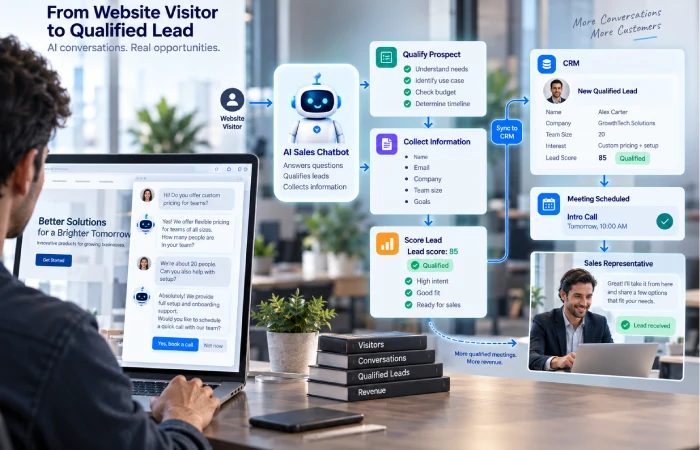
Sales chatbots are different to customer support ones.
Our overarching goal is not just to find answers but to aid in bringing a prospect closer to taking the next step in the sales cycle.
A sales chatbot can:
- Welcome to your website readers.
- Ask gouging questions.
- Has a good understanding of his products or services.
- Ascertain the intent to purchase
- Favor the relevant offerings.
- Capture contact information
- Book meetings
- Route is a route to sales reps.
According to 2026 India research of Salesforce, 91% of salespeople they studied reported that the AI agents were essential to business success and many of the teams believed they would reduce the amount of research and content-creation.
This is emblematic of a trend I have begun to call treating AI as part of the revenue workflow rather than only as a customer support tool.
Next: AI Sales Chatbots for Lead Generation
AI Chatbots for Ecommerce Businesses
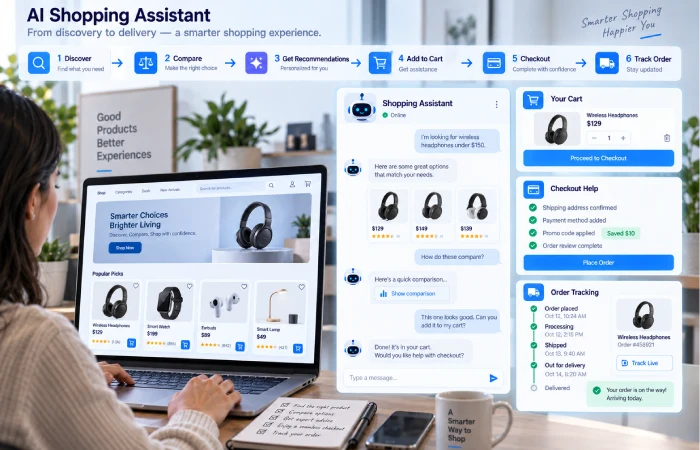
Ecommerce is most appropriate for conversational AI, as customers frequently seek advice before, during and after they buy.
A chatbot can enhance the customer journey 365 days a year from product discovery to after-sales service.
Before the Purchase
The chatbot can answer questions about:
- Product specifications
- Sizes
- Compatibility
- Availability
- Features
- Delivery options
During the Purchase
It can enable shoppers to choose between options, answer checkout questions, and direct them to appropriate products.
After the Purchase
Depending on the integrations available, the system can help with:
- Order tracking
- Returns
- Exchanges
- Shipping questions
- Product support
This allows the chatbot to be integrated into the customer‘s experience rather than an additional FAQ.
Next: AI Chatbots for Ecommerce Businesses
AI Chatbots vs Traditional Chatbots
There is some overlap between the two in practice but there is an important distinction.
| Feature | Traditional Chatbot | AI-Powered Chatbot |
|---|---|---|
| Response method | Fixed rules/scripts | AI creation or retrieval response |
| Natural language | Limited | Much stronger |
| Context | Usually limited | Even more, Can keeps the ‘context of conversation. ’ |
| Knowledge | Predefined flows | Can utilize interrelated knowledge bases. |
| Flexibility | Variability: studies conflicting with the theory. Loci with irregular variability. | Higher |
| Integrations | From basic to advanced: | In many cases designed for deeper integrations |
| Automation | Rule-based | Can support multi-step workflows |
| Human handoff | Usually simple | Can transfer more information that is more detailed |
| Best use | Simple predictable questions are those described in the first sum-by-list question. The idea being that there are not many influences on the people being asked the question. Were they to be asked a more complex sensitive question they out to be more vulnerable to bias effects. | A wider range of business discussions. |
Canned chatbots, however, are not effectively (“useless”.)
A simple rule-based bot can also be the optimal option if the workflow is indeed constrain and predictable.
The flaw being is believing that each company wants the leading edge product that is there for top end computing.
AI Chatbot Platforms
A variety of platforms are available to businesses.
Customer Service Platforms
These concern, among other things, support conversations, ticketing and knowledge bases, and human-agent workflows.
CRM-Based Platforms
These tie conversational AI directly with the customer record and sales process.
Ecommerce Platforms
They concentrate on help in shopping, with the some guiding on finding the product and post sale support.
General AI Agent Platforms
These give more flexibility to companies looking to link AI to numerous systems and workflows.
For instance, Intercom states that Fin is a customer agent that can be used across service, sales and ecommerce use cases and integrate with existing helpdesk systems.
OpenAI is also increasingly working in the enterprise space with AI agents for customer and internal workflows, focusing on evaluation, deployment and control.
Plays a crucial role as the optimal system for platform category is between. a support team may be very different from the best system for an ecommerce store.
Next: AI Chatbot Platforms Comparison
How to Build an AI Chatbot for Business
Businesses generally have three options:
Buy a ready-made platform
This is usually the fastest route.
Customize an existing AI platform
This provides more control while avoiding the cost of building everything from scratch.
Build a custom chatbot
This is appropriate when the business needs highly specific logic, data connections, security controls or workflows.
A practical implementation process looks like this:
Step 1: Define the Use Case
Don’t begin with “We need an AI chatbot.”
Begin with:
“We need to reduce repetitive customer questions.”
Or:
“We need to qualify website leads.”
Or:
“We need to help shoppers find suitable products.”
Step 2: Prepare the Knowledge
The chatbot is only as useful as the information it can reliably access.
Gather:
- FAQs
- Product documentation
- Policies
- Support articles
- Internal procedures
- Approved answers
Remove outdated information before connecting it to the system.
Step 3: Set Permissions
Determine what the chatbot can read and what it can do.
Access should be limited to what is required for its job.
Step 4: Define Escalation Rules
Decide when a human must take over.
Examples include:
- Complaints
- Sensitive account issues
- Refund exceptions
- Legal questions
- High-value sales requests
- Technical cases outside the knowledge base
Step 5: Connect Business Systems
Depending on the use case, integrations may include:
- CRM
- Helpdesk
- Ecommerce platform
- Order system
- Calendar
- Knowledge base
- Ticketing system
Step 6: Test Real Conversations
Don’t test only perfect questions.
Test vague requests, incorrect assumptions, unusual wording and requests outside the chatbot’s knowledge.
Step 7: Monitor and Improve
Review:
- Resolution rate
- Escalation rate
- Customer satisfaction
- Lead conversion
- Response accuracy
- Failed conversations
AI chatbot deployment should be an ongoing process, not a one-time installation.
Benefits of AI Chatbots for Business
Faster Responses
Customers can receive answers without waiting for a support representative.
Lower Repetitive Work
Employees can spend less time answering the same basic questions.
Better Lead Handling
Sales teams can respond to prospects before interest disappears.
Scalable Support
The same automated system can handle many conversations at once.
Consistent Answers
Approved information can be presented consistently across conversations.
Better Customer Experience
A useful chatbot can provide immediate assistance while keeping human support available for complicated issues.
Salesforce’s 2026 service research found that organizations using AI agents are reporting measurable value, with customer satisfaction among the leading improved metrics.
Limitations and Risks
AI chatbots are not perfect.
Incorrect Answers
Generative AI can produce inaccurate information.
Business systems therefore need reliable knowledge sources, testing and monitoring.
Poor Customer Experience
A chatbot becomes frustrating when it repeatedly misunderstands the customer or prevents access to a human.
Privacy Problems
A chatbot may encounter sensitive customer information.
Businesses need appropriate access controls, data policies and security measures.
Integration Failures
A chatbot that cannot access current information may give outdated answers.
Over-Automation
Not every conversation should be handled by AI.
The goal is not to eliminate human interaction. The goal is to use automation where it works and humans where they add greater value.
How Much Does an AI Business Chatbot Cost?
There is no single price.
Cost can depend on:
- Number of conversations
- Number of users
- AI model usage
- Integrations
- Automation runs
- Knowledge-base size
- Voice support
- Human-agent seats
- Security requirements
- Custom development
A simple chatbot can be relatively inexpensive.
A large customer-service system connected to CRM, ecommerce and internal systems can become a significant technology project.
Businesses should calculate total cost of ownership, not just the monthly software fee.
How to Choose the Best AI Chatbot for Your Business
Start with the workflow, not the vendor.
Ask:
What problem are we solving?
How many conversations does it affect?
What information does the chatbot need?
Which systems must it access?
What actions should it be allowed to perform?
When should a human take over?
How will performance be measured?
What security and compliance requirements apply?
Then compare platforms against those requirements.
| Business Need | Important Capability |
|---|---|
| Customer support | Knowledge base + ticket integration |
| Lead generation | Qualification + CRM integration |
| Ecommerce | Product and order data |
| Appointment booking | Calendar integration |
| Technical support | Documentation + troubleshooting |
| Large support teams | Analytics + routing + administration |
| Custom workflows | APIs + automation + agent capabilities |
Key Metrics to Track
A chatbot is no different from any other business system in terms of performance measurement.
Customer Service
Track:
- Resolution rate
- Escalation rate
- First-response time
- Customer satisfaction
- Repeated-contact rate
Sales
Track:
- Qualified leads
- Meeting bookings
- Conversion rate
- Lead response time
- Revenue influenced
Ecommerce
Track:
- Product interactions
- Add-to-cart activity
- Conversion rate
- Average order value; This element could influence the relationship between the response variable and the predictor variable (average order value). High average order value will result in high revenue generated to the Etsy‘s.
- Pre-sell support contacts (up to the point of purchase).
What the exact metric depends on what the bot is meant to do.
Common AI Chatbot Mistakes
Launching before a clearly defined use case and objective.
A chatbot should have a specific business objective.
Linking information of low quality
Out of Date FAQs Lead To Out of Date Answers.
For users, the six packs could be: hiding the option: ‘human’; still view the standard pack. Packing the standard pack. That‘s why they had to warn the user: ‘quickly pack into a standard pack’.
Automation should not be designed so that Customers cannot escape from it.
Overly permissive permissions Allowing a user to perform actions that aren‘t necessary for their tasks.
Please break down the permissions to only allow access to what is needed for the workflow.
Ignoring testing
Real users will make inquiries that were never demonstrated.
Measuring chatbot activity, rather than business objectives
Number of conversations alone does not guarantee that the chatbot has achieved success.
Attempting to automate everything.
5. Certain interactions require human judgement.
Frequently Asked Questions
What is an AI-powered chatbot for business?
A conversational software system that employs AI to interpret questions, formulate or search for answers and aditionally to perform business related operation or connect the user with a human team.
What are the best AI chatbots for business?
The best chatbot depends on the business requirement. Customer-service teams, sales organizations and ecommerce companies can have very different needs.
Can an AI chatbot replace customer service employees?
Can do some of customer service, for example repetitive requests. However, for more complex, sensitive and high-value services of customers’ interaction with companies, human employees are still very crucial.
Can AI chatbots generate sales leads?
Yes. Sales chatbots can qualify visitors, gather information, and book meetings.
Can ecommerce stores use AI chatbots?
Yes. Ecommerce chatbots can assist shoppers in finding products, answering product related questions and providing post-sale help when integrated with the relevant systems.
Should a small business use an AI chatbot?
A small business may gain if its expected are many repetitive questions, high web visitors, or require faster lead response. A simple focused deployment is typically preferable to a large scale enterprise system.
What is the difference between an AI chatbot and an AI agent?
A chatbot is focused on conversation. An AI agent can do more, by using tools, pulling information in and taking permitted actions to complete a workflow.
How do I build an AI chatbot for my business?
Begin by creating one use case, preparing trustworthy knowledge, choose a platform or development approach, plugging system, adjusting parameters, human escalation and validating real conversations.
Final Thoughts
Business-oriented AI-driven chatbot innovations are emerging as a key addition to customer services, sales and ecommerce workflows.
The most significant change is not just thatthey sound more natural.
It is that the modern systems are able to link the dialogue with business data, programs and activities.
Customer-service portals are shifting toward AI agents that can handle increased demand and support human agents. Salesforce indicates that adoption of AI-agents in customer service organizations rose considerably from 2025 to 2026.
Sales is also transitioning to agent-based workflows, with the most recent 2026 India research from Salesforce highlighting high demand for AI agents from sales reps.
Meanwhile, offering AI-enabled support through platforms such as Intercom evolving into sales and ecommerce, while OpenAI is marketing enterprise agents on behalf of customer and internal workflows.
Yet the best chatbot may not be the most sophisticated.
A useful chatbot needs to solve an actual problem, draw on accurate information, connect with the appropriate systems, safeguard customer data and understand the limits of its expertise.
For most businesses, the strongest starting point is simple:
Pick out one repetitive, high volume process, automate in a good way, measure the outcome and grow only when the figures allow it.