




Introduction – ai chatbot platforms comparison
Selecting which AI chatbot platform can be a matter of finding the chatbot that offers the most.
Perhaps you‘ve got a customer-service team that needs a helpdesk-centric solution. Your sales team might need lead qualification and CRM integration. If you run an ecommerce site, they‘ll need product recommendations and order data. If you‘re building an entirely custom AI agent, your developers will want a platform to do it in.
This is the reason why, in order to compare AI chatbots platform, use case, integrations, customization, automation and business needs should be the key factors.
Table of Contents
What Is an AI Chatbot Platform?
AI chatbot platform is the underlying technology used to build, operate or deploy chatbots.
Depending on the platform, it may provide:
- AI models
- Chat interfaces
- Knowledge bases
- Workflow automation
- APIs
- Business integrations
- Analytics
- Human handoff
- Security controls
- Agent-building tools
Some platform are for business users without any technical skills and include information systems, although other platform are for developers and include developer platforms.
Main Types of AI Chatbot Platforms
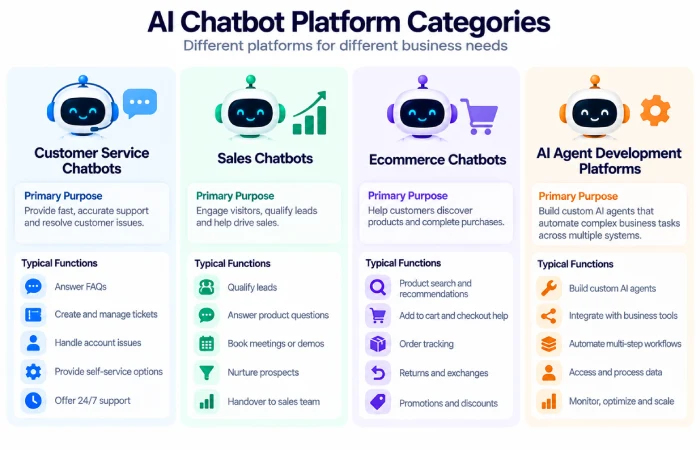
Customer Service Platforms
These platforms support.
They typically provide:
- Knowledge-base integration
- Ticket management
- Customer conversations
- Agent handoff
- Support analytics
Among the best-known AI vendor products are those of Zendesk, which currently offers an AI customer-service platform that handles ‘case resolution, integrations, and long-and mid-tail routing to human agents’.
Sales Chatbot Platforms
Sales-oriented platforms focus on:
- Lead capture
- Qualification
- Product questions
- Meeting booking
- CRM integration
Intercom‘s existing Fin platform supports sales to service roles, for example lead qualification & meeting booking.
Ecommerce Chatbot Platforms
These are centered on online shopping.
They may support:
- Product discovery
- Recommendations
- Order tracking
- Returns
- Shopping assistance
Shopify defines ecommerce ai chatbots as having the dual role of: 1. Customer service 2. Conversational shopping”
AI Agent Development Platforms
These platforms are for business and developers who need to have better control.
For instance, the Microsoft Foundry Agent Service offers managed infrastructure for prompt and hosted agents, as well as tools, models, security, monitoring and publishing offers.
More planning need for them, but they also got the advantages of being the most customizable.
AI Chatbot Platforms Comparison
| Requirement | Support Platform | Sales Platform | Ecommerce Platform | Agent Development Platform |
|---|---|---|---|---|
| Customer support | Strong | Moderate | Strong | Custom |
| Lead generation | Moderate | Strong | Strong | Custom |
| Product recommendations | Limited | Moderate | Strong | Custom |
| CRM integration | Strong | Strong | Varies | Custom |
| Workflow automation | Strong | Strong | Strong | Strong |
| Custom development | Limited | Moderate | Varies | Strong |
| Human handoff | Strong | Strong | Strong | Custom |
| Technical skill required | Low–Medium | Low–Medium | Low–Medium | Medium–High |
This comparison shows why there is no universal chatbot platform. The right choice depends on the workflow.
Features to Compare
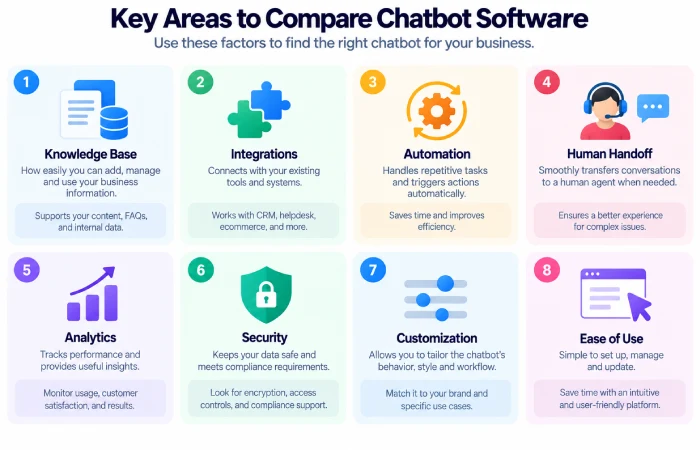
Knowledge Base
Review the way in which the platform enables the AI to utilize business data.
Learning good knowledge management is important since the bot will require the correct information to answer.
Integrations
6. Look for any existing links to the systems you business currently has in place.
These may include:
- CRM
- Help desk
- Ecommerce platform
- Calendar
- Databases
- Knowledge bases
Automation
Determine if the should, the can do, actions are supported.
A more complex workflow type could enable a bot to locate information, generate a task, modify a record, or initiate a different action.
Human Handoff
A flight plan is necessary for each business chatbot.
If not gracefully handled, customers should not get caught in an automated loop.
Analytics
Look at whether the platform provides useful measurements such as:
- Resolution rate
- Conversation volume
- Escalation rate
- Customer satisfaction
- Conversion rate
- Failed conversations
Security
Businesses should consider:
- Authentication
- Access permissions
- Data handling
- Encryption
- Logging
- Administrative controls
Security considerations are of particular concern if the chatbot has access to internal data of the organisation or its customers.
Business Chatbot Software Comparison by Use Case
For Customer Support
Prioritize knowledge-base quality, ticketing integrations, escalation, and support analytics.
For Lead Generation
Engage training Focus on qualification, CRM integration, Meeting booking, and sales workflows.
For Ecommerce
Prioritize product data, suggestions, data concerning the order, Shopping Guide and Integration with Stores.
For Internal Business Use
Prioritise document searching, permissions, inside expertise, and connections to workplace software.
For Custom Applications
Concentrate on APIs, models, and tools, as well as security, observability, and flexibility of development.
How to Choose an AI Chatbot Platform
1. Define the Main Problem
3. You know what you want the chatbot to do before shopping around.
2. Identify Required Integrations
Deine Anpassenden Tools Achte auf die Integrationen und Anwendungen, mit welchen dein Chatbot interagieren soll.
3. Decide How Much Customization You Need
A ready-made support chatbot and a dedicated AI agent (and their diversity of costs), could not be more different.
4. Consider Your Technical Team
A platform that needs knowledge to build may not be a good fit for an organization looking for a straightforward no-code solution.
5. Test With Real Conversations
By addressing the actual questions and concerns of your customers or employees, you provide a natural resource they can consult.
6. Measure Business Results
Focus on using chatbots that is just the start.
Some metrics that will be useful are time savings, resolution rate, lead quality, customer satisfaction, and conversion.
Common Mistakes
Most companies just base their platforms on the AI model.
Other mistakes include:
- Ignoring integrations
- Using overly complicated equipment
- Cost for extras incorrect fee for additional services.
- M1.1 Neglecting security requirements
- Not planning for human handoff
- Expanding on an initial offer of limited business information
- Compare prices not actual capacity
The cost of the cheaper chatbot may be irrelevant if it involves extensive heavy lifting or importing of software to do the job.
FAQs
What should I compare in AI chatbot platforms?
Contrast the primary use case of the platform, integrations, knowledge management, automation, human handoff, analytics, security, customization, and ease of use.
Are all AI chatbot platforms the same?
N0. There are those that deal with customer service and those that are more in sales, ecommerce or those who develop custom AI agents.
What is better for a small business: a ready-made chatbot or a custom platform?
A pre-existing platform might be simpler if the business use case is trivial. If the interaction logic is complex or requires significant business-system integrations, custom development is likely to be more rational.
Do AI chatbot platforms support human agents?
Most business-focused platforms offer human handoffs or agent-assisted functions. The flow varies by platform.
Final Thoughts
When doing an AI chatbot platforms comparison, always start with the business problem, not the software.
Customer service platforms, sales platforms, ecommerce chatbot platforms, and AI agent builder platforms all excel in different areas.
Select according to the function you want your chatbot to have, the integrations your software solution requires, the degree of customization you require, and the security features your business requires.
Continuing down this path, where chatbots become more powerful agents, the line between a chatbot and a broader business automation system is starting to be blurred.
Of course, the ideal end platform is whichever product workd for you, helps you the most, produces no extra processes, and is straightforward.