


Table of Contents
Introduction
Shoppers who are browsing online frequently require information prior to making a purchase.
They may have questions such as “can I get this product?”, “which is the most suitable option?”, “how do I get this done?”, or “Where is my order?”.
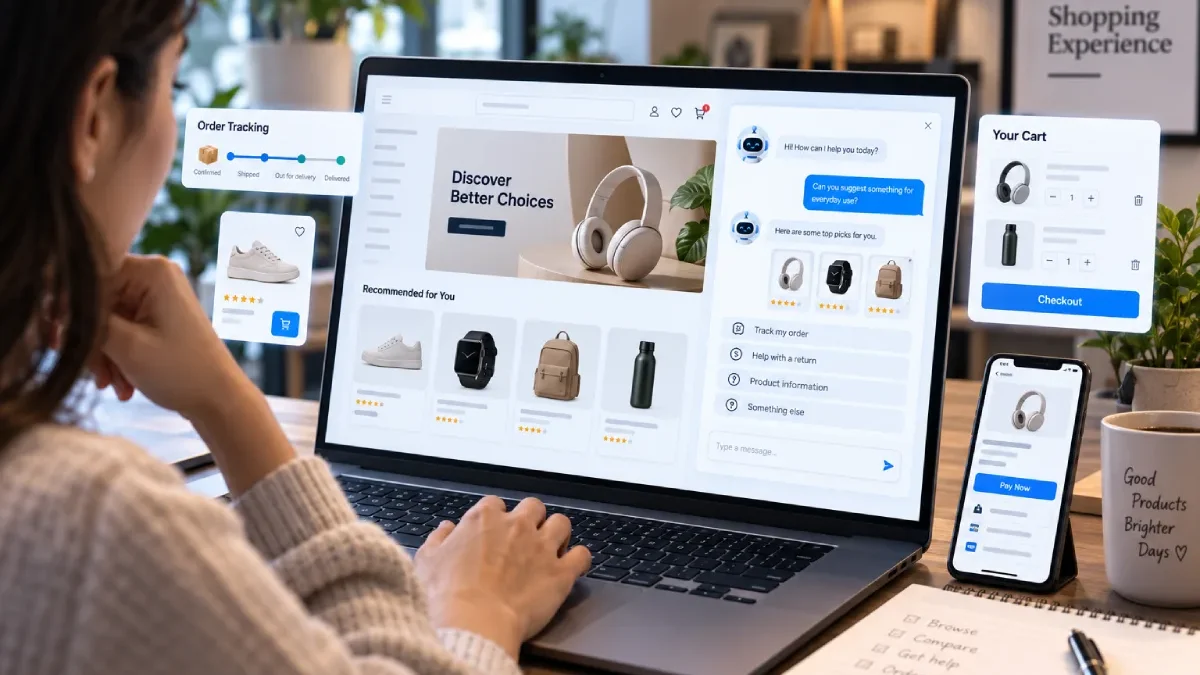
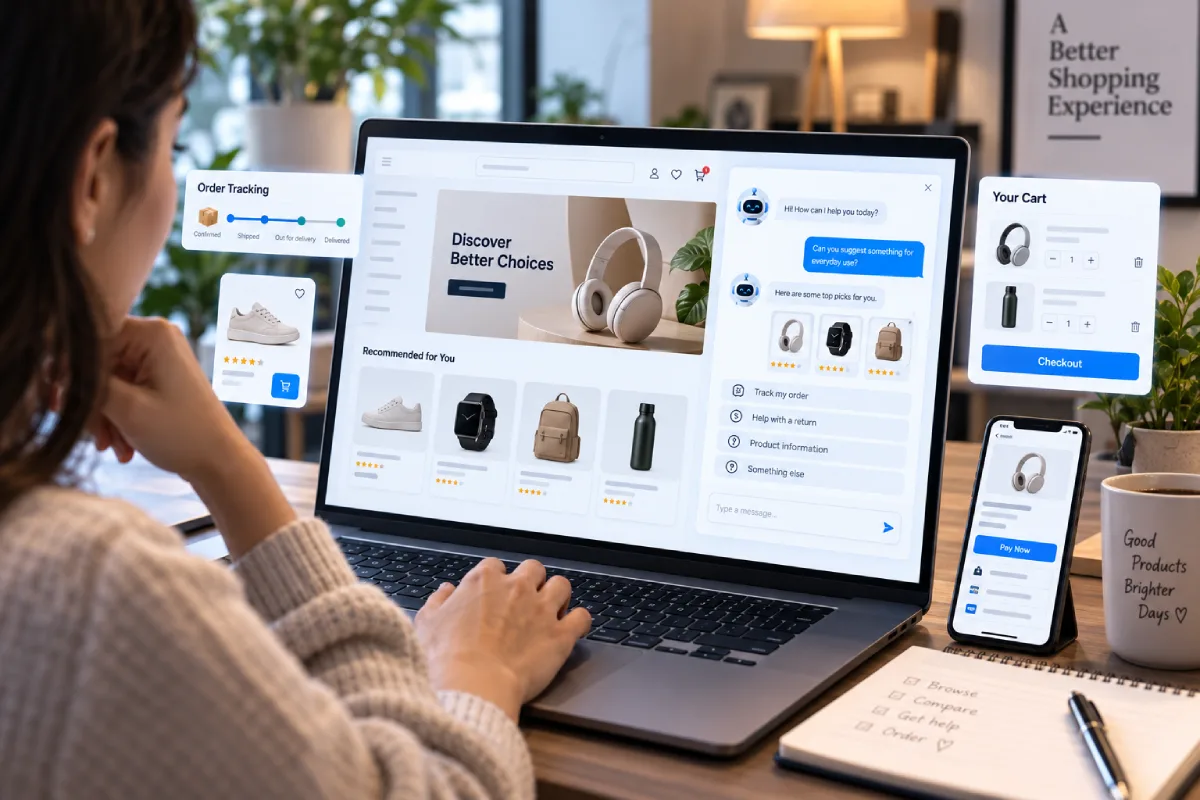
AI chatbots for ecommerce companies can answer right in the shopping experience.
Help with product discovery, customer service, order questions and in some cases more complex shopping workflows. According to 2026 the ecommerce researcher by Shopify, AI chatbots are also used for recommend product and order questions, customer support and conversational shopping.
What Are AI Chatbots for Ecommerce?
An ecommerce chatbot is a conversation system based on artificial intelligence which is purely designed for ecommerce.
Can handle discussions with customers via web, app, or messenger and can give answers using either the store‘s products or processes.
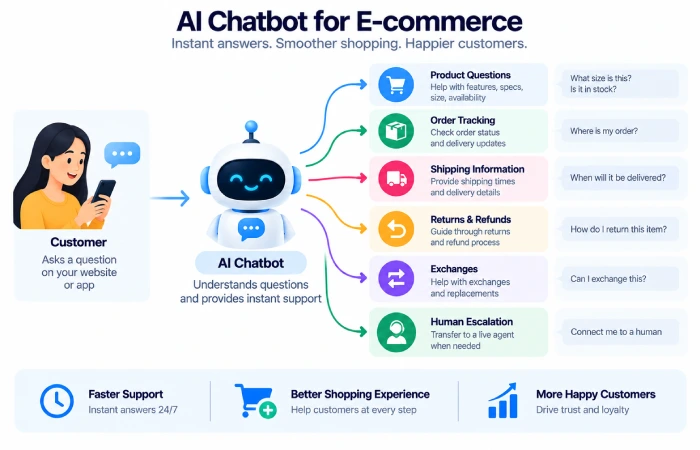
Typical uses include:
- Product questions
- Product recommendations
- Order tracking
- Shipping information
- Returns and exchanges62. (Note that there are additional reasons for return.) It is customary that most retailers accept the return of a product within a certain period of time for refund or exchange. In designing the return policy, consider the potential problems that might arise from returns, such as abuse, shoplifting, and retailer inconvenience. Take steps to minimize these problems.
- Customer support
- Cart assistance
- Lead collection
- Purchase guidance
It is integrated into the shopping experience rather than being a further support channel.
How Ecommerce Chatbots Help Customers
Product Discovery
Not all the time you give them what they want. Customers do not always know what they want.
A shopper may ask:
I require a portable notebook editor of video editing on a budget of ’₹ 80,000’.
An AI bot can utilize product data and user interests to filter the options.
This method of conversation is such that it may be more comfortable than hunting through dozens of pages for a product.
Product Recommendations
An ecommerce chatbot can ask questions about:
- Budget
- Size
- Features
- Brand preferences
- Intended use
- Style
- Delivery requirements
And then, it would suggest appropriate items to buy.
Such recommendations should be made on the basis of existing product features, as opposed to hypothetical product features.
Ecommerce Customer Service Bot Uses
Order Tracking
But after buying, where is your item?
A connection with order and shipping info whether in a database or in some other system can give an update without a person having to check the order.
Returns and Exchanges
A chatbot can explain our return policies, take order information, and tell customers the right way to do it.
Nevertheless, a human review may be necessary in cases involving exceptional disputes or policy exceptions.
Shipping Questions
Common questions include:
- What is the delivery time?
- Can I ship to my delivery address?
- Can I order if I only want it delivered express?
- What will the delivery charges be?
Suitable for the automated response where someone performing the search knows the shipping information of the business.
Specifically, Shopify mentions order tracking, return requests, customer reviews, and-routing critical issues as examples of ecommerce AI applications.
AI Chatbots and Conversion
The ecommerce chatbot can also make things easier for the customer before it goes to the basket:
For example, a shopper may hesitate because a product page does not clearly explain:
- Compatibility
- Sizing
- Materials
- Delivery
- Warranty
- Available options
Rather than get off site to find the answer, the customer can turn to the chatbot.
This can‘t promise more sales, but eliminating unnecessary ambiguity on a shopping cart experience has the potential to make it better.
AI Chatbots and Agentic Commerce
The move of ecommerce towards AI supported shopping is visible away from website and in the other one.
Shopify announced an increase in AI generated traffic to Shopify stores in January 2026, and how merchants could list products in AI shopping experiences like ChatGPT Microsoft Copilot, Google AI Mode, and Gemini.
This provides a wider role for the product data.
The product‘s name, description, price, availability, and other details must be correct as AI systems might display that information when assisting customers in finding products.
AI Chatbot Workflow for Ecommerce
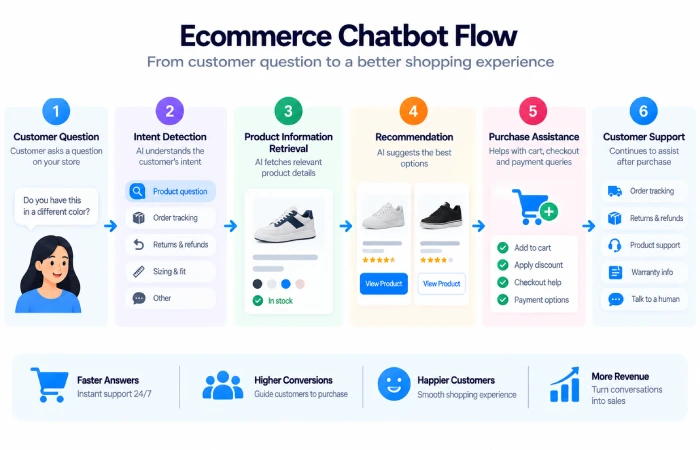
A basic ecommerce chatbot workflow can be:
Customer ask–> AI interpret customer‘s intent–> first product/store information retrieved–> response to customer
A more advanced workflow can be:
Customer requests advice → preferences recorded → items scrutinized → advice given → customer requests additional advice → transaction finalized
For support:
Order question –> Customer identified –> Order information retrieved –> Status given –> Escalation if required
How to Choose an Ecommerce Chatbot
Check Store Integration
Integration with your online store. The chatbot needs to be integrated with your online store or have a quick access to the required store information.
Review Product Data
The chatbot is only as good as what stands behind it.
Update part numbers, pricing, stock levels, policies and shipping details.
Check Support Features
Search for oversight monitoring, return/complaint, customer question, human hand off.
Consider Personalization
An effective ecommerce chatbot must be capable of apprehending customer preferences without assuming things which have not been explicitly communicated.
Review Security
Customer & order information should be protected with the proper permissions and security.
How to Implement an Ecommerce Customer Service Bot
Start small.
1. Identify Common Shopper Questions
Use the support tickets and customer messages for the common questions.
2. Build the Knowledge Base
Create tabs for product, shipping, payment and policy.
3. Connect Store Data
Make sure the chatbot is only allowed the proportionate access to the systems it needs.
4. Create Human Escalation
Facilitate relay of difficult issues to persons.
5. Test Product Recommendations
Verify if the Chatbot is recommending products correctly.
6. Measure Results
Track:
- Customer satisfaction
- Resolution rate
- Escalation rate
- Cart activity
- Conversion
- Support workload
Common Mistakes
E-commerce companies should not use AI just because it seems sophisticated.
Common mistakes include:
- Providing wrong stock balance.
- Providing old pricing.
- Suggesting unavailable items.
- Concealing human assistance
- Poor quality of product data
- Dispute automation reviews
In addition, Shopify notes that ecommerce AI also poses risks related to privacy, automation, data quality, and the complexity of integration.
FAQs
Can ecommerce chatbots recommend products?
Yes. They are able to inquire about what the customer wants and to give suggestions on the products to take based on the existing information.
Can an ecommerce chatbot track orders?
Yes, if it is linked to the store‘s ordering or shipping system.
Can chatbots handle returns?
They may also provide an explanation on which policies apply and may walk customers through the routine returns process. These machines can require human review for complex cases.
Are AI chatbots useful for small ecommerce businesses?
Yes. They can also decrease the amount of support work done repeatedly, and make it easier for shoppers to search for information using it, rather than a large shop floor staff.
Final Thoughts
AI chatbots utilized by ecommerce businesses can help clients through multiple stages of the purchasing process.
They cannot assist customers in browsing or shopping but can be very effective in answering questions prior to purchase, providing order status information, clarifying policies, and escalating more complex issues to human representatives.
That‘s the only thing that matters – correct information.
A chatbot that is linked with accurate product and order data can be an effective component of an ecommerce workflow. A chatbot based on out-of-date data can be a liability.