




Machine Learning Model Development
Machine learning allows businesses to predict the behavior of consumers, [identify] when erroneous activity is taking place, [personalize] product recommendations, [organize] information into categories, and [make] decisions.
However, constructing a useful ML system is not simply selecting an algorithm and training it. First, the business problem must be understood; then, the relevant data must be prepared, a suitable model must be selected for training, the model’s performance tested, and finally, it deployed into a real application.
This overall process is called as machine learning model development.
It also doesn‘t end once the model is in production. Data & behavior of customers change over time, so the accuracy of the model isn‘t constant either. AWS describes machine learning as an iteration lifecycle including Business objectives, data processing, model building, deployment & management. (AWS ML Lifecycle)
Table of Contents
What Is Machine Learning Model Development?
Development of a machine learning model is the derivation of a model to represent how data gives rise to outcomes. The process in developing a machine learning model is:
For example:
Historical sales data = power input to machine learning model forestimatingfuture demand
Or:
Customer message is input. Message category is output. Customer message is the input category ; message category is the output category of the machine-learning model.
Unlike rule-based (classic) software, which is often overly dependent on explicitly defined rules, ML models excel by learning from examples.
A typical project includes:
- Problem definition
- Data collection
- Data preparation
- Feature engineering
- Model selection
- Model training
- Model tuning
- Evaluation
- Deployment
- Monitoring
These are not always linear. Sometimes teams return to earlier steps when during testing data, model, or. business objective.
Machine Learning Model Development Process
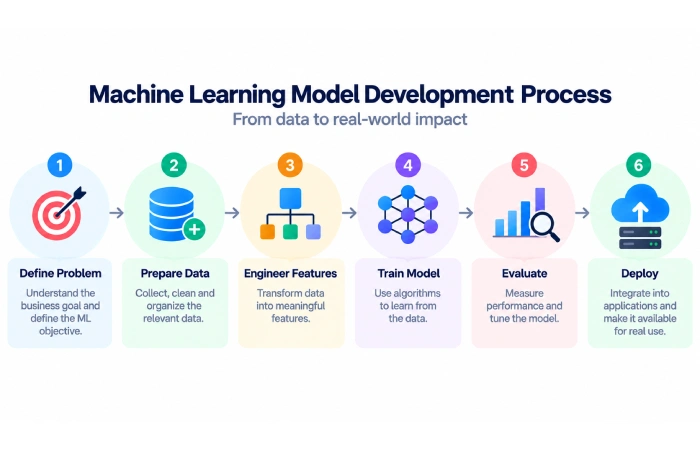
1. Define the Business Problem
Begin with the problem rather than the algorithm.
Imagine if a company was wanting to reduce the amount of customers who stop using their services. The developers then firstly have to sit down and decide that to models, the companies churn.
The project could look like:
Customer activity and account information.
Output: Probability that a customer will leave
The firm will want to quantify whether the model is useful, as a technically accurate model is of little value if the predictions it produces do not facilitate a worthwhile business result.
2. Collect and Prepare the Data
The model needs relevant training data, which could include:
- Sales records
- Customer information
- Website activity
- Sensor readings
- Images
- Documents
- Text
- Transaction data
More data is not necessarily best. The data must be meaningful, trustworthy and representative of the environment in which the model will ultimately be applied.
Raw data may also have missing values, duplicated records, misspelled data, inconsistency, and wrong label.
Data preparation tackles these issues prior to the model training phase. AWS considers data gathering, preprocessing and feature engineering as essential aspects of the ML lifecycle. (AWS Machine Learning Lens)
3. Perform Feature Engineering
Features are the inputs to a model that are used to produce the prediction.
For a customer churn model, useful features might include:
- Purchase Frequency
- Account age
- Recent activity
- Support requests
- Average order value
Feature engineering is the process of designing new, transforming, extracting or selecting relevant features from the data available.
For example, rather than feed a model every single purchase, one would provide a team with the number of purchases that a customer made in the last 30 days. Quantified data in the right format can make it easier for the model to find real insights.
4. Select and Train the Model
The appropriate algorithm depends on the problem.
Common ML tasks include:
Classification
Used when the model needs to choose a category.
Spam → Yes or No
Regression
Used when the output is a numerical value.
Predict next month’s sales
Forecasting
Used to estimate future values from historical patterns.
Predict weekly product demand
Recommendation
Used to suggest products, content, or services.
Anomaly Detection
Used to identify unusual behavior or patterns.
Computer Vision
Used to analyze images or video.
Natural Language Processing
Used to work with text and human language.
The development team can compare different algorithms instead of assuming the first one they try will be the best.
What Are ML Model Training Services?
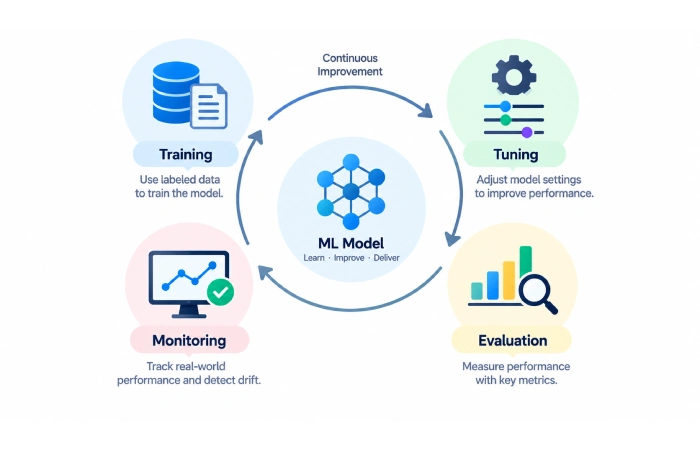
ML model training services are platforms, tools, infrastructure, or professional services used to train machine learning models using prepared data.
At a simplified level:
Training data → Algorithm → Trained model
In a real project, training may involve multiple experiments, computing resources, model configurations, data management, and evaluation.
Cloud platforms can also host and manage the infrastructure of this work, such as AWS SageMaker which offers managed support for training machine learning models where teams do not need to develop and custom build all of infrastructure and tooling themselves. (AWS SageMaker Training)
The available approaches include:
- Cloud ML platforms
- Managed AI services
- Self-managed infrastructure
- Dedicated development teams
- Custom ML development environments, such as the GUI environment provided by the Mathworks website.
The correct choice will be influenced by the size of the project, how much money is being spent, what sort of infrastructure is required and what documentation and experience are already available.
Model Training, Tuning, and Evaluation
Training is generally carried out by several experiments.
The training data. This is used to train the model.
Validation data is used to compare methods and tune the model during development.
Finally test data give an estimate of how the model does on unseen data.
Another parameter often seen when using models is called a hyperparameter. Hyperparameters allow the developer to experiment with different settings, trying to find those that increase the performance of the model.
Once the model is built evaluation with the relevant evaluation metric for this type of problem has to be performed.
For classification, teams may use:
- Accuracy
- Precision
- Recall
- F1 score
For regression, common measures include:
- A mean absolute error is…
- Mean squared error, where the sum is taken over the non-zero predicted cases.
- The root mean squared error.
Having a good metric is not enough to produce business value. For instance, a model for fraud detection would need to reach a balance between uncovered frauds and raised false alarms.
Avoiding Overfitting
Overfitting happens when a model learns the training examples too closely and struggles with new data.
A model can look excellent during training but perform poorly once it encounters real-world examples.
Teams can reduce this risk using techniques such as:
- Train/test splits
- Cross-validation
- Regularization
- Feature selection
- Hyperparameter tuning
The goal is to build a model that generalizes well rather than one that simply memorizes its training data.
From Model Development to Production
Training is only one part of the project.
The model needs to become part of a system where applications or people can actually use its predictions.
A simple architecture might look like:
Application → API → ML model → Prediction → Application
For example, a customer-support application could send a new message to an ML model. If the model predicts Billing, the application could route the request to the billing team.
At this stage, software engineering becomes important. Production systems may require APIs, security, scaling, logging, version control, monitoring, and error handling.
Model Deployment and Monitoring
Once a model has been trained, evaluated, and validated, it can be deployed.
Deployment may involve:
- API endpoints
- Cloud services
- Internal applications
- Edge devices
- Batch processing
- Real-time inference systems
The deployment method depends on how and where predictions need to be generated.
Deployment isn’t the end of the lifecycle either.
Real-world conditions change. Customer behavior, product demand, data sources, and other factors can shift over time. Monitoring can track:
- Prediction quality
- Input data changes
- Model latency
- Error rates
- Resource usage
- Data drift
AWS recommends monitoring ML systems so teams can detect issues such as performance degradation and data drift. (AWS ML Monitoring)
MLOps in Machine Learning Development
MLOps applies software engineering and operations practices to machine learning.
It helps teams manage:
- Data pipelines
- Training
- Testing
- Deployment
- Model versions
- Monitoring
- Retraining
This becomes increasingly important when a company moves from experiments to multiple production models.
Google’s MLOps guidance covers areas including continuous training, deployment, prediction serving, model management, governance, and monitoring. (Google Cloud MLOps)
Custom Model Development vs Prebuilt AI
Not every business needs a custom model.
A prebuilt AI service may be the better choice when the requirement is common. For example, a company that simply needs speech converted to text may have little reason to build its own speech-recognition system.
Custom development can make more sense when:
- The business problem is highly specific
- Existing AI tools don’t provide the required result
- Company-specific data is important
- Custom integration is required
- The business needs greater control
The best choice depends on the problem, data, cost, technical requirements, and expected business value.
Common Challenges
Poor Data
Low-quality or irrelevant training data can lead to unreliable predictions.
Unclear Objectives
A model is difficult to evaluate when the business goal isn’t clearly defined.
Data Leakage
Data that wouldn’t actually be available when making a prediction can accidentally enter the training process and make the model appear more accurate than it really is.
Overfitting
A model can perform well on training data while struggling with new examples.
Deployment Problems
A successful prototype still needs engineering before it can operate reliably in production.
Model Drift
Changes in data or real-world behavior can reduce model performance after deployment.
Maintenance
Production ML requires ongoing monitoring, testing, updates, and improvement.
How to Choose a Machine Learning Development Partner
A good development partner should understand more than model training.
Look for experience with:
- Data engineering
- Model development
- Cloud infrastructure
- APIs
- MLOps
- Monitoring
- Security
- Application integration
One useful question to ask is:
“What happens after the model is trained?”
The answer should cover deployment, monitoring, updates, and ongoing ownership.
FAQs
What is machine learning model development?
It is the process of designing, training, testing, deploying, and maintaining a machine learning model for a specific business or technical problem.
What are ML model training services?
They are platform, infrastructure, tools or professional service used to train the machine learning models with preprocessed data.
What are the main steps in machine learning model development?
The significant steps are the problem scoping for the business, data preparation, feature engineering, choosing a model, training and fine tuning it, evaluating the results, deploying it and continuously monitoring the model effect.
How long does machine learning model development take?
There‘s no set schedule. A small proof of concept might be done in a matter of days, whereas a production system with large amounts of data and integrations, as well as security, deployment, and monitoring, might take much longer.
Do I need custom machine learning development?
Not that would do it. A prebuilt AI service might be good enough to handle general problems. Customized development becomes more relevant if the company needs a solution that deals with its distinctive needs or work on its own data.
Why is monitoring important after deployment?
Can change overtime-The data a model receives may change over time. Monitoring allows teams to see if there is a problem with the performance, data drift, or operation that could impact the prediction.
What is MLOps?
MOLOps can be thought of as blending of machine learning, software engineering and operational practices to activities like training, deployment, monitoring, versioning and maintenance among others.
Final Thoughts
The process of creating a machine learning model involves much more than merely putting an algorithm through its paces.
A dependable project begins with a well-understood business problem and an appropriate dataset. Subsequently, teams pre-process the data, engineer relevant features, choose and train models, assess the results, and link the selected model to a production environment. application.
The work continues after deployment through monitoring and maintenance.
The overall lifecycle can be summarized as:
Business problem → Data → Features → Model → Training → Evaluation → Deployment → Monitoring
Using ml model training services can make the process easier when a team needs scalable infrastructure or managed ML capabilities.
But the technology should come after the problem.
Start by deciding what you want the system to predict or automate, determine how success will be measured, and then choose the simplest machine learning approach that can solve the problem reliably.
This guide is part of our Machine Learning Development Services cluster. You can also explore custom machine learning development services, machine learning consulting services, machine learning application development, machine learning integration services, and how to choose a machine learning development company.