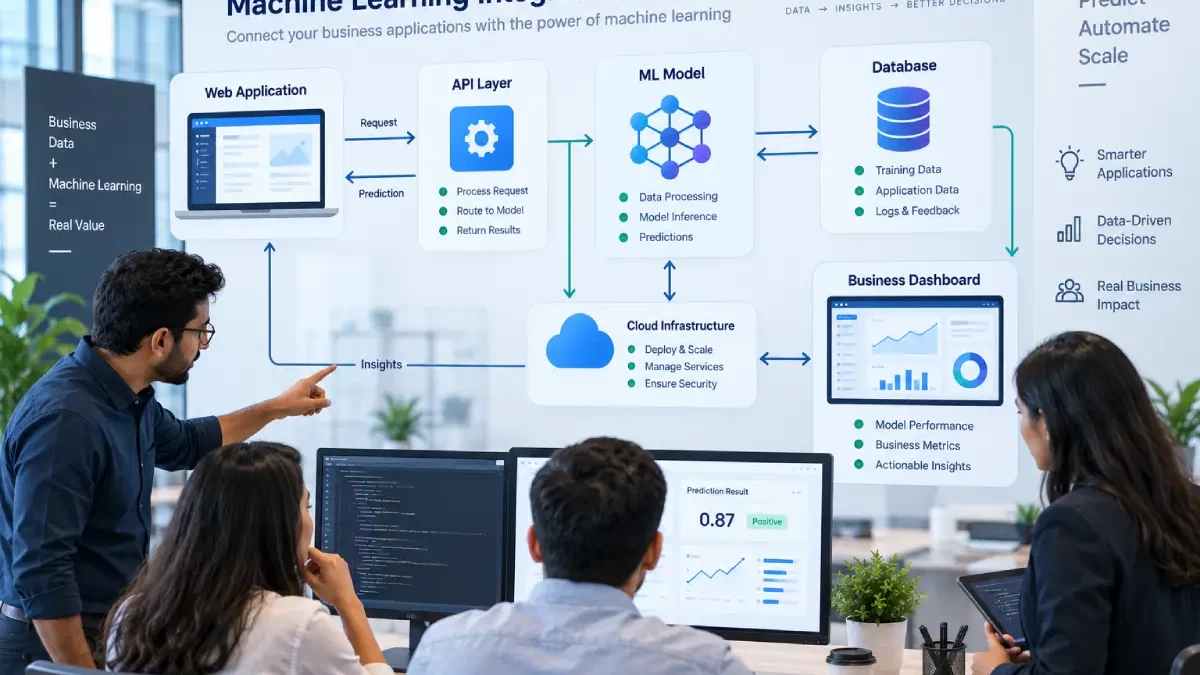

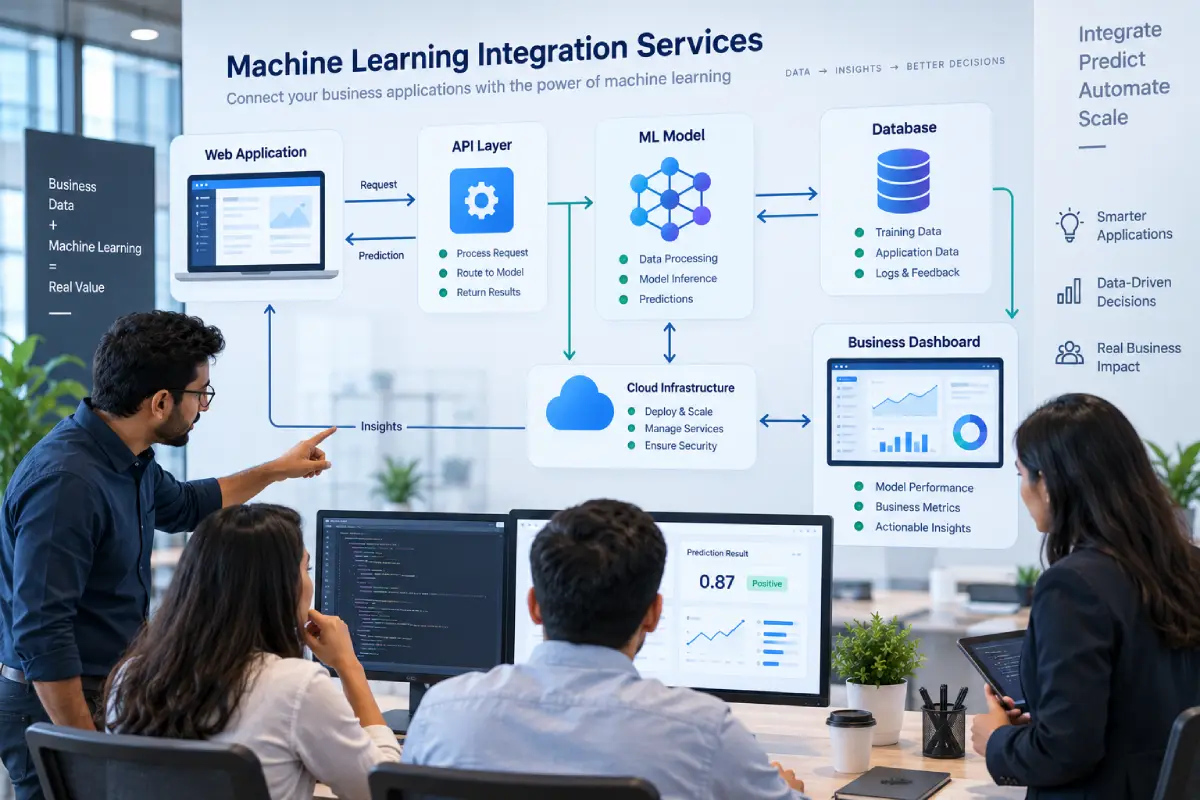


Machine Learning Integration Services: Complete Guide
Machine learning can make a business application smarter. A machine learning model alone is not a business application.
A model has to be compatible with the software, databases, APIs, clouds and workflows that a business has in place. This is where the services of machine learning integration play a part.
ML integration integrates the capabilities of ML programs and systems, so that they blend with current applications or systems to work as a single application.
For instance, one ecommerce site might already have a Web site, database of customers, and system for handling orders. The addition of a machine learning model might provide intelligent recommendations for products. The integration layer would deliver customer activity to the model and then deliver product recommendations to the website.
This is a guide that describes the concept of integration of machine learning, how it works, standard ways of doing it, advantages, use cases, problems it can have, and what you should consider looking for in an integration team.
Table of Contents
What Are Machine Learning Integration Services?
ML integration services: is a service which helps in integrating the machine learning model or AI capabilities into current software system.
We don‘t want just to build a model. We want to be able to use this model in a real application.
An integration project may connect an ML model with:
- Web applications
- Mobile apps
- Business software
- Databases
- Cloud platforms
- APIs
- CRM systems
- ERP systems
- Ecommerce platforms
- Customer support tools. For customers, it is equipment including the phone system, web pages, and written instructions.
- Business workflows within the internal company.
The possibility exists that the model (environment) may be located within the current infrastructure of the organization, deployed in the cloud, or accessed through an external service.
The integration method depends on the type of model, application architecture, data requirements, security needs, and expected traffic.
Why Is Machine Learning Integration Important?
Business generally: Businesses tend to have existing systems already in place that perform critical functions.
It is not always necessary to replace those systems in order to adopt machine learning as a new addition. It is often much more effective to embed machine learning technologies into the current technology stack.
Machine learning can also be applied to an existing system such as a company‘s customer support platform. Instead of ripping out the existing system, machine learning can be used in addition to. Consider the ability to class tickets and assign them to the relevant team.
This could be beneficial in making the transition to ML more viable.
Machine learning integration can help businesses:
- Make existing applications smarter built-in service intelligence, knowledge tips, culture awareness.
- Automate data-based tasks
- Improve personalization
- Map the predictions made by ML algorithms to business processes
- Leverage existing data more effectively
- Use human decision-making less.
- Create new features without rewriting the whole app
How Machine Learning Integration Works
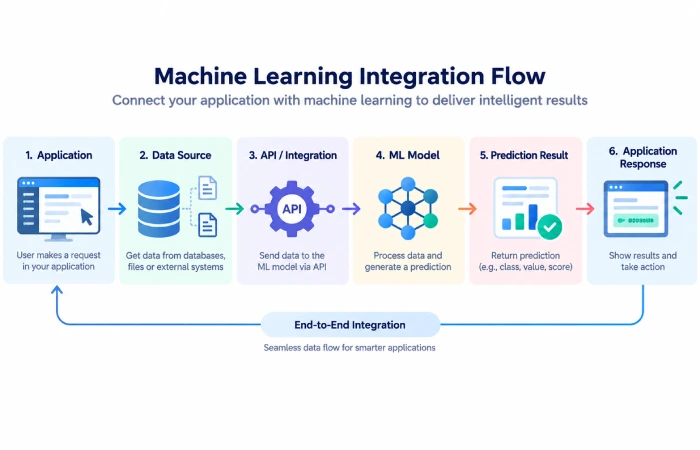
A common integration consists of.
1. Data Source
The application has to gain access for fetching the information needed by the model.
The data could be from a database, application event, user input, sensor, document or other API.
2. Integration Layer
The integration layer handles interactions between the application and the machine learning platform.
It may handle:
- API requests
- Authentication
- Data transformation
- Validation
- Error handling
- Response processing
3. Machine Learning Model
The model is supplied with the needed input and produced an output.
Depending on the application, this could be:
- A prediction
- A classification
- A recommendation
- A score
- A response generated by the tool that informed that a certain URL was related to a page on the site.
- An anomaly alert:
4. Application
Is occupied with the model‘s result.
For example, a recommendation result provided from the ML system could be shown as suggested products on an ecommerce website.
The basic flow can look like this:
Application → API → ML Model → Prediction → Application
More advanced systems can have several sources of data, additional processing services, multiple databases, monitoring components and so on.
What Is ML API Integration?
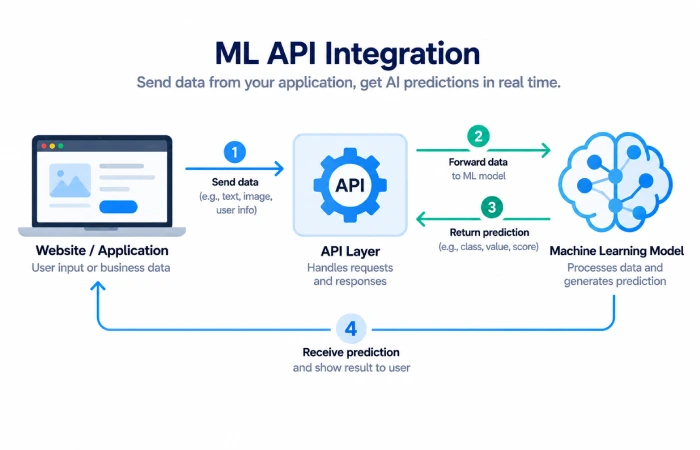
The API of the ML is one of the most common ways to be integrated to an application.
An API (Application Program Interface) is an interface for communication between two software systems.
For instance, an application can transmit customers data to an ML service via an API. The ML will calculate a prediction by using the data and transmit it back.
A simplified flow might look like:
Customer Data → Application → ML API → Model → Result→ Application
APIs have a great feature where you can decouple the machine learning model from the core of your application.
This can be useful as developers can update the model without having to rebuild the application‘s front end.
API integration is particularly useful when:
- The model is stored on another server.
- Many applications require identical ML functionality
- A business is using third-party AI service. 4.2. Sentence for “What”: A business is implementing third-party AI services. The above sentences denotes the usage of AI services by any business. The first sentence signifies the usage of AI services without specifying the type of usage (if imposed by the business itself or by a third-party). The second specifies that a third-party is using the AI services.
- Separately scalable must be independently scaled.
- Various development teams are responsible for the application and model.
Common Machine Learning Integration Methods
There is no one size fits all integration technique.
API-Based Integration
And the communication between the application and the ML system is through an API.
A set of scripts is a typical method for web application and business application.
The above enables the application and the ML system to be decoupled (by making the calls a third party can decouple the ML system and the application between themselves), yet transfer data back and forth.
Database Integration
Certain applications require machine learning predictions to integrate seamlessly with existing DBs.
For example, a prediction can be stored alongside customer or transaction records and later used by another business process.
This approach requires careful planning around data structure, permissions, performance, and data consistency.
Cloud Integration
Businesses may connect ML models to cloud-based applications and services.
Cloud infrastructure can provide computing resources, storage, networking, deployment systems, and monitoring capabilities for ML workloads.
Embedded Model Integration
For some applications, the machine learning model can be deployed directly inside the software environment.
This can be useful when low latency, offline functionality, or local processing is important.
Event-Based Integration
An application can trigger a machine learning process after a specific event occurs.
For example:
New order → Event generated → ML prediction → Risk score → Order workflow
This approach can be useful for automation and real-time business processes.
Machine Learning Integration Services Process
The one professional integration project always begins with the environment of existing technology, not starting separately from the ML model.
Step 1: Understand the Existing System
Current application, databases, APIs, infrastructure, and workflows are examined by the development team.
The aim is to get an idea as to where machine learning belongs.
Step 2: Define the Integration Requirements
The team identifies:
- Required inputs
- Expected outputs
- Data formats
- API requirements
- Security controls
- Response-time requirements
- Expected traffic
- Error-handling rules
Clearly stated requirements will prevent working to do something that doesn‘t need doing.
Step 3: Select the Integration Architecture
The suitable architecture is then chosen.
This could be achieved through direct API calls, an integration hub or service, event-driven we not cloud architecture, or whatever else.
The architecture should meet the application‘s technical and business requirements.
Step 4: Connect Data Sources
The ML system will need the correct information from the application that is currently used.
Creators establish the needed links and convert the data into the expected model form.
Step 5: Connect the ML Model
The model is then attached to the application.
For some projects, this could mean setting up a custom model, hooking up a hosted model, or consuming a third-party AI service.
Step 6: Test the Integration
Test should be both on software behavior and model output.
Common checks include:
- API functionality
- Data validation
- Authentication
- Response time
- Error handling
- Model output
- Load performance
- Security
Step 7: Deploy and Monitor
If the integrated system passes the testing, it can be installed.
Monitoring Applications errors, abnormal traffic, performance problems and changes in mode behavior are detected by the «Monitoring.”
Benefits of Machine Learning Integration Services
Works With Existing Software
Business can still add ML capabilities without having to buy out everything they use.
Better Automation
Machine learning can be though of as being directly related to a workflow from a machine perspective, in that the prediction or classification can trigger an action.
Improved User Experience
It can be used for personalized recommendation, intelligent search, automatic support, and so on that users directly connected with.
Centralized ML Capabilities
A single ML service can serve multiple business applications.
Easier Application Updates
When machine learning is provided through APIs or services, changes to the model can frequently be isolated from the application.
Machine Learning Integration Use Cases
Machine learning integration can be embedded in a wide range of businesses.
Ecommerce
Four things any ecommerce site can do with ML.
Financial Services
Banks and financial portals can integrate ML models into their transaction platforms to predict fraud or perform risk analysis.
Healthcare
Healthcare applications can adopt machine learning for Image processing, prediction assistance, document processing, etc.
Customer Service
Customer support system field – the system implements the use of ML in classifying tickets, detecting customer intentions, prioritizing requests or supporting support agents.
Marketing
Marketing platforms tie machine learning into customer data for segmentation, lead scoring, personalization and campaign analysis.
Manufacturing
Predictive models could be combined with equipment data within a manufacturing system to predict maintenance problems.
Challenges of Machine Learning Integration
Integration gives rise to a number of technical issues which must be taken into account at an early stage.
Data Compatibility
Former applications and ML systems might be because of different data formats.
Developers must transform and verify data prior to submitting it to the model.
Security
APIs and data connections also need to be secured, especially if applications are processing customer, financial or business information.
Latency
Certain applications demand results from program execution before the beginning of the next one.
Too much processing time in the integration architecture; the end users tend to get discouraged or the program may come to a crawl.
Scalability
The ML service might handle a much larger volume of request as the popularity of the application grows.
The design must expect the traffic and growth over the time.
Model Changes
A model can then be separately updated from the application.
The integration has to gracefully handle changes and not break downstream unexpectedly.
Monitoring
A working integration still requires monitoring.
The complete system can be impacted by technical problems, shifting data distributions, and the effectiveness of the model.
How Much Do Machine Learning Integration Services Cost?
The cost depends heavily on the complexity of the integration.
A small project connecting one application to an existing ML API can be relatively straightforward.
A larger enterprise project may involve multiple applications, databases, APIs, security layers, data pipelines, custom models, and monitoring systems.
Important cost factors include:
- Number of systems being connected
- API complexity
- Data volume
- Model complexity
- Cloud infrastructure
- Security requirements
- Real-time processing requirements
- Testing requirements
- Ongoing maintenance
Before estimating cost, it is better to define exactly which applications need to communicate and what the ML system needs to accomplish.
How to Choose a Machine Learning Integration Company
The right development partner should understand both machine learning and traditional software integration.
Ask potential providers how they would handle your:
- Existing application architecture
- Data sources
- API requirements
- Security requirements
- Deployment environment
- Model updates
- Monitoring
- Scalability
A team that understands only model development may not be enough for a complex integration project.
Look for experience with application development, APIs, databases, cloud infrastructure, machine learning deployment, and system monitoring.
You can also review our main guide to machine learning development services and our related guide on machine learning application development.
Final Thoughts
ML truly becomes all the more valuable when it can operate on the systems a business already has in place.
ML integration services is the means of connectivity between the ML models and applications/databases/apis/business workflows.
To a lot of industries, the ML API integration is an easy way to add intelligent functions into the current software without developing an entire new software platform.
The optimal integration method needs to be designed based on most suitable architecture, data strategy, security policy, performance forecast, long-term plan and etc..
Mainpoint should be on creating a steady connect that works well in the real world instead of justconnectinga model andcall it done.