



How to Choose a Machine Learning Development Company
Selecting a machine learning development company is an important decision for any business that plans to create a product powered by machine learning or upgrade an existing system.
In the current deep industry there are many companies providing ML services, but the capabilities are very different from those companies. Some companies provide consulting, while others Provide model development, application development, data engineering, MLOps, or end-to-end pipeline.
The right partner will understand the business problem and the machine learning side.
This cheat sheet will tell you what to look for, what questions to ask, how to analyze companies, and when it makes sense to hire machine learning developers directly.
Table of Contents
Why Choosing the Right ML Development Company Matters
A machine learning project is much more than just using a model.
The general ML life cycle may be defined as discovering the business goal, preparing data, building and assessing a model, deploying the model and monitoring the system after deployment (after live). AWS‘s take is more about a repeated life cycle on machine learning than building a model once for all.
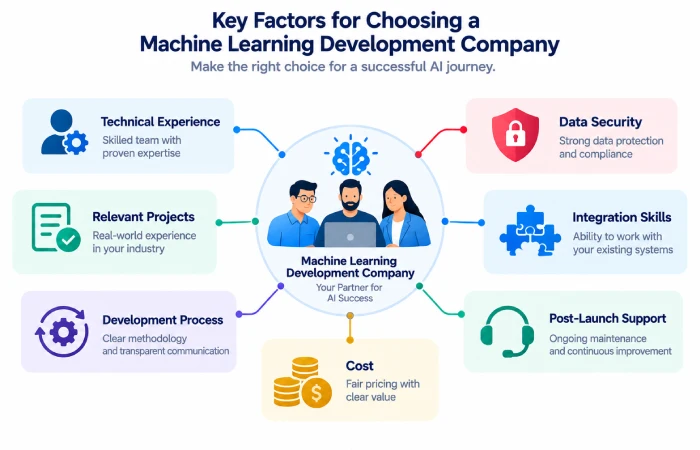
That means the development partner needs to understand several areas:
- Data preparation
- Machine learning
- Software development
- APIs and integrations: They are four types of integrations available from various systems and tools.
- Cloud infrastructure
- Testing
- Deployment
- Monitoring and maintenance: there is a need to accurately monitor the system and implement effective maintenance until the final disposal of the system to ensure the functioning of the system.
So an individual company that is good at one stage of the process might not be the correct destination for the whole job.
Define Your Requirements First
Develop a concrete idea of what you are trying to build before entering into contact with an ML development company.
Begin with the business problem.
For example, you may want to:
- Estimate the customer attrition rate
- Can identify fraudulent transactions
- Automate document classification
- Recommend products
- Forecast sales
- Analyze images
- Create an intelligent support system (e.g. on-line diagnosis)
Attempt defining success.
Instead of saying, “We need an AI solution,” a stronger requirement is:
“Identify the customers who are likely to cease services.”
This provides a potential development partner with something concrete to assess.
They should also establish what data they already possess, which systems will require integration, how many users will utilize the solution, and any security and regulatory requirements.
Look for Relevant Technical Experience
Firstly, just see if they have experience working on projects similar to what you need.
A company may claim companywide expertise and machine learning, but what you need to know is whether they can solve the kind of problem you‘re working on.
For example, a team developing a demand-forecasting system on the other hand would require very much less experience in computer vision, but still have an even greater need for forecasting experience.
Look for experience in areas such as:
- Predictive analytics
- Natural language processing
- Computer vision
- Recommendation systems
- Classification
- Forecasting
- Generative AI
- Machine learning APIs
- MLOps
Check too if the company is able to plug existing apps into ML systems. Some ML development providers specifically cover model deployment, APIs, workflow integration, monitoring, and ongoing optimization.
Check Their Development Process
A quality ML company should be able to clarify the way they will go about the project.
How does it go further? say, to the next stage of discussion.
A practical process often includes:
1. Discovery
The team gains an understanding of the business problem, objective, users, technology, and data.
2. Data Assessment
The team assesses the appropriateness of the current information and pinpoints the deficiencies that pose potential project risks.
3. Proof of Concept
For projects that are not well understood, a limited proof of concept can be used to test the feasibility of the proposed approach before committing a large amount of time and money.
4. Model Development
The team prepares the data, chooses an approach, trains or adapts the model and assesses how well the task has been performed.
5. Application Development
The ML feature receives data from the live product, application, API or workflow that it is part of.
6. Deployment
Full production The entire solution is ready to be moved into production.
7. Monitoring and Improvement
Following the systems launch, it is necessary to keep the system running properly.
This section is significant because a machine learning project does not stop when the model receives an acceptable test score.
Evaluate the Machine Learning Team
Ask who will really do the work.
A capable team may include several roles:
- AI and machine learning engineers.
- Data scientists
- Data engineers
- Software developers
- Cloud engineers
- MLOps engineers
- Project or product managers
You need not have all of this people full-time, but the skill set is needed.
Remember to at least also inquire about your team‘s experience using your chosen technology stack.
For example, developers may work with Python, PyTorch, TensorFlow, cloud ML platforms, APIs, databases, containers, and deployment tools depending on the project.
The technology should support the project rather than become the main selling point.
Review Their Previous Projects
Request for case studies, demonstrations or samples of work history.
The important thing is not to spend lots of time on attractive screenshots.
Try to understand:
- What was the problem?
- What data was taken?
- What model style, type or program was utilized?
- Was this model deployed in the production environment?
- In what ways was it incorporated?
- What measures of performance were used?
- What happened following implementation?
Having a company explain the technical and business outcome of a project in detail is generally an easier one to judge than any by stating we worked with such and such technologies:
Ask About Data and Security
Data handling should be introduced early on.
Question where the data will be kept, who has the keys, how will the data transfer and how will be protected during the creation and deployment.
This is really critical for the applications that include customer records, financial data, healthcare records, company‘s internal applications, or other sensitive data.
However you should also be aware of whether any data you provide will be sent to third-party services or external AI APIs.
Please do not assume that each provider implements the same measures to secure my data.
Ask How the Model Will Be Monitored
A machine learning application may change its behavior after go-live.
Fresh data may also differ from data that were used in development. Trend in user behavior may change as well.
This is the very reason for which the supervision and retraining has to be defined rather before the rise.
Examples include automation, scheduling, versioning and testing, monitoring, and processes for maintaining models as data and requirements evolve.
Ask the development company:
- What are we going to measure?
- What criteria will be used to assess the model‘s performance?
- How will data changes be recognised?
- In what circumstances is the updating of the model?
- Whotake care of the production problems?
- What if the model has to change?
These questions can also possibly reveal the business‘s thoughts on other aspects.
Compare Cost, Not Just Price
The cost of developing techniques around machine learning (ML) can vary dramatically.
A simple implementation, perhaps using an existing model or API, will cost relatively little in custom development. A large system featuring custom models, many data pipelines, integrations, cloud infrastructure, and continuous monitoring could cost a great deal more.
Before doing any comparison between quotes, see what is offered within each quote.
One company may include:
- Discovery
- Data preparation
- Model development
- Application development
- Deployment
- Monitoring
- Maintenance
One may set a quotation exclusively for model creation.
A cheaper proposal is not necessarily a cheaper one if critical work has been dropped.
Understand the Development Timeline
Request the company to break the project down into stages.
It is also a useful proposal if it describes what is expected in the phases of discovery, proof of concept, development, testing and deployment.
Use more than one statement, e.g., “the project will take three months”.
Find out what the project will deliver at each stage.
It is therefore easier to monitor progress more efficiently and catch the problem early on.
When Should You Hire Machine Learning Developers?
There is an option that some of the business may prefer to expand the internal team.
You may consider hiring machine learning developers directly when:
- ML will be at the heart of your products for a long time.
- You anticipate ongoing internal growth.
- What you already have is engineering leadership, which is the management of people in the context of engineering projects.
- You desire ownership of the development process in the long run
- You have the budget to develop a broader technical team.
Hiring developers provides you with more control, yet you are responsible for finding the right people, managing them technically, maintaining the infrastructure, planning the project, and developing it.
For a one-off project or a very early stage of an ML effort, it can be easier to partner with an external development team.
Questions to Ask Before Hiring an ML Company
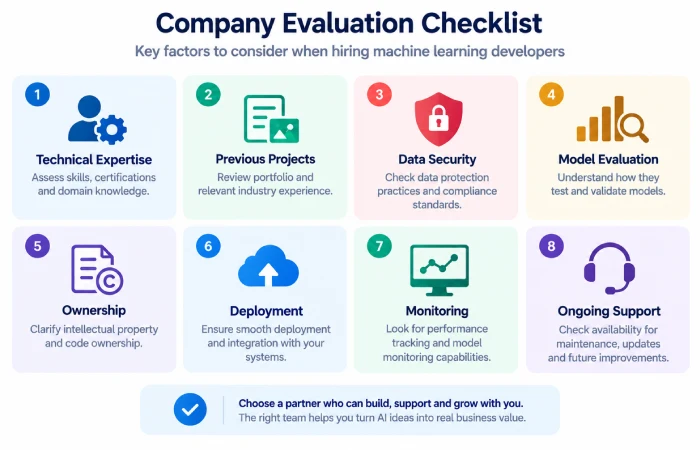
Before signing a contract, ask these questions:
What type of machine learning projects have you built?
Look for relevant experience rather than a long generic technology list.
Can you work with our existing software?
This is particularly important when the ML system must connect to current applications, databases, APIs, or business workflows.
How will you evaluate the model?
The company should be able to explain which metrics matter and why.
Who owns the code and model?
Make sure ownership and licensing terms are clearly written into the agreement.
What happens after launch?
Understand whether support, monitoring, maintenance, and retraining are included.
How do you handle security?
Ask about access controls, data handling, infrastructure, and third-party services.
What happens if the proof of concept does not work?
A mature provider should be comfortable discussing technical uncertainty rather than promising guaranteed results.
Red Flags to Watch For
Be cautious when a company:
- Promises guaranteed business results
- Cannot clearly explain its development process
- Focuses only on buzzwords
- Has no relevant project examples
- Avoids discussing data quality
- Provides a quote without understanding your requirements
- Cannot explain how the system will be maintained
- Gives unrealistic timelines for complex projects
A strong ML development company should be able to discuss limitations as openly as opportunities.
Final Thoughts
Learning how to select a machine learning development company starts with a clear understanding of your own project.
Precisely define the business problem, specify your data, know your existing software systems, and determine what results you require the machine learning application to produce.
Next, assess them on related experience, technical competencies, development approach, integration, security, cost, and ongoing support.
The better partner isn‘t the one with the longest list of AI available technologies but the one that can figure out what is your problem, give you a workable answer, implement it correctly and follow it up.
Any company that chooses to employ machine learning developers should approach the hiring in the same way. The main thing is to establish the proper balance of machine learning, software engineering, data and operational skills for the project in hand.
For a broader look at the services involved, see our machine learning development services guide.