



Custom Machine Learning Development Services
If you think about it, businesses collect enormous amounts of data.
Sales data, customer logs, website statistics, images, documents, product data and business data can all provide valuable patterns.
Machine learning, is the application of data mining techniques to build intelligent predictive or classificatory models, product recommender system, anomaly detectors or business decision systems.
However, this is not the case for everyone.
From time to time the problem is very narrow.
This is where custom machine learning development services start to come into play.
A specialized machine learning approach to a company‘s data, process, business rule, and objective is developed as opposed to fitting a generic product to a business challenge.
Table of Contents
What Are Custom Machine Learning Development Services?
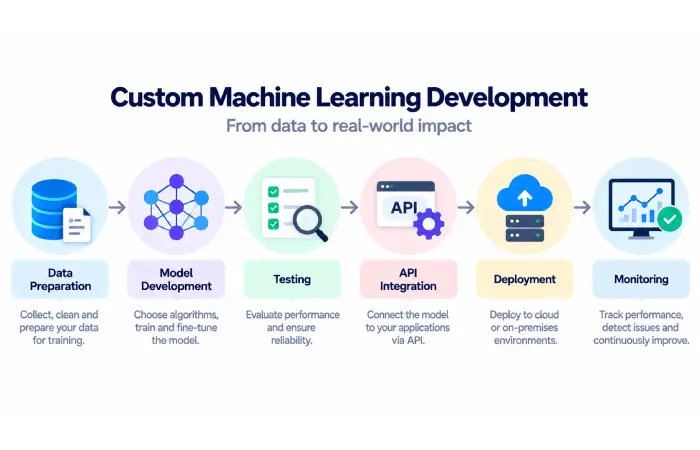
Custom ML development services involve the conceptualization, creation, implementation, and ongoing tuning of an ML solution to specific business needs.
A typical project can include:
- Business and use-case analysis
- Data preparation
- Feature engineering
- Model selection
- Model training
- Evaluation and testing
- APIs or application design or development
- Production deployment
- Monitoring
- Ongoing improvement
So a complete ML project is then much more than training a model.
Production-oriented ML tasks require data pipelines, integration with existing architectures, monitoring and plan for maintenance as real-world data changes.
Why Choose Custom Machine Learning?
The software product a commercial off the shelf product is developed to serve a larger audience.
Instead, that company might develop its own custom ML system for that particular problem.
For instance, a retailer may require the demand forecast model that relies on the history of the sales from the same retailer.
A model for transaction risk scoring could be required by a financial company.
A producer might need to identify faults at equipment level by using the sensor readings.
Rather then filling the existing system with the data, a customized system can be built using the available data and the real business process.
We do not want to build a very good powerful model.
The goal is to build an ML system performing in the contextual environment is business needs it.
What Do Custom ML Services Include?
1. Machine Learning Consulting
Most project begins with the definition of the problem.
A development team may review:
- Business goals
- Available data
- Existing software
- Expected outcomes
- Technical limitations
- Deployment requirements
It helps you assess if machine learning is even relevant.
A well-defined ML project should define its goal before building it. Some production ML providers may decide to adopt a data-readiness review, use-case assessment, architecture planning, feasibility analysis as the first step.
2. Data Preparation
It is important to note that machine learning are data hungry.
Raw data might have the following: lack of data, repetition, the file created in different formats, the file may have wrong label, and the data in the file out of date.
The developers of the data can organize it and build pipelines to provide the right types of data to the model.
3. Custom Model Development
Methods are chosen by the group depending on the problem.
Examples include:
- Classification
- Regression
- Forecasting
- Recommendation systems
- Anomaly detection
- Ranking
- Natural language processing.
- Computer vision
The model is then fitted and tested to a set of relevant data.
4. Model Testing
A trained model is not necessarily deployable out of the box.
Testing may involve accuracy testing, edge case testing, stability testing and even business requirements comparison.
For some projects, teams might also assess bias, explainability, latency and operational cost.
5. Application and API Integration
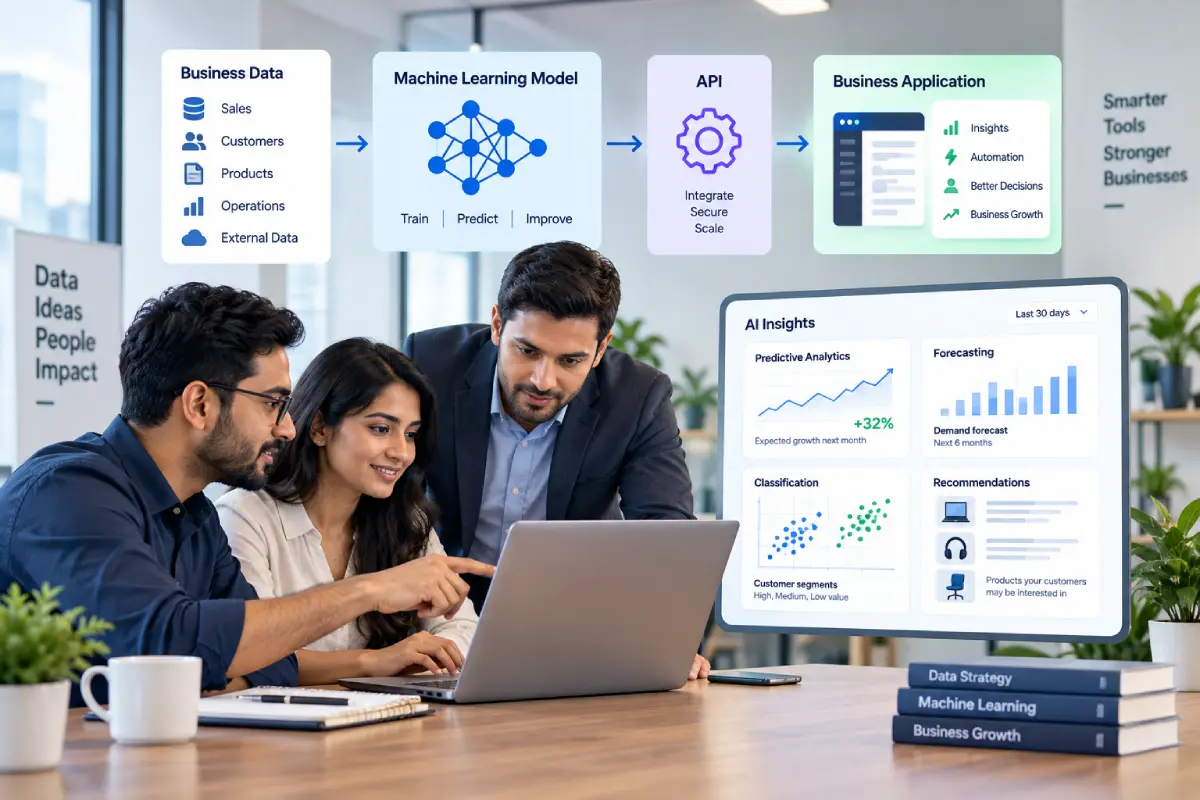
A machine learning model is of no use, if it is not being used to make a decision, by employees or a customer.
It thus could be linked to an application (if a GUI is needed), a dashboard, a backend or an API.
For example:
Customer data applies to ML model, Prediction API, or Business app?
This allows to incorporate the prediction into an existing workflow.
6. Deployment and Monitoring
After deployment, your work isn‘t over.
Current data is, well, current data. Data may have been collected years ago, may have come from a sample or limited observations but not data in the world.
As the customer behavoirs market or operating conditions change the accuracy of model should deteriorate.
Employing MLOps methods on them for monitoring, version controlling, testing, retrening as well as controlled deployment.
Common Custom Machine Learning Use Cases
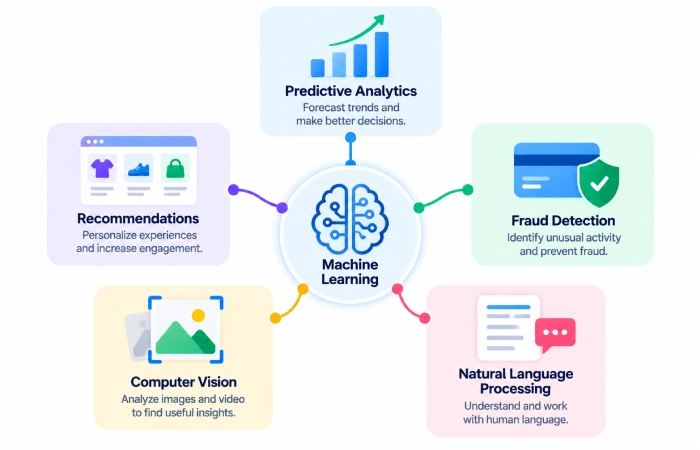
You can use custom ML development in any field.
Predictive Analytics
Companies can analyze past data in order to make predictions for the future.
Examples include:
- Sales forecasting
- Demand prediction
- Customer attrition prediction (or churn prediction) As with many analytical problems, better methods exist now to predict whether or not a customer will leave in the future.
- Risk scoring
Recommendation Systems
Recommendation models. They can also predict what the customer might want and recommend accordingly by analyzing customer behavior, browsing and shopping patterns to recommend products, services or content.
This kind of system is also implemented by the majority of online shops and content providers.
Fraud Detection
Employing machine learning techniques to detect anomalous transaction patterns can be used for signposting potentially suspicious activities.
The model can be incorporated as an additional step in a risk-management procedure.
Computer Vision
Can just be a model that analyzes images or video.
Possible applications include:
- Quality inspection
- Object detection
- Image classification
- Visual monitoring
Natural Language Processing
NLP is primarily concerned with text and with language.
Businesses can use them for:
- Document classification
- Sentiment analysis
- Search
- The message processing at the customer end: (i) How the message is sent (ii) How is the message progresses through the multi-service provider/ communication network: In a typical Multi-Service Network.
- Information extraction
Anomaly Detection
ML models can find patterns that are not normal.
This may be useful to people in charge of security monitoring, transactions and operational systems.
Custom AI Development Company vs Off-the-Shelf Software
A custom AI creation company develops or customizes solutions to meet a particular business need.
Off-the-shelf software caters for the wider market and generally comes with a ‘fixed’ function.
| Custom ML Development | Off-the-Shelf Software |
|---|---|
| Concerned with a particular problem | Designed for general-purpose use |
| Information about the company itself | Typically relies on established workflows |
| More control can be achieved over the model and system. | Begins to work more quickly. |
| Can integrate seamlessly with current systems. | Integration is contingent on the options6 available |
| Needs to be taken forward and maintained. | Usually easier to manage |
Apart from these two, neither is dominant.
A ready-made solution might be more appropriate in situations where the problem is generic and the product is available off-the-shelf, for example:
Customized development requires a clear defined task, data and workflow.
Benefits of Custom Machine Learning Services
Better Fit
The solution is based on the business problem.
Greater Flexibility
The development team can select the model, the architecture, the data pipeline and the way to integrate.
Existing System Integration
Custom machine learning systems can integrate with existing applications, APIs, dashboards, and internal processes.
More Control
Companies are able to have more control on the evolution, qualification, deployment and improvement.
Room to Scale
A properly designed production system should be able to evolve as data size and business demands change.
All these advantages strongly rely on data quality and implementation. Customized development does not necessarily mean a more precise model only for being customized.
How the Custom ML Development Process Works
A pragmatic development process can be divided up into the following steps.
Step 1: Define the Business Problem
Begin with the decision or process that you want the model to be able to support.
Step 2: Check Data Readiness
Analyze the volume, integrity, format, access rights and utility of the data at hand.
Step 3: Build a Prototype
First, to provide a proof of concept, test the method on a small dataset.
Step 4: Train and Evaluate the Model
Train the model and measure performance against agreed requirements.
Step 5: Integrate the Model
Link the model to the application, API, dashboard, or workflow where its result will be employed.
Step 6: Deploy
Ensure the system is moved into the production environment.
Step 7: Monitor and Improve
Monitor model performance, monitor changes in data, record errors, usage, and business results.
This lifecycle approach is meaningful since the machine learning system requires monitoring after the launch, not only in the stage of development.
What Does Custom ML Development Cost?
There is no one fixed price for custom machine learning development.
There are lots of factors on what the cost is.
Data Complexity
Clean, well-structured data is for the most part simple to work with in comparison to disorganized, untagged data.
Model Complexity
A simple classification model can be significantly less work to build than a sophisticated computer vision or forecasting system.
Integration Requirements
What about linking a model to a real application or part of enterprise architecture? This adds engineering work.
Security and Compliance
The more sensitive the information, the more additional controls, testing, infrastructure may be necessary.
Ongoing Support
Monitoring, retraining, optimizing, and maintenance may continue to be added to the long-term cost.
The right way to do this is to define a small pilot first, then put in place measurable requirements, and finally estimate the production project.
How to Choose a Custom AI Development Company
Selecting the appropriate development partner is more than just examining a list of technologies.
Look for Relevant Experience
Question if they‘ve handled your kind of learning problem before.
Check the Development Process
An effective team should be able to detail the pipeline for data processing, model evaluation and deployment, and monitoring.
Ask About Integration
Learn how the model integrate into your systems.
Discuss Ownership
Indicate who owns the code, models, data pipelines, documentation, and other deliverables.
Ask About Post-Launch Support
Determine who will oversee the model post launch and maintain it in the future.
Start With a Focused Project
It‘s wise to see if any solution will work with a small proof of concept or pilot before any significant investment.
Common Mistakes
Starting With the Technology
We need an AI model that understands visual scenes and can incorporate reasoning inspired by common sense.
Begin with:
What is it that we are trying to solve, what problem do we want to resolve?
Ignoring Data Quality
A bad or irrelevant dataset will never be made good by a complex model.
Building Only a Prototype
A notebook or demo is not a production system.
Forgetting Integration
The model need to slot into the workflow where the output will actually be used by the users.
Ignoring Monitoring
Once deployed, you may find that:performance evolved due to changes in real-world data
FAQs
What are custom machine learning development services?
They are provided by ML vendors for designing, developing, testing, deploying, integrating, maintaining the ML solutions, which are based on a particular business need.
Why use custom machine learning instead of an existing tool?
Custom ML may be appropriate if your business problem, data, or workflow is extremely domain-specific and current tools don‘t offer the functionality needed.
What can a custom machine learning model do?
It can also, depending on the project, make predictions, categorise data, spot anomalies, recommend products or content, analyse language or process images.
Does custom ML require a machine learning development company?
Sometimes not. Some companies do the building internally. Some collaborate with a development partner when they require more expert know-how, a surge of engineering capacity or speedier access to ML capabilities.
How long does custom ML development take?
No time table is universal. A focused prototype can be minuscule in comparison to a production system with data pipelines, application integration, deployment, testing and monitoring.
Is custom machine learning expensive?
Cost can be higher than typical software buying, because of the development and continued engineering. A well-targeted pilot can prove the feasibility and projected scope for a larger project.
Final Thoughts
Custom machine learning development services become valuable when a business faces a unique issue that existing solutions cannot effectively address.
In the development phase, work is often from consulting, data preparation, custom developed models, testing, integration and deployment to continuous monitoring.
What makes a project working successfully doesn‘t reside in a mere construction of a strong model.
It requires the correct information, a well-defined business goal, effective integration, dependable implementation and an ongoing review.
To compare your own company with custom AI development vendors, include in your comparison the experience, process, integration needs, ownership, and maintenance & support.
Begin with a single well defined problem and quantifiable target. Demonstrate it with a targeted pilot then raise it to a full production system as results warrant the effort.
This guide is part of our Machine Learning Development Services cluster. You can also explore machine learning consulting services, machine learning model development, machine learning application development, machine learning integration services, and how to choose a machine learning development company.