


Table of Contents
Introduction – Managed Cloud Services
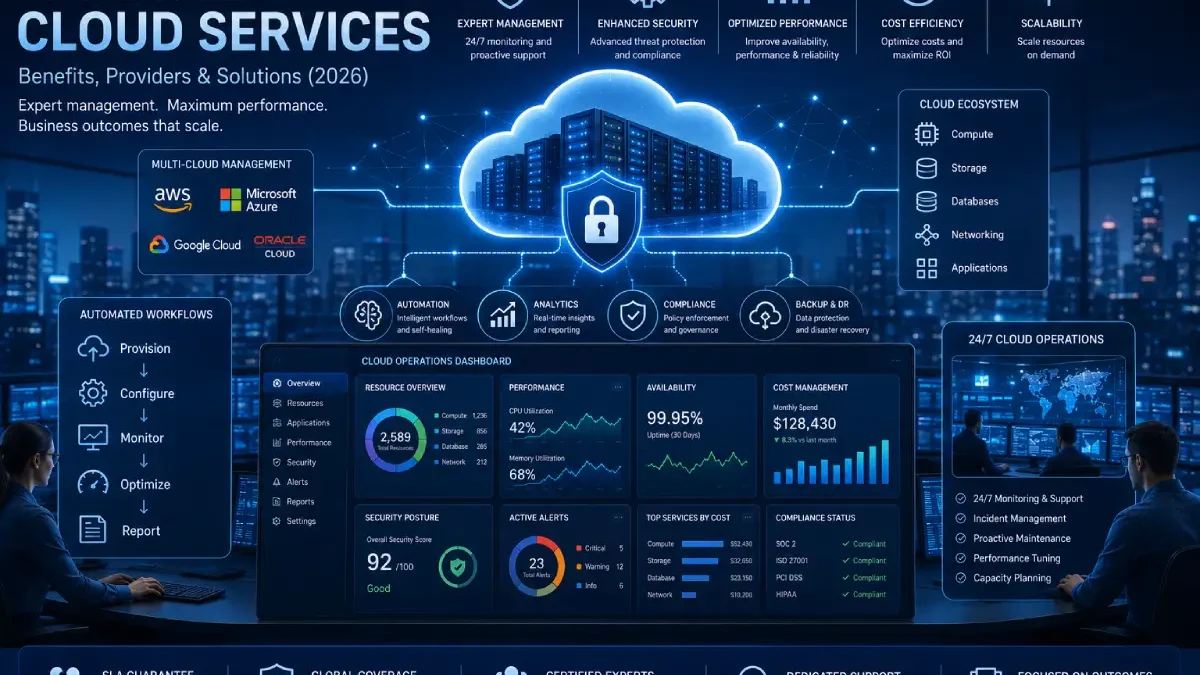
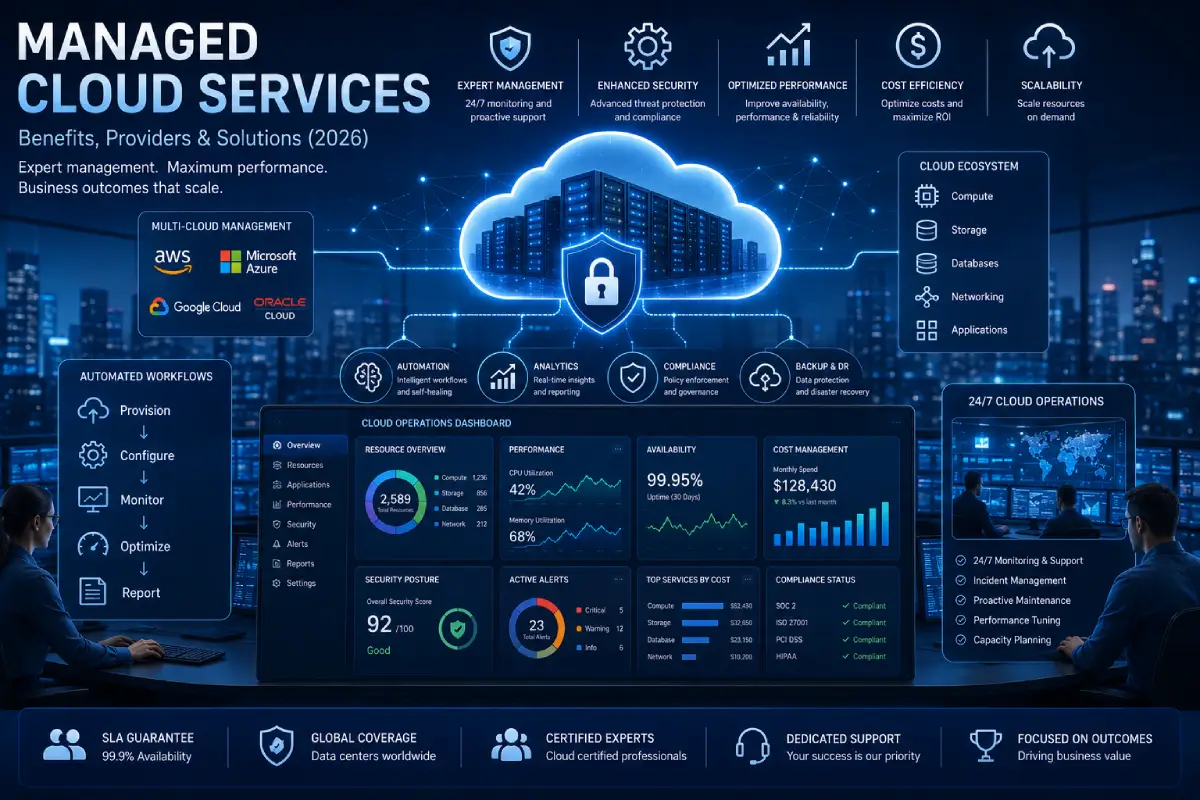
As cloud environments become more complex, many organizations are turning to managed cloud services to simplify operations, improve security, and optimize costs. While cloud platforms provide powerful infrastructure and services, managing them effectively requires specialized expertise, continuous monitoring, and proactive maintenance. Managed cloud service providers help businesses handle these responsibilities, allowing internal teams to focus on innovation and core business objectives.
Managed cloud services go beyond basic infrastructure support. They include cloud infrastructure management, security monitoring, backup and disaster recovery, performance optimization, compliance management, cost control, and 24/7 operational support. Whether a business uses Amazon Web Services (AWS), Microsoft Azure, Google Cloud Platform (GCP), or a hybrid cloud environment, managed service providers (MSPs) help ensure cloud resources remain secure, reliable, and cost-efficient.
This guide explains what managed cloud services are, explores their benefits, and outlines the different types of cloud management services available to businesses in 2026.
TECH HUB
This Article Is Part of the Future Tech Trends Hub
Explore AI trends, future innovations, next-generation computing, smart technologies, digital transformation, automation, robotics, emerging devices, and technology predictions shaping tomorrow inside our
Future Tech Trends Hub.
What Are Managed Cloud Services?
Managed cloud services are outsourced IT services that help organizations manage and optimize their cloud infrastructure, applications, and operations.
Instead of hiring large in-house cloud operations teams, businesses work with a managed cloud provider that handles daily management tasks while ensuring performance, availability, and security.
Managed cloud services typically support:
- Public cloud environments
- Private cloud environments
- Hybrid cloud deployments
- Multi-cloud infrastructures
These services can be customized based on an organization’s size, industry, and technical requirements.
Why Businesses Choose Managed Cloud Services
Managing cloud infrastructure requires specialized skills and continuous attention.
Organizations often choose managed cloud services to:
- Reduce operational complexity
- Improve cloud security
- Lower IT costs
- Increase system reliability
- Access cloud expertise
- Support business growth
- Improve disaster recovery
- Accelerate cloud adoption
For many businesses, outsourcing cloud operations is more cost-effective than maintaining a large internal cloud management team.
Benefits of Managed Cloud Services
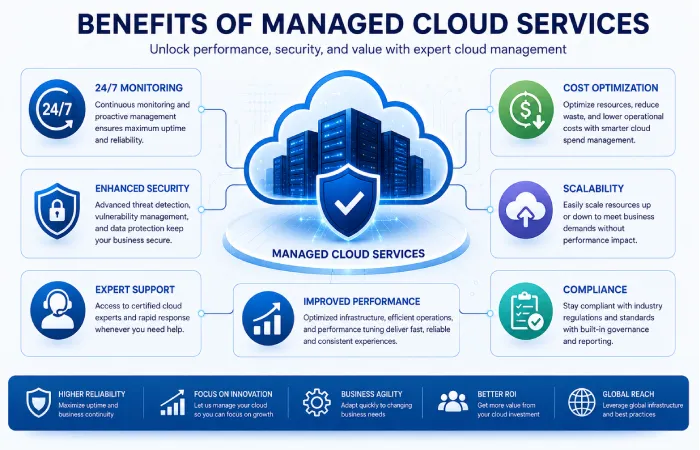
Managed cloud services provide both operational and financial advantages.
Access to Cloud Expertise
Managed service providers employ certified cloud engineers and specialists who understand cloud architecture, security, networking, and performance optimization.
Businesses gain access to experienced professionals without the cost of hiring full-time specialists.
Improved Reliability
Continuous monitoring and proactive maintenance help reduce downtime.
Most providers offer Service Level Agreements (SLAs) that define expected availability and response times.
Higher availability improves customer satisfaction and business continuity.
Enhanced Security
Managed cloud providers implement security controls such as:
- Identity and Access Management (IAM)
- Threat detection
- Vulnerability management
- Encryption
- Firewall configuration
- Compliance monitoring
These services help organizations strengthen their cloud cybersecurity posture.
Cost Optimization
Cloud costs can increase quickly if resources are not managed effectively.
Managed providers help organizations:
- Remove unused resources
- Right-size virtual machines
- Optimize storage usage
- Monitor cloud spending
- Recommend cost-saving strategies
Effective cloud cost management improves return on investment.
24/7 Monitoring and Support
Many providers offer around-the-clock monitoring to identify and resolve issues before they affect business operations.
Continuous support allows organizations to maintain reliable services even outside normal business hours.
Types of Managed Cloud Services
Managed cloud services cover many aspects of cloud operations.
Cloud Infrastructure Management
Infrastructure management includes maintaining:
- Virtual machines
- Storage
- Networking
- Load balancers
- Compute resources
Providers monitor system health and optimize infrastructure for performance and availability.
Cloud Security Management
Security services help protect cloud environments through:
- Identity management
- Security monitoring
- Threat detection
- Compliance support
- Security assessments
These services reduce cyber risks and improve regulatory compliance.
Backup and Disaster Recovery
Managed providers help organizations protect critical data through:
- Automated backups
- Disaster recovery planning
- Data replication
- Recovery testing
These capabilities improve business resilience during outages or cyber incidents.
Performance Monitoring
Continuous monitoring identifies issues affecting:
- Application performance
- Infrastructure utilization
- Network latency
- System availability
Providers use monitoring tools to detect and resolve problems before they impact users.
Cloud Cost Management
Cloud management services often include financial optimization by:
- Tracking resource usage
- Identifying waste
- Recommending reserved capacity
- Optimizing storage tiers
- Improving workload efficiency
This process helps organizations control cloud spending while maintaining performance.
Who Uses Managed Cloud Services?
Managed cloud services are valuable for organizations across many industries.
Common users include:
- Small and medium-sized businesses
- Large enterprises
- Healthcare organizations
- Financial institutions
- Government agencies
- Educational institutions
- E-commerce companies
- Software development firms
Businesses with limited internal cloud expertise often benefit the most from managed services.
Managed Cloud Services vs Traditional IT Management
The shift from traditional IT to managed cloud operations has changed how organizations manage infrastructure.
| Traditional IT | Managed Cloud Services |
| On-premises infrastructure | Cloud-based infrastructure |
| Manual maintenance | Automated management |
| Fixed hardware capacity | Scalable cloud resources |
| Internal IT teams | Cloud specialists and MSPs |
| Capital expenditure | Operational expenditure |
| Limited monitoring | 24/7 monitoring and support |
Managed cloud services allow organizations to modernize operations while reducing administrative overhead.
When Should a Business Consider Managed Cloud Services?
Businesses should evaluate managed cloud solutions if they:
- Have limited cloud expertise
- Experience frequent performance issues
- Need stronger cloud security
- Must meet compliance requirements
- Want to reduce operational costs
- Plan to migrate additional workloads to the cloud
- Need continuous monitoring and support
Managed services can also help organizations accelerate digital transformation by allowing internal teams to focus on innovation instead of infrastructure maintenance.
Core Managed Cloud Services
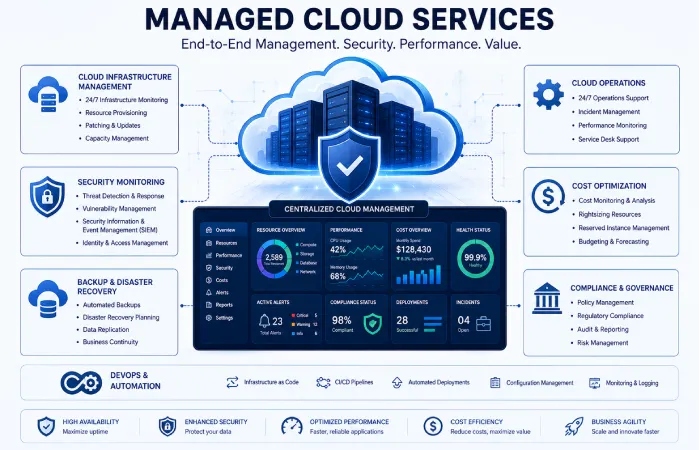
A managed cloud provider delivers a wide range of services that help businesses operate cloud environments efficiently. Rather than simply maintaining servers, providers manage the entire cloud lifecycle—from infrastructure and security to monitoring, optimization, and technical support.
Below are the most common managed cloud services offered in 2026.
Cloud Infrastructure Management
Cloud infrastructure management is the foundation of every managed cloud solution.
Providers manage critical resources such as:
- Virtual machines
- Cloud storage
- Networking
- Load balancers
- Containers
- Kubernetes clusters
Their responsibilities include provisioning resources, monitoring infrastructure, applying updates, and ensuring systems remain highly available.
Benefits
- Improved system reliability
- Better resource utilization
- Reduced downtime
- Faster deployment of new workloads
Cloud Security Management
Security is one of the primary reasons organizations partner with managed cloud providers.
Security management typically includes:
- Identity and Access Management (IAM)
- Firewall configuration
- Threat detection
- Vulnerability assessments
- Security monitoring
- Compliance reporting
- Incident response
Providers continuously monitor cloud environments to identify and respond to potential threats before they impact business operations.
Backup and Disaster Recovery
Business continuity depends on having reliable backup and recovery processes.
Managed cloud providers usually offer:
- Automated backups
- Data replication
- Disaster recovery planning
- Recovery testing
- Business continuity support
These services help organizations recover quickly after hardware failures, accidental deletions, or cyberattacks.
Performance Monitoring and Cloud Operations
Continuous monitoring allows providers to detect issues before they become service disruptions.
Cloud operations services commonly include:
- Infrastructure monitoring
- Application performance monitoring
- Network monitoring
- Availability monitoring
- Capacity planning
- Automated alerting
Proactive monitoring reduces downtime and improves user experience.
Cloud Cost Optimization
One of the biggest challenges after cloud adoption is controlling operational costs.
Managed cloud providers help organizations optimize spending by:
- Identifying unused resources
- Rightsizing virtual machines
- Optimizing storage usage
- Recommending reserved instances
- Monitoring monthly cloud costs
Regular cost reviews help organizations maximize the value of their cloud investments.
Compliance and Governance
Many organizations operate under strict regulatory requirements.
Managed cloud providers assist with compliance by supporting frameworks such as:
- ISO 27001
- SOC 2
- HIPAA
- PCI DSS
- GDPR
Compliance services may include:
- Security assessments
- Audit preparation
- Policy enforcement
- Compliance reporting
- Configuration reviews
This reduces compliance risks and simplifies regulatory audits.
DevOps and Automation Support
Many managed cloud providers also support DevOps initiatives.
Services often include:
- CI/CD pipeline management
- Infrastructure as Code (IaC)
- Automated deployments
- Configuration management
- Container orchestration
- Kubernetes management
Automation reduces manual work, improves deployment speed, and minimizes configuration errors.
Managed Cloud Services Comparison
The following table summarizes the most common managed cloud solutions.
| Managed Service | Primary Purpose | Business Benefit |
| Infrastructure Management | Manage compute, storage, and networking | Improved reliability |
| Security Management | Protect cloud environments | Reduced cyber risk |
| Backup & Disaster Recovery | Protect and restore business data | Business continuity |
| Cloud Operations | Monitor systems and performance | Higher availability |
| Cost Optimization | Control cloud spending | Lower operational costs |
| Compliance Management | Meet regulatory requirements | Reduced compliance risk |
| DevOps Support | Automate deployments | Faster software delivery |
A combination of these services creates a well-managed and secure cloud environment.
How to Choose a Managed Cloud Provider
Not all managed service providers offer the same level of expertise or support.
When evaluating a provider, consider the following factors.
Technical Expertise
Look for providers with certified professionals experienced in:
- Amazon Web Services (AWS)
- Microsoft Azure
- Google Cloud Platform (GCP)
- Kubernetes
- Cloud networking
- Security
Experience across multiple cloud platforms is valuable for hybrid and multi-cloud environments.
Service Level Agreements (SLAs)
Review the provider’s SLA carefully.
Important metrics include:
- Uptime guarantees
- Response times
- Resolution targets
- Support availability
Clear SLAs help establish expectations and accountability.
Security Capabilities
Evaluate whether the provider offers:
- Identity and Access Management
- Security monitoring
- Threat detection
- Compliance support
- Incident response
- Vulnerability management
Security should be integrated into every managed service offering.
Scalability
Choose a provider that can support future business growth.
The provider should be able to:
- Scale infrastructure quickly
- Add new cloud services
- Support expanding workloads
- Manage multiple cloud platforms
Scalability prevents the need to change providers as your business grows.
Customer Support
Reliable technical support is essential.
Look for:
- 24/7 availability
- Dedicated account managers
- Multiple support channels
- Proactive communication
- Regular performance reviews
Strong customer support contributes to smoother cloud operations and faster issue resolution.
Signs You Need Managed Cloud Services
Organizations often benefit from managed cloud solutions if they experience:
- Frequent downtime
- Rising cloud costs
- Limited in-house expertise
- Security concerns
- Compliance challenges
- Rapid business growth
- Complex hybrid or multi-cloud environments
Recognizing these signs early can help prevent operational inefficiencies and improve long-term cloud performance.
Managed Cloud Services Best Practices
Implementing managed cloud services successfully requires more than selecting a provider. Organizations should establish clear governance, monitor performance, and continuously optimize their cloud environment to maximize business value.
Define Clear Business Objectives
Before partnering with a managed cloud provider, identify your primary goals.
Common objectives include:
- Reducing operational costs
- Improving system availability
- Strengthening cloud security
- Meeting compliance requirements
- Supporting business growth
- Accelerating cloud adoption
Clearly defined objectives help measure the success of managed cloud initiatives.
Choose the Right Service Model
Not every organization requires the same level of support.
Some businesses only need infrastructure monitoring, while others require complete cloud operations management.
Evaluate your requirements based on:
- Infrastructure complexity
- Internal IT expertise
- Security requirements
- Compliance obligations
- Budget
- Business growth plans
Choosing the appropriate service model prevents unnecessary costs while ensuring adequate support.
Monitor Performance Continuously
Regular performance monitoring helps identify issues before they affect users.
Track important metrics such as:
- Application response times
- Resource utilization
- Network latency
- Storage performance
- System availability
Performance reports should be reviewed regularly to identify opportunities for optimization.
Review Cloud Costs Regularly
Cloud costs can increase over time if resources are not managed efficiently.
Organizations should:
- Remove unused virtual machines
- Archive inactive storage
- Optimize database usage
- Review monthly cloud spending
- Implement cloud budgeting
Continuous cost optimization ensures cloud investments remain aligned with business objectives.
Strengthen Security
Security should remain a continuous priority.
Organizations should:
- Enable Multi-Factor Authentication (MFA)
- Apply least-privilege access controls
- Encrypt sensitive data
- Review access permissions
- Conduct vulnerability assessments
- Monitor security alerts
Combining managed cloud services with strong internal security policies creates a more resilient cloud environment.
Maintain Regular Communication
A successful partnership requires ongoing collaboration.
Schedule regular reviews with your managed cloud provider to discuss:
- Performance metrics
- Security updates
- Cost optimization opportunities
- Capacity planning
- Upcoming business requirements
Regular communication ensures cloud services continue supporting organizational goals.
Future Trends in Managed Cloud Services
Managed cloud services continue to evolve as organizations adopt new technologies and operating models.
AI-Powered Cloud Operations (AIOps)
Artificial intelligence is transforming cloud operations by helping providers:
- Detect anomalies
- Predict infrastructure issues
- Automate incident response
- Optimize performance
- Reduce downtime
AIOps enables faster problem resolution and improves overall operational efficiency.
FinOps and Cloud Cost Management
FinOps combines financial management with cloud operations to help organizations optimize cloud spending.
Managed cloud providers increasingly offer FinOps services, including:
- Cost forecasting
- Budget monitoring
- Resource optimization
- Usage analytics
- Financial reporting
These capabilities help businesses control costs while maintaining performance.
Multi-Cloud Management
Many organizations now operate workloads across multiple cloud platforms.
Managed providers help simplify:
- Resource management
- Security policies
- Monitoring
- Governance
- Cost optimization
Unified management reduces operational complexity in multi-cloud environments.
Automation and Infrastructure as Code (IaC)
Automation continues to reduce manual administration.
Common automation capabilities include:
- Automated provisioning
- Configuration management
- Policy enforcement
- Scaling resources
- Software deployments
Infrastructure as Code improves consistency while reducing configuration errors.
Frequently Asked Questions
What are managed cloud services?
Managed cloud services are outsourced IT services that help organizations manage cloud infrastructure, security, monitoring, backups, performance optimization, and daily cloud operations.
What does a managed cloud provider do?
A managed cloud provider is responsible for tasks such as:
- Infrastructure management
- Cloud security
- Monitoring
- Backup and disaster recovery
- Cost optimization
- Performance management
- Technical support
The exact responsibilities depend on the service agreement.
Why should businesses use managed cloud services?
Managed cloud services help organizations:
- Reduce operational complexity
- Improve security
- Lower IT costs
- Increase reliability
- Access cloud expertise
- Improve business continuity
They allow internal teams to focus on strategic business initiatives rather than routine infrastructure management.
Are managed cloud services suitable for small businesses?
Yes.
Small and medium-sized businesses often benefit because managed services provide enterprise-level expertise without requiring a large internal IT department.
This makes advanced cloud management more affordable and accessible.
How do I choose a managed cloud provider?
When evaluating providers, consider:
- Technical certifications
- Industry experience
- Security capabilities
- Compliance expertise
- Service Level Agreements (SLAs)
- Customer support
- Pricing transparency
- Scalability
Selecting a provider that aligns with your business requirements ensures a more successful long-term partnership.
Conclusion
Managed cloud services help organizations maximize the value of cloud computing by providing expert management, continuous monitoring, security, cost optimization, and operational support. Rather than dedicating internal resources to routine cloud administration, businesses can rely on experienced managed service providers to maintain reliable, secure, and scalable cloud environments.
Whether your organization operates on Amazon Web Services (AWS), Microsoft Azure, Google Cloud Platform (GCP), or a hybrid or multi-cloud infrastructure, managed cloud solutions simplify operations while improving performance and reducing operational risk. Services such as infrastructure management, cloud security, backup and disaster recovery, monitoring, compliance, and FinOps help organizations achieve better business outcomes and focus on innovation.
As cloud technologies continue to evolve, partnering with the right managed cloud provider can improve operational efficiency, strengthen cybersecurity, and support long-term digital transformation.
Cloud Computing Services Hub
Discover cloud computing services, deployment models, cloud providers, storage solutions, security services, migration strategies, and managed cloud solutions for businesses and individuals.