


SEO Basics for Beginners: A Complete Guide
If you’re new to SEO, it can be overwhelming trying to learn all the industry jargon, applying the various tools and strategies…
Fortunately, the basic idea is simple.
This refers to Search Engine Optimization (SEO).
The generic terms used for search engines are search engine optimization and it allows websites to be optimized for search engines to provide the content to users.
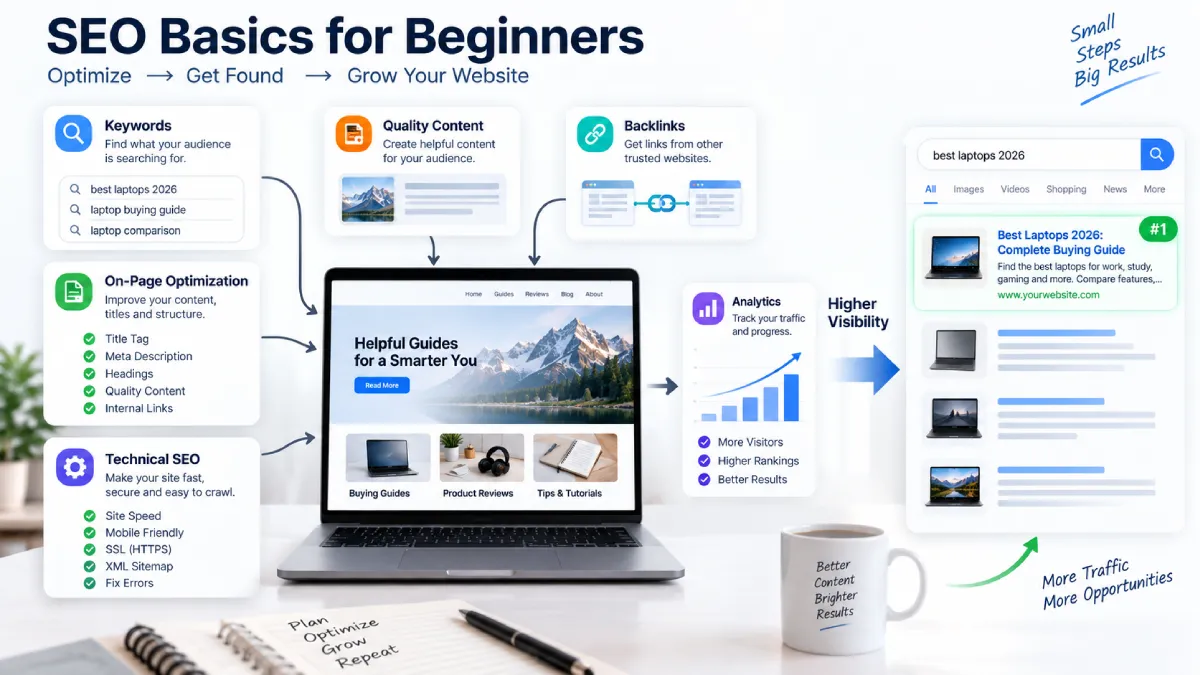
You don’t have to learn everything simultaneously. Begin with the basics, comprehend the functioning of search engines, and proceed to explore keyword research, on-page SEO, technical SEO, and link building.
This guide introduces the SEO fundamentals for the absolute beginner in a layman’s terms.
Table of Contents
What Nature SEO?
This is the abbreviation of Search Engine Optimization.
It’s about optimizing various pages on your website so that search engines can find, understand, and potentially rank your pages well for relevant searches.
For example, suppose someone searches for:
Most powerful laptop for college students.
A site with an interesting article on student laptops might wish to have that page show up high in the search engine listing.
SEO can also make the website content more organized, more relevant, and easy for search engines to index.
SEO is not just about putting keywords into an article. It can involve:
- Website content
- Keywords
- Page titles
- Headings
- Internal links
- Images
- Website structure
- Page speed
- Mobile usability
- Technical settings
- External links and backlinks The number of links which point to the site from other sites, known as backlinks, is one of the factors used to determine the PageRank as most of the backlinks link to the important pages Within the site or the home page. But the home page is not influenced significantly by the internal backlinks of the any site. It is better to use keywords with branding in the text instead of the anchor text.
It is the general aim of this site to be user friendly with the search engines.
Why is it important?
The question that everyone is asking on the internet today in regards to SEM. To understand fully, then it is good to have a brief discussion on search engines.
Search engines are the primary methods that people have for finding information on the internet.
The user was looking for a product before purchasing it, searching for a tutorial for solving a specific problem, looking for a local service or comparing something.
It allows you to get your website shown for searches that are relevant to your business or topic, and without having to pay for each click.
SEO can help a website:
- Get increased organic search traffic from GOOGLE.
- People searching for information with their innovative search engine, thereby greatly improving the relevance of their search engine.
- Improve online visibility I’m pleased to report that the services will significantly enhance the online visibility of the business (including the website and through direct traffic).
- Develop sustainable website traffic
- Help users to locate the content that is most relevant to them.
- Business Development/Support Leads and Sales
Ranking on 1 th page of google / SEO is not assured. Keyword position is not constant, you cant get first position for highest search competition.
This is the reason that SEO should be constantly revisited rather a one off exercise.
How Search Engines Work
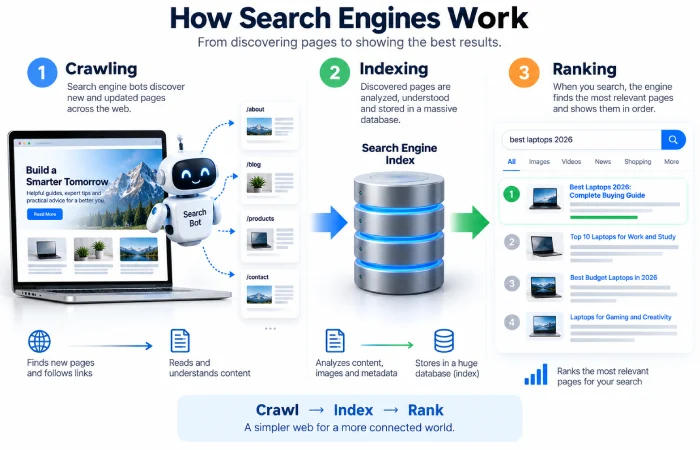
Now it’s necessary to have an idea of how a search engine works with web pages in general to know the concept of SEO.
The three main stages are:
Crawling → Indexing → Ranking
Crawling
Crawling refers to the discovery of web pages.
When applying a search engine, a crawler (also called a spider or a bot), which is an automated program, runs searches for URLs on the web.
Link searching: a crawler can follow links from other pages, from XML sitemaps, and from other known URLs.
For example, if Page A links to Page B, then a search engine may follow the link and find page B.
Use a website 2.1 with less than adequate navigation, broken links or technical restrictions.
Indexing
When an search engine finds a page, it will crawl it and consider whether storing information about that page in its index.
The index is a massive repository of information about web pages that the search engine has already crawled.
Indexing- worth noting that pages must usually be indexed before they can rank in normal organic listings.
Indexing, of course, does not guarantee any page a high position in the search results.
It is possible for there to be a page, which is indexed and so appears in search results, but hardly receives any search visitors.
Ranking
When an individual is performing a search, the search engine goes through the appropriate pages stored in its index to see how useful the result would be.
These results are then listed on the page of search results.
Several factors can influence page performance for search.
These may be relevance, content, the quality of the website, links, usability, and more.
That’s the reason why SEO is by far more than just placing a keyword inside of an article.
The Main Types of SEO
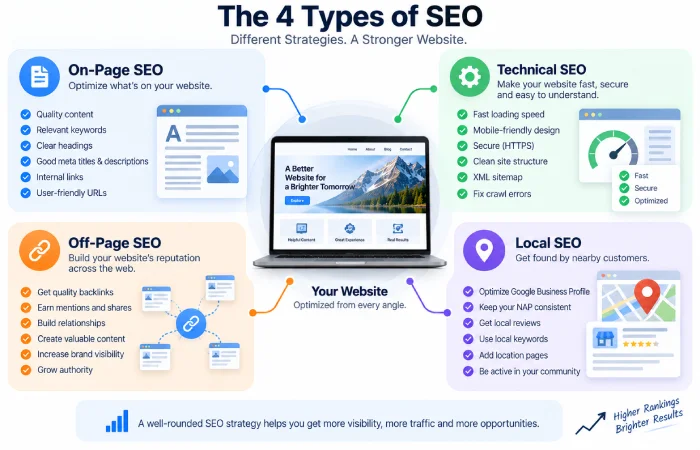
It is common to categorize SEO into different areas. If you know these categories, you will find it easier to systematically learn SEO.
On-Page SEO
On-page SEOare elements on a webpage.
Common areas include:
- Page titles
- Headings
- Content
- Keywords
- Internal links
- Image optimization
- URLs
- Meta descriptions
The aim is to make the page useful, precise, well-organized and pertaining to the search.
- Learn on page optimization Learn on page optimization from our comprehensive On-Page SEO Tutorial.
Technical SEO
Technical SEOThe technical aspect of a site refers to aspects that impact crawling, indexing and usability.
Examples include:
- XML sitemaps
- Robots.txt
- Canonical URLs
- Mobile usability
- Page speed
- Structured data
- Redirects
- Broken links
I don’t think it requires any sophisticated level of coding knowledge to grasp the fundamentals of technical SEO.
Off-Page SEO
Off-page SEO deals with actions external to your website aimed at creating support for it.
Cross-referenced one of the most popular.
A backlink is a link from someone elses site to your site.
Links can be used by search engines to discover pages, as well as being used as indicators of relevance and importance.
Quality is important. Trying to get lots of low-quality (or unnatural) links is not a good SEO strategy.
Find out more here.
Local SEO
Local SEO (Search Engine Optimization) Involves.
Would you think it is very critical for all other businesses like restaurants, doctors, salons, repair companies, stores and local services?
Local SEO can include:
- Google Business Profile
- Details of local business information
- Reviews
- Local content
- Location pages
- Local links
SEO vs Paid Search
Search engine optimization and paid search have a presence on search engines; however, means and methods differ from each other.
SEO is essentially about natural search results.
Paid search: through advertising engines, sponsored results are displayed on specific searches.
For instance, a firm might pay to display an ad for a keyword and simultaneously improve its SEO to achieve better organic rankings.
Organic Search
Regarding traffic:The search engines refer to free searches.
You are not charged every time someone clicks on your organic listing to the search engine.
But there will be a struggle to earn and sustain the organic visibility.
Paid Search
One of the reasons paid search can generate traffic rapidly is because advertisers can establish campaigns and bid for particular searches or target markets.
Generally, the traffic goes on only until the campaign itself is active and paid.
SEO and paid search are separate channels but many firms combine the two as part of a broader digital marketing strategy.
Basic SEO Terms for Beginners
When you’re learning SEO, you’re going to be introduced to a lot of new vocabulary.
Here are some of the more frequent ones.
Keyword
A keyword is a word or phrase of users when they’ve gone on the internet to look for something.
Examples include:
- Best laptop 2026.
- SEO tutorial
- How to speed up my slow website
Keywords are useful to know what people want.
Search Intent
Search intent is the purpose of a search.
A person may want to:
- Learn something
- Name a particular website.
- Compare products
- Buy something
- Find a local service.
Knowing intent helps you know what kind of page to develop.
SERP
SERP is the abbreviated name of Search Engine Results Page.
It is the page a user sees immediately after passing a search term.
SERP may include organic results, paid (ads) results, images, videos, maps, author box,Know., then box, other special search features.
Organic Traffic
Organic traffic is the traffic to a web site that comes from the search engine’s unpaid results.
Backlink
What is a backlink? A backlink is a link back to your web site from another web site.
Internal Link
An internal link links another page of your website with the page on your website.
Title Tag
A title tag is the HTML title that identified the individual web page. Search engine took this as the name displaying on search engines.
Meta Description
A meta description is a brief description of a webpage.
It may show under the title in a search result and may aid in a user understanding what the page is about.
Indexing
Web pages are stored, and a certain amount of information about a web page is processed within a search engine’s index.
Crawl
Crawl. When a search engine bot trawls and uncovers pages on a web site.
Keyword Research and SEO
The final SEO tool I’m considering are keywords and why these are essential. Keywords are essential to your SEO strategy in the sense that they link the content you are producing to what your audience is searching for.
But keyword research isn’t as easy as taking one phrase that’s popular and repeating it over and over in an article.
A useful keyword research process considers:
- What people want.
- Search intent
- Competition
- Relevance
- Related topics
- Long-tail keywords
For instance, rather than optimizing for just “laptop,” a website could optimize for more specific search queries like “best laptop for editing video” or “best laptop for university students”.
More exact searches could help clarify the user intent.
What qualities does a good SEO piece possess?
Another key was that good SEO content needed to be useful to the reader first.
A page is there to answer the question or provide a solution to the problem which led to a search.
Useful content often has:
- A concise, focused topic
- A strong introduction
- Logical headings
- Easy-to-read paragraphs
- Helpful examples
- Relevant information
- Native keywords usage
- Internal links
- Appropriate images will be incorporated where possible
There shouldn’t be the temptation to write an article just to hit a designated word limit.
Sometimes a concise page that successfully answers a question is more valuable than a much longer, repeated page.
Beginner SEO Checklist
A quick and easy process: Use this bare minimum checklist as a starting point to search engine optimization of your website.
Website Basics
- Ensure that access to important pages is possible.
- Make URLs descriptive and user-friendly.
- Ensure the site is mobile responsive.
- Look for any dead links.
- Freeze page under indirect access control if not already protected. Consequently, prevent search engines from erasing valid pages.
Content
- Develop useful material for a defined audience.
- I find it helpful to understand the search intent before I start writing.
- Incorporate natural keywords.
- Use helpful headings to structure the information.
- Do not be repetitious.
- Revise obsolete facts.
On-Page SEO
- Title tag should be clear.
- Write a meta description that is informative.
- Use appropriate headings.
- The question can also be discussed using an example of this type of society.
- Optimize your images and add valuable alternative text.
- Always keep URLs short and descriptive.
Technical SEO
- Consider creating an XML website map.
- Check robots.txt.
- Furthermore I would also like you to go through ones I have not yet covered: review the indexing problems I have.
- In general, while it is better to include references to sources to support general statements, the use of canonical URLs is appropriate where a particular source can be cited.
- Fix the broken pages. Redirect lack of pages.
- Track the website performance.
Off-Page SEO
- Obtain quality backlinks.
- Provide valuable information that other sites might cite.
- Steer clear of any black-hat link-building techniques.
- Concentrate on relevance and quality, not on the number of links.
Common SEO Mistakes Beginners Make
Getting into SEO is all about trial, so beginners will encounter similar obstacles.
Focusing Only on Keywords
Keywords are important but the more you repeat them the more difficult what you’re writing is to follow.
Response writing ofyour questions. Write naturally. Focus on the user’s question.
Ignoring Search Intent
It can identify the right word but still fail if does not match the searcher’s actual desire.
A product comparison seeker would want two to three different pages on the comparable products. A searcher seeking a definition will want to see the main head of the page.
Publishing Thin Content
Pages with extremally little content can have a hard time against powerful sources.
Why not put the energy into creating useful pages around subject matters that your visitors really care about?
Ignoring Technical Problems
World class content can still face issues if preeminent pages are un-crawlable and un-indexable.
Regular basic technical audits should be carried out regularly as part of your SEO campaign.
Expecting Instant Results
Search Engine Optimization is not instant.
New websites often take time to gain exposure. Competitive topics may take even longer.
Stay away from anyone who guarantees top rankings or immediate organic traffic.
How to Learn SEO Step by Step
The site does not need to learn everything to of SEO straight away.
A simple learning path is:
Step 1: Learn the fundamentals of SEO.
Step 2: Master keyword research. I’m not going to go into keyword research here, but it is made incredibly easy with free online keyword tools you can find with a simple Google search.
Step 3: Master on-site SEO.
Step 4: Get some technical SEO under your belt.
Step 5: Learn about backlinks and link building.
Step 6: Get to know google search console.
Step 7: Practice by improving a real website.
It encourages you to learn more step-by-step rather than attempting to satisfy yourself with everything all at once.
Final Thoughts
When you section off SEO into smaller chunks, it is much easier to grasp the key SEO fundamentals that will help you at a basic level.
Start by learning how search engines crawl, index and rank pages. Then learn keyword research, on page seo, technical seo, link building and measuring performance.
SEO is not about trying to fool search engines.
We discuss about building a website which is functional, usable, well-structured, and relevant to what people are searching.
The most practical way to really learn SEO is to learn it and, and then test it on an actual site.