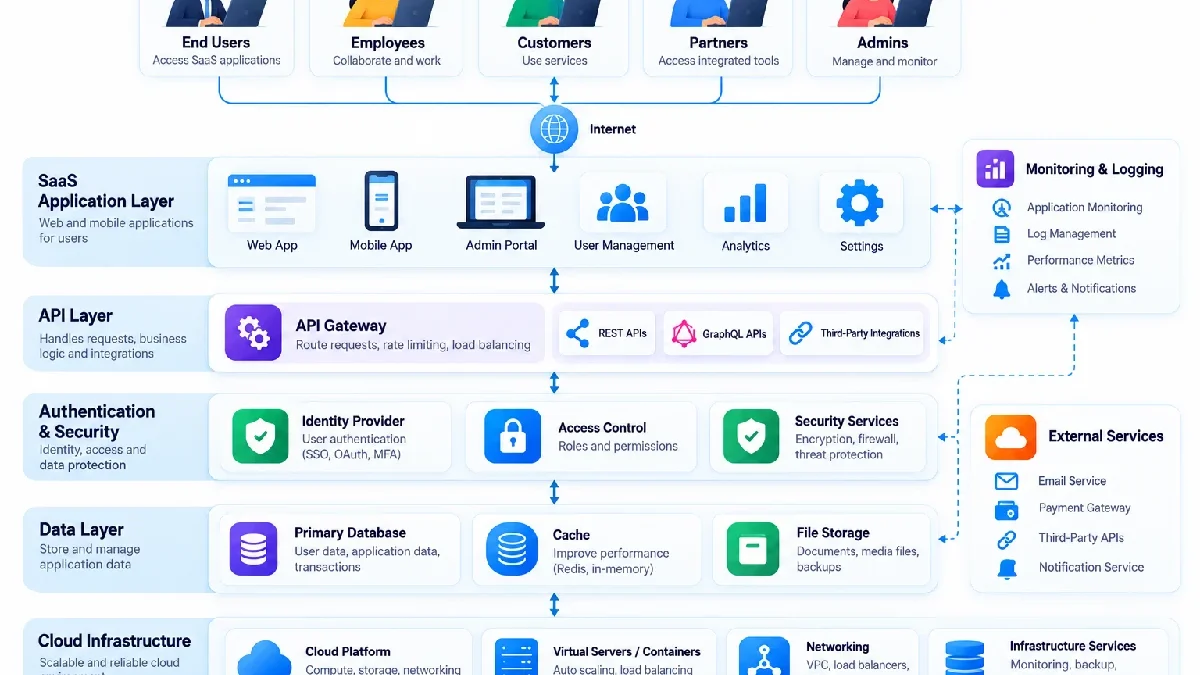

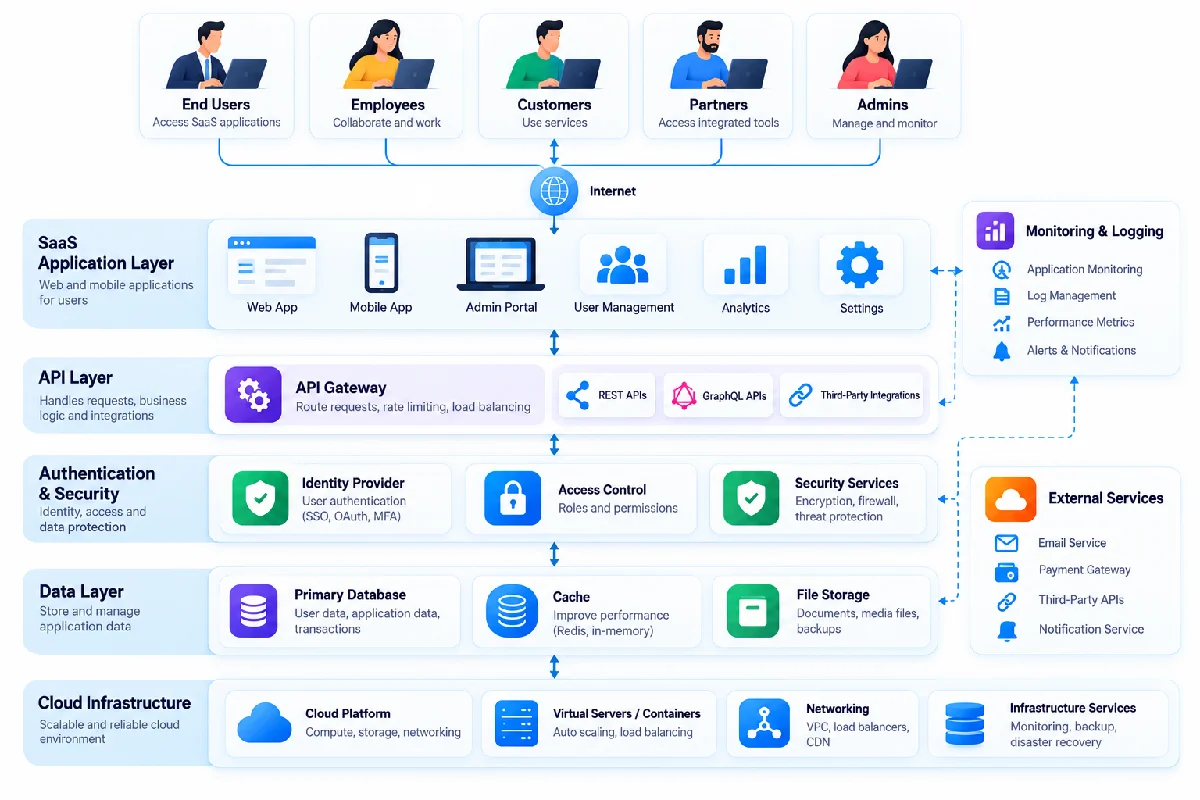


Although may all seem very simple to users, but it takes a lot of technologies to provide such a service.
The architecture controls the application‘s identity on a per-user basis, their data, the user authentication method, the way data is persisted, the communication, the scaling and also the security.
Knowing the basic layout helps describe how cloud-based SaaS platforms are thus able to deliver what the customer wants to a great number of different customers.
Table of Contents
What Is SaaS Architecture?
SaaS architecture is the manner in which the software will be delivered as a service. It is the technical framework for software delivery.
It comprises the application, databases, infrastructure, authentication, tools, interfaces, operating system, the network, monitoring, and anything else that supports the application.
The specific architecture varies from product to product, but most SaaS systems will require several distinct layers.
Main Components of SaaS Architecture
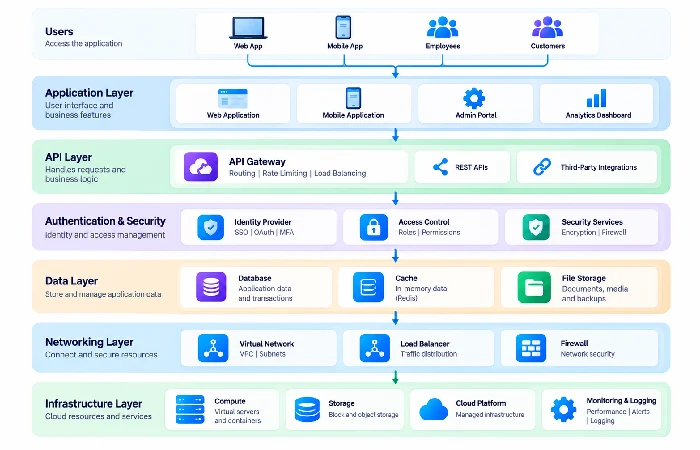
Application Layer
This is the interface(s) that the users see.
It has the ability to create features used in web application such as dashboards, forms, reports, search, workflows and many more.
API Layer
Application programming interfaces (api‘s) make it possible for different systems and software to interact.
A SaaS platform might also offer an API, so you can easily integrate it with your other business applications.
Using for instance, a customer relationship management program will communicate with accounting or marketing tools.
Authentication Layer
Authentication identifies the user.
A SaaS application may support:
- Login by using email and password:
- Single sign-on
- Multi-factor authentication
- Session management
Authorisation then controls what that user is permitted to access.
Database Layer
This contains the database of applications.
Such as users, customer records, transactions, documents, configurations, and activity information depending on the platform.
Designing the database is particularly crucial under circumstances where several customers work with the same platform.
Infrastructure Layer
Costs includes the cloud computing resources such as servers, storage, networking and other resources to run the platform.
What Is Multi-Tenant SaaS Architecture?
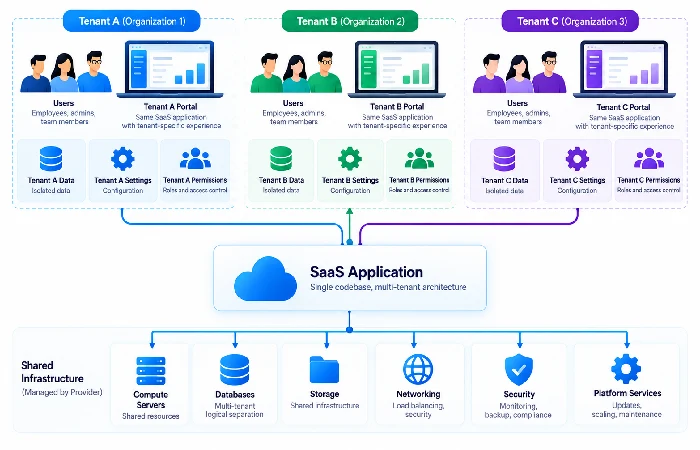
Multi tenant architecture offers several tenants to access and utilize the same application environment, while maintaining their data and information in a logically segregated manner.
Another way to look at this is as a single Software as a Service platform serving multiple organizations.
Each customer may have its own:
- Users
- Data
- Settings
- Permissions
- Organisation-level configuration
Underlying platform is shared.
Why Multi-Tenancy Is Important
Multi-tenancy facilitates the large-scale operation of SaaS by providers.
Unlike the previous alternative, a provider can keep its tenant data properly separated while providing customers with a shared application stack, by sharing components.
May come that can enhance resource efficiency and reduce the task of some maintenance operations.
Single-Tenant vs Multi-Tenant
| Single-tenant | Multi-tenant |
|---|---|
| Dedicated environment per customer | Shared application environment |
| Greater environment separation | Shared infrastructure with logical isolation |
| Can require more resources | Can improve resource efficiency |
| More customisation possible | Standardised platform is common |
The exact implementation depends on the SaaS product.
Scalability
A SaaS application must be able to adapt to fluctuating numbers of users and workloads.
Scalability can involve:
- More computer resources:
- Load balancing
- Database optimisation
- Caching
- Distributed services
- Automatic scaling
A platform that is fine with a couple of hundred users might have to change its architecture completely once it is used so much.
Data Isolation
Multi-tenancy makes data isolation particularly critical.
There are no should‘ts = The information of a customer‘s, for instance, should not be made available to another customer.
Architects can employ need for (independent) database; individual schemas; tenant specific id‘s; access rights; encryption; or a mix of these techniques.
Monitoring and Reliability
Monitoring is also required for SaaS architecture.
Providers may track:
- Application performance
- Server health
- Errors
- Database performance
- Traffic
- Security events
- Availability
Monitoring enables teams to detect issues early.
Why Architecture Matters to Users
While players may not directly ever view the architecture, they are impacted by it.
Good architecture can support:
- Faster applications
- Better reliability
- Ensure the data is well- segregated.
- Scalable services
- Consistent performance
Architecture may also enable integration options, level of customisation, availability and scalability over time for business.
Final Thoughts
SaaS architecture is, application, databases, API, authentication, infrastructure, security, monitoring and every other cloud object.
Multi-tenant SaaS architecture could be very important as one platform will support many customers and have logical separation for their data and configuration.
Specific implementations differ per product but the overall goal is the same: provide a reliable, scalable and secure software service via the cloud.