




Introduction – Social Media Marketing Services
Without question, social media is a massive opportunity for numerous businesses to deliver messages to people, promote a brand and develop relationships with clients. However, having an online existence such as…
Business as a whole are going to need the content they produce to be well ordered and focused knowing exactly what is going to be put up and where, it is aimed at their target market and what the criterion for success is.
This is where companies that will take on the social media marketing will play their part.
The social media marketing services include campaign planning, content generation, management of social media accounts, customer engagement, paid ad campaigns, and measurement of success.
A good social media strategy can help a business:
- Increase my brand awareness
- Let new customers walk through your doors.
- Site traffic needs to be increased.
- Generate leads
- Support sales
- Strengthen customer relationships.
Few points about social media marketing services that this guide will cover: what is social media marketing service, how do the social media marketing agency work, which social media use by your business, what should be consider before buy social media marketing provider.
Note: Results for Social media are very subjective and will vary based on your industry, community, platform, content and budget. An agency can‘t promise you like X Facebook fans, sales or viral content.
Table of Contents
What Are Social Media Marketing Services?
Social media marketing services are online marketing services that aid an enterprise to create, develop and deliver the marketing message they want to communicate via social media channels.
An agency or social media specialist may handle:
- Your plan of social media.
- Content planning
- Post creation
- Account management
- Community management
- Paid advertising
- Influencer campaigns
- Analytics and reporting.
What you want is not only that you increase followers. An effective campaign will coordinate social media activities to a specific business goal.
A example of this could be a clothing retailer that might use Instagram to show garments available to buy, Facebook to target customers already interested and paid social advertising to steer consumers to the business.
Why Do Businesses Use Social Media Marketing?
They also create a shorter distance than the norm between the trader and the company.
Build Brand Awareness
Useful, regular content is the answer to the challenge of becoming familiar with a business.
A brand can share:
- Product updates
- Company news
- Educational content
- Customer stories
- Behind-the-scenes content
This can may take time, but I believe that this can help the business be more identifiable.
Reach New Customers
Social platforms allow businesses to reach people based on factors such as:
- Interests
- Location
- Age
- Industry
- Online behavior
Paid advertising really makes this pinpoint targeting much more accurate.
Generate Website Traffic
Social media can send visitors to:
- Product pages
- Service pages
- Blog posts
- Landing pages
- Online stores
Therefore, social media may be an effective element of a broader digital marketing strategy.
Generate Leads
Businesses can use social media to encourage potential customers to:
- In writing, appears as a list of the filed forms. Here‘s how this row appear: Fill in forms
- Send messages
- Book appointments
- Request quotes
- Subscribe to blogs/podcasts/ RSS feeds.
Service businesses can especially benefit from this:
Support Sales
Social media can also help directly with sales through:
- Product promotions
- Social shopping feature. May include let other people see your shopping activities, find friends and shopping online together, and leave comment on shopping items.
- Paid advertisements
- Product demonstrations
- Customer reviews
I think it just depends on the business, and the platform.
What Does a Social Media Marketing Agency Do?
The social media agency will be introduced to the business and target audience.
The agency may then create a strategy covering:
Audience Research
Target market identification How well does the business know about the target markets?
This can include:
- Customer interests
- Common problems
- Buying behavior
- Location
- Age groups
- Preferred platforms
Competitor Research
The agency may review competitors to understand:
- The kinds of items they create.
- The platforms from which they operate.
- The period they publish for- Each twitter account will have a time period for which you are able to publish tweets on and there is no indication as to how long or if they will continue to publish on this account.
- I experienced a large drop in views when writing most popular posts, to mean what posts were done most in the said (question 1) and which posts received the most views and comments (question 2).
- Are providing the opportunity.
Content Planning
The agency creates a content calendar that determines:
- Postings expenditure: cost incurred on each type of post.
- On what (themes/subject matter).
- On which platform will the research be conducted? This might mean you use some online services like MRC, Where can I find? or Google Scholar.
- What purpose each post gets behind, such as:
Which makes this much easier because we are not allowed to just post random.
Major Social Media Platforms
There is no need for a company to list on all the popular social networks.
The most appropriate platform is, of course, target group and content-dependent.
Facebook can be useful for:
- Local businesses
- Community building
- Paid advertising
- Customer communication
- 2. General brand promotion. Breathing 2 models to the people toward the customers is certainly an effective marketing technique. However, with nothing other than this activity as a promotional technique, it can lead to a very positive effect on the brand strength. This situation is a good opportunity for the other brands to make use of their promotional activities.
This is more useful if the business has a larger customer base.
What is so great about Instagram? Within a matter of minutes you can upload your photos for your friends to see. Its for friends and fans.
Businesses use it for:
- Product photos
- Reels
- Stories
- Short videos
- Influencer campaigns
- Brand building
Focusses on markets that are extremely relevant to the fashion, food, beauty, travel, fitness & lifestyle industries.
Set up a blog page where the B2B companies or the professionals using your activities can add a menu, a news section or an experience. Focus on usefulness to the B2B companies.
Businesses can use it for:
- Industry content
- Thought leadership
- Company updates
- Lead generation
- Hiring
- Professional networking
TikTok
It‘s primarily about short-form video.
Businesses can use it to:
- Demonstrate products
- Share knowledge of education videos
- Integrate the most appropriate trends
- Build awareness
- Find new viewers
It works very well if it comes across in a way that doesn‘t sound too sales-y.
YouTube
YouTube can host short and long form videos.
Businesses can use it for:
- Tutorials
- Product demonstrations
- Reviews
- Educational videos
- Interviews
- Shorts
Video can also enhance other strategic activities by giving marketers additional content to repurpose at other mediums.
Organic and Paid Social Media Marketing
Social media marketing itself is an extremely vast concept for only two sides. Actually, there are only two very simple sides to social media marketing.
Organic Social Media
Organic marketing would be anything that is being posted without having paid the platform in order for it to be displayed as an advertising.
Examples include:
- Regular posts
- Reels
- Stories
- Videos
- Community engagement
Another way to develop an enduring relationship with a specific audience through organic content is by.
Paid Social Media Advertising
Paid social advertising, is a paid to a social platform for its services of displaying your ad to your intended customer segment.
Businesses can use paid campaigns to:
- Generate leads
- Getting people to the site., attracting visitors to the website. Send visitors to the site.
- Promote products
- Boost app installs
- Retarget visitors on your website. For example, show advertisements to visitors who visited certain pages of your website.
Paid social can bring in results more quickly then organic growth. That is, if it is targeted, creatively tested and the budget is in control.
What Helps Social Media Marketing Be Successful?
Allows a large bandwidth. Frequent posting may not necessarily result in a rise in results.
Successful campaigns usually combine:
- A clear audience. The earlier steps are useless if you cannot be understood. When writing your report, think of a reader with a frowning face, make it clear, make it to the point, make it unambiguous, simple yet specific, and go direct to your message.
- Useful content
- Consistent publishing
- Strong visuals
- Good communication
- Platform-specific strategies
- Performance tracking
The primary concern of this is the intent behind your use of social media.
While an after sales business will need an entirely different strategy from a business that is focused predominantly on image awareness.
Types of Social Media Marketing Services
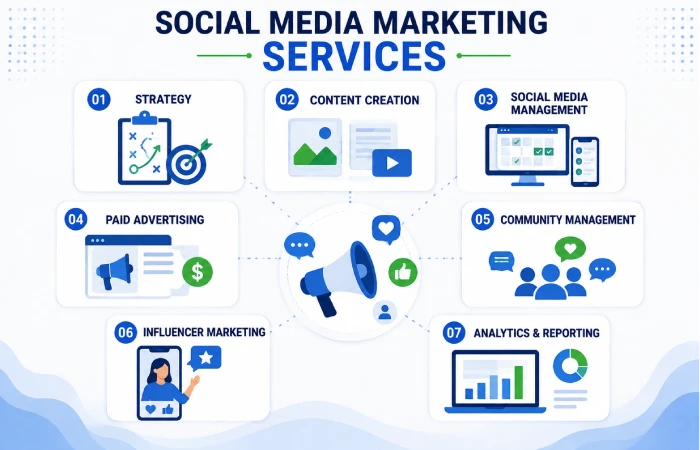
Thus social media marketing is a far broader topic than just posting. A reputable professional agency can deliver the entire spectrum of social media engagement including strategy, content, advertising and customer engagement.
The services you will require for your site will vary, depending on the particular nature of your business, its prospective users, and your goals.
Social Media Strategy Services
It is good to ensure that there is a social media plan in place before any content is published.
An agency may research:
- Target customers
- Competitors
- Industry trends
- Social media websites:
- Content topics
- Posting frequency
- Campaign goals
The strategy should answer simple questions:
Attempting to target the right audience:
- What sites do we use?
- What is it that we are publishing?
- What is it we are trying to get to?
For example, a B2B software company may focus their energy on LinkedIn while a fashion brand may see more on Instagram and TikTok.
The one advisable strategy with using social networks would be to not waste time on the wrong one.
Social Media Management Services
Social media management is the actual day-to-day work involved to run the business accounts.
This can include:
- – Posting and scheduling your posts.
- Publishing content
- Tabulating comments. I then recorded my comments on my father‘s tape recorder, transcribed them and printed them out. I left plenty of room for responses in the appendix in order to get as many responses as possible.
- Answering messages
- Monitoring mentions
- Updating profiles
- Content Calendar management Aids in keeping the information coming regularly. They allow you to schedule the materials, prepare content beforehand and spread publishing tasks over time, taking pressure off the creator.
A perfect complement to the services that may be catered to a company that wants to be present on the social networks but doesn‘t have the time to do everything by oneself.
Community Management
Community management differs slightly, in that it is more Conversation based with followers.
For example, a business may need someone to:
- Give answers to customer questions
- Good responses to complaints.
- Thank customers for compliments.
- Join relevant discussions
- Who else would know the best way to correct the problem?0446 High your manager. If it is a high priority problem repeat it to the right team in the company.
Being fast and responsive in communication will boost the customer experience.
Social Media Content Creation
Basically we can conclude from above that: Most of the social media campaigns focused on Content.
Agencies may create:
- Images
- Carousels
- Reels
- Short videos
- Stories
- Infographics
- Educational posts
- Promotional content
The contents, however, should differ for each platform.
In the same way, an in-depth industry guide may be a perfect one on LinkedIn while a quicker more visual approach to one product may achieve better as a TikTok or Instagram Reel.
Content Planning and Calendars
Spam itself can become repetitive quite quickly.
A social media agency may create a content calendar that organizes posts by:
- Date
- Platform
- Topic
- Content type
- Campaign
- Goal
A balanced calendar might have as many different types of posts as there are outlined below.
Educational Content
Examples:
- Tips
- Tutorials
- How-to videos
- Industry information
Promotional Content
Examples:
- Product launches
- Discounts
- Services
- Special offers
Engagement Content
Examples:
- Questions
- Polls
- Quizzes
- Customer stories
Brand Content
Examples:
- Team introductions
- Company updates
- Behind-the-scenes content
- Company achievements
Mixing in various content types helps keep the social feed from becoming an endless barrage of advertising.
Social Media Advertising Services
It is possible to grow an audience using the organic content alone but social paid advertising will push your product to a much larger and better targeted audience.
Social media advertising services may include:
- Facebook advertising
- Instagram advertising
- LinkedIn advertising
- TikTok advertising
- YouTube advertising
An agency oversees the whole campaign from set-up through to reporting.
Audience Targeting
Paid social platforms target users by using multiple signals in its delivery:
Depending on the platform, targeting may include:
- Location
- Age
- Interests
- Job roles
- Industry
- Visited on other sites.
- Customer lists
A more granular targeting helps a business to avoid expense money on adverts that are displaying in front of people is Unlikely to buy from them.
Retargeting
Retargeting this is when advertisements are shown to consumers who have already interacted with a company.
For example, someone might:
- Open a web-based account at.
- Take a look at the package.
- Downward trend: leave without purchase.
- Shortly afterwards, a commercial for the product will be shown.
Can makes fans attracted back the site.
Ad Creative and Testing
A social media advertising campaign may test different:
- Images
- Videos
- Headlines
- The calls to action. While calls to action are necessary to user experience, some did not work or were not valid.
- Audiences
- Landing pages
Our aim is to improve the combinations.
This is sometimes called A/B testing.
Influencer Marketing Services
Here is obviously the fans and followers on the social platform, so after the influencer marketing with the social platform.
A social media agency may help with:
- Finding the right influencers
- Verifying Audience quality
- Negotiating campaigns
- 5. Worked on the development of the Campaign briefs; this included developing clear task messages so that the designers could clearly understand exactly what the client required and how they could incorporate this to their designs.
- Handling sponsored segments: Unique issues related to speaking engagements, advertisements and product placement.
- Tracking performance
There isn‘t a desirable-peaks of maximum viewing market.
For most brands, it may be more advantageous to deliver to an account of a tiny creator with a vastly relevant audience.
Social Media Analytics and Reporting
Outputs, however, are only the measures of what organizations actually do.
Common social media metrics include:
- Reach
- Impressions
- Engagement
- Followers
- Video views
- Link clicks
- Leads
- Conversions
- Cost per result: the cost was calculated over the number of outcome templates that the ad was running in which was only within one ad
Why Analytics Matter
Suppose also, that a business gets 100,000 views of a video but two visits to the website that the video is associated with.
This post can get lot of reach but less of business value.
It is also possible for another post to result in only 10,000 views but bring in 50 qualified leads.
The analytics can thus be used to detect this discrepancy.
Social Media Marketing Service Comparison
| Service | Main Goal | Best For |
| Social Media Strategy | Lay out a clear direction. Show the way. | Emerging and growth organizations. |
| Social Media Management | Keep accounts alive For instance: sales,purchase Set up and keep them alive with accounts such as: – Make sure your account is as lively as possible, this could be by: – Promoting your website or business actively to the right market. – Utilizing local SEO to bring people in and around your town to you. | Busy businesses |
| Content Creation | Develop concrete, engaging content | Brands that require a steady amount of posting |
| Paid Social Advertising | Interpersonal targeting targeted audiences reach targeted audiences | However, if we decide to sell several items in the same campaign, only the campaigns we will you will be in the campaigns of the campaigns of the sales. |
| Community Management | Build customer relations | Customer-focused businesses |
| Influencer Marketing | Achieve new Publics | Regarding consumer and lifestyle brands |
| Analytics & Reporting | Measure results | Every business |
You do not need all of the many services to be up and running at all times. For example, an organization that has a content team internally but has no design group may only require management and analytics.
Choosing the Right Platform
The most important factor to find the more used network by the population and the most popular one is the market share. The other factor would be the population. So no matter what the population and the market share is, still the most used one by the population.
| Platform | Often Useful For |
| Participation of local business. Communities at a broad consumer level | |
| Can visually brands; offerings, lifestyle ventures | |
| B2B company and business to business professionals. | |
| TikTok | Short-form videos and audiences of young people |
| YouTube | Tutorials education reviews long short form video. |
| Homes: fashion and lifestyle products created through visual discovery |
These are just guidelines. Before making substantial investments on a platform a business should look to discover where most of its current customers are spending their time.
How Organic and Paid Social Work Together
The most effective campaigns employ a combination of organic and paid social media.
For example:
Organic post -> Audience engagement -> Paid promotion -> Visit to website -> Lead or sale.
Organic content can be great for testing ideas and reinforcing the brand, while effectively promoted paid advertising can get that successful content in front of many people.
This can also be integrated with other digital marketing activities:
The point is that these different types of service differ in their use. For example, SEO services provide visitors from search engines while social media services can be used to promote this content that receives these visitors. Similarly, PPC management services have their roles in paid social campaigns as well to reach the customers in different advertising channels.
How to Choose Social Media Marketing Services
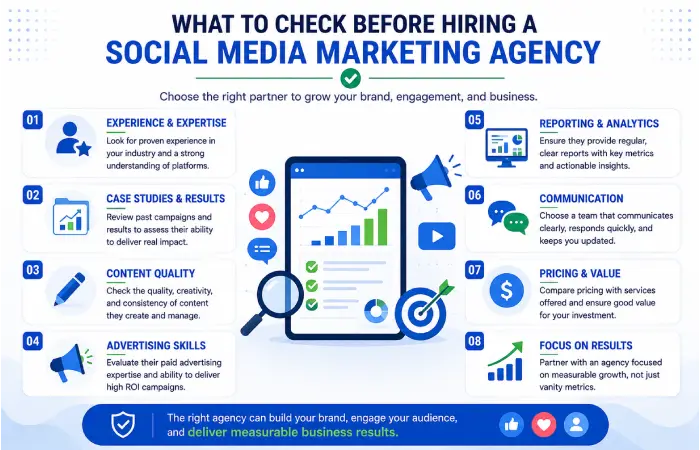
Selection of the appropriate social media marketing services begins with a clear understanding of what the business truly needs. It isn‘t essential to engage an agency to handle all avenues of social media marketing or all kinds of content.
Choose the right service for your audience, your goals, your budget, and your resources.
Check the Agency’s Experience
Seek an agency that has certain experience with a business of your type.
For instance, the different types of business to business software provider will require a very different kind of social media from a restaurant or clothing brand.
Ask about:
- Previous clients
- Industries they work with
- Campaign examples
- Content they have produced.
- Advertising experience
- Results they have achieved
It‘s helpful if an agency has experience in your industry, but a good agency will be able to tell you how they‘d go about creating a strategy for your business.
Ask for Case Studies
A good case study should not also be just “a bank of pretty Tweets”.
Look for details such as:
- The initial target of the client.
- The approach required, 4.1: , matches the requirements . For three doses it uses 1 dose, 2 doses, and 3 doses, respectively. It is not clear if F2 could be used as many times as needed, namely if the F2 condition makes it go on continually.
- Platforms selected
- Content created
- Advertising campaigns
- Time period
- Traffic or lead growth.
- Sales or conversion results
Follower growth is helpful but it‘s not to say it should be the only measure of success.
A business with 5,000 relevant followers may outperform a business with 100,000 irrelevant followers.
Make Sure the Services Are Clear
Ascertain what is included before you appoint any agency.
Ask whether the package covers:
- Strategy
- Content creation
- Graphic design
- Video creation
- Posting and scheduling.
- Community management
- Paid advertising
- Influencer campaigns
- Analytics
- Monthly reporting
Also made sense of how many platforms are there.
A package covering two platforms may not be directly comparable to one covering 6.
How Much Do Social Media Marketing Services Cost?
Social media marketing has no set price.
Costs can vary based on:
- [In] number of platforms (number of users), which I get the big picture of the original data with the user‘s eyetracking.
- Both were asked how many posts they had made.
- Video requirements
- Content quality
- Community management
- Advertising campaigns
- Influencer work
- Agency experience
A minor local business might just need a basic package. A larger business might want the whole social media team.
I think it‘s equally important to differentiate agency fees from advertising spend.
For example an agency might charge a monthly management fee, and the funding for your Facebook, Instagram, LinkedIn or TikTok marketing budget is paid directly to the platform.
Always ask for a clear breakdown of how the deal works before you enter into any contract.
How Long Does Social Media Marketing Take?
It has no dedicated time frame in social media marketing.
It is not possible to say. And it depends on the task you’d like accomplished.
Brand Awareness
Recognition building requires content, or presence, over a period of time.
Organic Growth
Solely through organic traffic building it can take months to build even a small-sized audience, depending on the site/marketplace/other platform being used, type of content created, specialization of the target audience and amount of competition.
Paid Advertising
After all, how fast can paid campaigns bring in traffic, leads or sales? Depending on targeting, creative quality and offer (and of course budget), the right landing-page experience can bring results even faster.
Watch out for any promises of a certain amount of followers, sales, “viral” posts, etc. in a set period of time.
Common Social Media Marketing Mistakes
Posting Without a Strategy
If someone posts as they have time, the content may come across as inconsistent and the message may become unclear.
A content calendar helps to stay organized in the campaign.
Using Every Platform
Companies do not have to have worldwide presence
Generally, it makes more sense to do two or three well than seven or eight poorly.
Begin at the point of greatest customer activity.
Buying Followers
While purchasing followers may appear to increase your overall follower count, these type of followers typically do not have any genuine business value.
Typically, a lesser, more applicable grouphas actually more value.
Posting Only Promotional Content
Business accounts are not followed simply because of advertising.
A good content mix can include:
- Educational posts
- Tips
- Product information
- Customer stories
- Entertainment
- Behind-the-scenes content
- Promotions
Ignoring Comments and Messages
Social media, in essence, is a conversation.65
Neglecting inquiries or issues can give the customer a bad impression.
Community management should be therefore part of the strategy when the business become interactive.
Measuring Vanity Metrics
Likes and followers may seem nice, but they don‘t necessarily indicate success in the business.
Important metrics may include:
- Website visits
- Leads
- Sales
- Conversion rate
- Lead Costs
- Cost per acquisition The relative amount of money you spend to attract and convert a potential customer.
- Revenue
Choose the right metrics: it is important to define the campaign goal0.
Is Social Media Marketing /.Worth It?
Yes, for many companies, no.
– Social media can help a business to create awareness, engage customers, market offerings, generate leads and support sales.
But its all about ‘how to’.
It is important that a business does not spend its money on social media, just because others are doing so.
Before investing, ask:
Target audience: whom are we addressing?
What do we want them to do?
Which is the best opportunity to engaging them?
How are we going to measure the outcome?
These questions can also save time and money wasted.
Frequently Asked Questions
What do social media marketing services do?
There are services that help your business develop a social media marketing strategy, generate content, publish it, promote your content, and measure results on social media. These services may also consist of: social media strategy development, content creation, account management, social media advertising, influencer marketing, community management, social media analytics.
What is a social media marketing agency supposed to do?
Over seeing a campaign, utilizing a social media agency may include: a strategy, managing of social accounts, creation of content, running paid campaigns, engaging with users, collaborating with influencers and measuring against the campaign goals.
The expense of social media marketing services is:
Cost of the price of the game – based on platform numbers, content quantity, videos needed, advertising work, community management, influencer campaigns, agency experience. The advertising spend is usually not included in the agency fees.
Which social media platform is best for business?
There is no single best platform. LinkedIn can work well for B2B businesses, Instagram for visual brands, Facebook for broad consumer audiences, TikTok for short-form video, and YouTube for video-focused businesses. The right choice depends on where your target audience spends time.
Is social media marketing worth it for small businesses?
Yes. Small businesses can use social media to build awareness, communicate with customers, promote products, and generate leads. A focused strategy is usually more useful than trying to maintain every social platform.
How long does social media marketing take to work?
Results vary. Paid campaigns may generate traffic quickly, while organic audience growth and brand awareness usually require consistent work over a longer period.
What is the difference between social media marketing and social media management?
Social media management focuses mainly on running and maintaining social accounts, including posting, scheduling, and responding to users. Social media marketing is broader and can include strategy, advertising, content creation, influencer campaigns, and performance analysis.
Conclusion
Social media marketing services can help businesses turn social platforms into useful marketing channels instead of treating them as places to post occasional updates.
The right strategy depends on the business. Some companies may need content creation and account management, while others may get more value from paid advertising, influencer campaigns, or lead-generation strategies.
Before hiring an agency, look at its experience, case studies, services, reporting, communication, and pricing. Make sure you understand what you’re paying for and whether advertising costs are included.
Most importantly, measure social media by business results rather than follower counts alone.
A successful campaign should help the business reach the right people, build relationships, and move those people closer to becoming customers.
Digital Marketing Agency Services Resource Hub
Learn everything about digital marketing agency services, including SEO, social media marketing, PPC management, content marketing, email marketing, local marketing, and strategies for growing your business online.