


Table of Contents
Introduction
Choosing the right cloud service provider is a critical step for businesses adopting cloud computing. Whether you’re migrating applications, developing cloud-native software, modernizing IT infrastructure, or deploying artificial intelligence (AI) solutions, the provider you select directly impacts performance, scalability, security, and long-term costs.
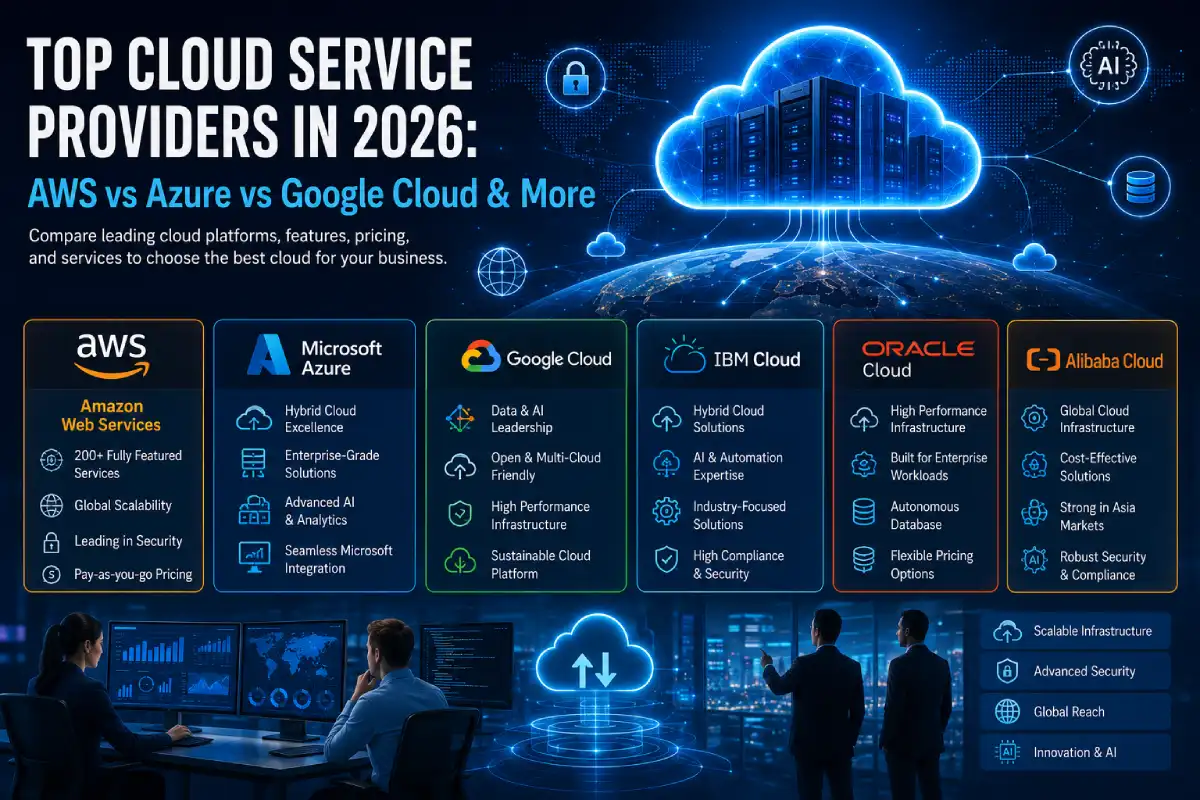
The global cloud market is led by Amazon Web Services (AWS), Microsoft Azure, and Google Cloud Platform (GCP). Other providers, including IBM Cloud, Oracle Cloud Infrastructure (OCI), and Alibaba Cloud, deliver specialized solutions for enterprise workloads, hybrid cloud environments, and regional markets.
This guide compares the leading cloud service providers, explains their strengths, highlights key differences, and helps you determine which platform best matches your business needs.
TECH HUB
This Article Is Part of the Future Tech Trends Hub
Explore AI trends, future innovations, next-generation computing, smart technologies, digital transformation, automation, robotics, emerging devices, and technology predictions shaping tomorrow inside our
Future Tech Trends Hub.
What Are Cloud Service Providers?
Cloud service providers (CSPs) are companies that deliver computing resources and services over the internet. Instead of purchasing servers, storage devices, and networking equipment, organizations rent these resources on demand.
Common cloud services include:
- Virtual machines
- Cloud storage
- Managed databases
- Networking services
- Artificial intelligence and machine learning
- Security and identity management
- Application hosting
- Backup and disaster recovery
- Developer and DevOps tools
Most providers use a pay-as-you-go pricing model, allowing businesses to pay only for the resources they consume.
Why Choosing the Right Provider Matters
Although major cloud providers offer similar core capabilities, each platform differs in pricing, integrations, security features, and enterprise services.
Selecting the right provider helps businesses:
- Scale infrastructure efficiently
- Reduce operational costs
- Improve application performance
- Strengthen security and compliance
- Accelerate software development
- Support global expansion
- Simplify IT management
Choosing a provider that aligns with your existing technology stack and long-term strategy can also reduce future migration costs.
Key Factors to Consider
Before selecting a cloud platform, compare providers based on the following criteria.
Service Portfolio
A comprehensive cloud platform should provide:
- Compute services
- Storage solutions
- Databases
- Networking
- AI and machine learning
- Analytics
- Security tools
- DevOps and automation services
A broader portfolio allows organizations to manage more workloads within a single ecosystem.
Scalability
Cloud infrastructure should scale as your business grows.
Look for features such as:
- Automatic resource scaling
- Global load balancing
- Flexible storage options
- High-performance computing
Scalable infrastructure ensures applications remain responsive during periods of high demand.
Security
Leading providers invest heavily in security.
Important features include:
- Data encryption
- Identity and Access Management (IAM)
- Multi-factor authentication
- Threat detection
- Backup and disaster recovery
- Compliance certifications
Organizations operating in regulated industries should also verify that the provider meets relevant compliance standards.
Global Infrastructure
The number of regions and data centers influences application performance and availability.
Evaluate providers based on:
- Geographic regions
- Availability zones
- Content delivery networks (CDNs)
- Edge locations
A strong global presence helps reduce latency and improve disaster recovery.
Pricing
Every provider uses consumption-based pricing, but billing models vary.
Common options include:
- Pay-as-you-go
- Reserved capacity
- Savings plans
- Enterprise agreements
Understanding pricing structures helps optimize cloud spending over time.
Leading Cloud Service Providers
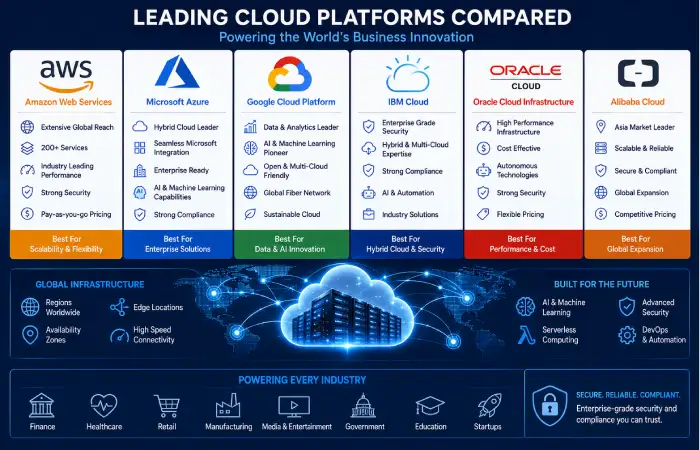
The following providers dominate the cloud computing industry:
Amazon Web Services (AWS)
AWS is the world’s largest cloud platform, offering hundreds of services across computing, storage, databases, networking, AI, analytics, and security.
Best Features
- Largest cloud ecosystem
- Extensive global infrastructure
- Excellent scalability
- Mature developer platform
- Advanced AI and machine learning services
Ideal For
- Startups
- Enterprises
- SaaS companies
- High-performance workloads
- AI and analytics projects
Microsoft Azure
Microsoft Azure is a leading enterprise cloud platform with strong integration across Microsoft’s ecosystem.
Its hybrid cloud capabilities make it a popular choice for organizations modernizing existing IT infrastructure.
Best Features
- Hybrid cloud support
- Microsoft 365 integration
- Enterprise-grade security
- Global infrastructure
- Identity management
Ideal For
- Enterprise IT
- Windows environments
- Government
- Healthcare
- Financial services
Google Cloud Platform (GCP)
Google Cloud is recognized for its strengths in artificial intelligence, analytics, Kubernetes, and cloud-native application development.
Best Features
- Vertex AI
- BigQuery analytics
- Kubernetes leadership
- High-performance networking
- Flexible pricing
Ideal For
- AI applications
- Data analytics
- Software development
- Containerized workloads
- Research organizations
IBM Cloud
IBM Cloud focuses on hybrid cloud, enterprise consulting, and regulated industries.
Best Features
- Red Hat OpenShift integration
- Enterprise consulting
- Hybrid cloud solutions
- Industry compliance
- Watson AI services
Ideal For
- Banking
- Healthcare
- Government
- Large enterprises
Oracle Cloud Infrastructure (OCI)
OCI is designed for organizations running Oracle databases and enterprise applications.
Best Features
- High-performance infrastructure
- Oracle database optimization
- Enterprise security
- Competitive enterprise pricing
Ideal For
- Oracle ERP
- Enterprise databases
- Manufacturing
- Financial institutions
Alibaba Cloud
Alibaba Cloud is the largest cloud provider in the Asia-Pacific region.
Best Features
- Strong regional infrastructure
- Competitive pricing
- E-commerce expertise
- Regional compliance support
Ideal For
- Asia-Pacific businesses
- Regional e-commerce
- Digital platforms
- Cloud-native applications
Quick Provider Comparison
| Provider | Best Strength | Best For |
| AWS | Largest cloud ecosystem | Enterprises and startups |
| Microsoft Azure | Hybrid cloud | Microsoft-based businesses |
| Google Cloud | AI and analytics | Developers and data teams |
| IBM Cloud | Compliance | Regulated industries |
| Oracle Cloud | Database performance | Oracle workloads |
| Alibaba Cloud | Asia-Pacific infrastructure | Regional expansion |
Each provider delivers Infrastructure as a Service (IaaS), Platform as a Service (PaaS), and a growing portfolio of AI-powered services. However, their ecosystems, pricing models, and specialization differ significantly.
In the next section, we’ll compare AWS, Azure, and Google Cloud in greater detail, examine pricing, security, AI capabilities, and business use cases, and help you identify the right cloud platform for your organization’s needs.
AWS vs Azure vs Google Cloud: A Detailed Comparison
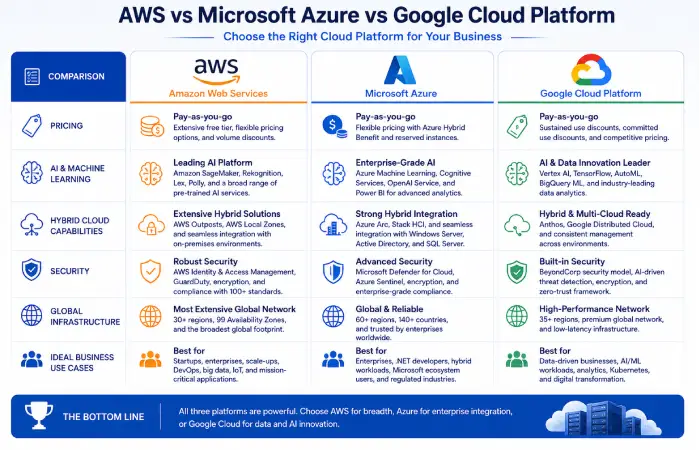
The majority of businesses evaluating cloud service providers compare three platforms first: Amazon Web Services (AWS), Microsoft Azure, and Google Cloud Platform (GCP). Together, they dominate the global cloud market and provide comprehensive solutions for infrastructure, application development, artificial intelligence, analytics, and enterprise computing.
While all three providers offer similar core services, each platform has distinct advantages depending on your business goals, technical expertise, and existing technology ecosystem.
Feature Comparison
The table below provides a quick comparison of the three leading cloud providers.
| Feature | AWS | Microsoft Azure | Google Cloud |
| Global Infrastructure | ⭐⭐⭐⭐⭐ | ⭐⭐⭐⭐⭐ | ⭐⭐⭐⭐☆ |
| Service Portfolio | ⭐⭐⭐⭐⭐ | ⭐⭐⭐⭐☆ | ⭐⭐⭐⭐☆ |
| Hybrid Cloud | ⭐⭐⭐⭐☆ | ⭐⭐⭐⭐⭐ | ⭐⭐⭐⭐☆ |
| AI & Machine Learning | ⭐⭐⭐⭐☆ | ⭐⭐⭐⭐☆ | ⭐⭐⭐⭐⭐ |
| Kubernetes Support | ⭐⭐⭐⭐☆ | ⭐⭐⭐⭐☆ | ⭐⭐⭐⭐⭐ |
| Enterprise Integration | ⭐⭐⭐⭐☆ | ⭐⭐⭐⭐⭐ | ⭐⭐⭐⭐☆ |
| Developer Experience | ⭐⭐⭐⭐⭐ | ⭐⭐⭐⭐☆ | ⭐⭐⭐⭐⭐ |
Although all three platforms are enterprise-ready, their strengths differ depending on the workload.
Pricing Comparison
Cloud pricing can significantly influence long-term operating costs. All major providers use usage-based billing, but they also offer discounts for long-term commitments.
| Pricing Model | AWS | Azure | Google Cloud |
| Pay-as-you-go | ✅ | ✅ | ✅ |
| Reserved Capacity | ✅ | ✅ | ✅ |
| Long-Term Discounts | ✅ | ✅ | ✅ |
| Free Tier | ✅ | ✅ | ✅ |
| Enterprise Agreements | ✅ | ✅ | Limited |
When comparing costs, don’t focus only on compute pricing. Consider:
- Storage costs
- Data transfer fees
- Database pricing
- Support plans
- Licensing costs
- Managed service charges
Using cloud pricing calculators before deployment can help estimate monthly expenses more accurately.
Artificial Intelligence and Machine Learning
AI has become a key factor when selecting a cloud provider.
Amazon Web Services
AWS offers an extensive AI ecosystem that includes services for:
- Machine learning model development
- Generative AI
- Image recognition
- Speech processing
- Natural language processing
Its broad range of AI services makes it suitable for organizations building intelligent applications across multiple industries.
Microsoft Azure
Azure provides enterprise-focused AI capabilities integrated with Microsoft’s cloud ecosystem.
Key strengths include:
- AI development platforms
- Enterprise automation
- Speech and vision services
- AI-powered business applications
Organizations already using Microsoft technologies often benefit from seamless AI integration.
Google Cloud Platform
Google Cloud is widely regarded as a leader in AI and data analytics.
Its platform excels in:
- Large-scale data processing
- Machine learning
- AI model deployment
- Natural language processing
- Cloud-native AI development
Google Cloud is particularly attractive for organizations building analytics and AI-driven products.
Security and Compliance
Security remains one of the most important considerations when choosing a cloud provider.
Leading providers offer:
- Identity and Access Management (IAM)
- Encryption at rest and in transit
- Multi-factor authentication
- Threat detection
- Security monitoring
- Backup and disaster recovery
- Compliance certifications
Each provider follows a shared responsibility model, where the provider secures the cloud infrastructure while customers are responsible for protecting their applications, user access, and data.
Global Infrastructure
A provider’s global network affects performance, reliability, and business continuity.
Large cloud providers operate multiple:
- Geographic regions
- Availability zones
- Edge locations
- Content delivery networks
A broader infrastructure helps reduce latency and supports disaster recovery by allowing workloads to run in multiple locations.
AWS and Azure currently maintain some of the largest global infrastructures, while Google Cloud continues to expand its worldwide footprint.
Which Cloud Provider Fits Your Business?
Different organizations prioritize different cloud capabilities.
Startups
Recommended providers:
- AWS
- Google Cloud
Why?
- Flexible pricing
- Startup support programs
- Fast deployment
- Easy scalability
Small and Medium-Sized Businesses
Recommended providers:
- Microsoft Azure
- Google Cloud
Why?
- Simpler management
- Productivity integrations
- AI capabilities
- Predictable pricing
Large Enterprises
Recommended providers:
- AWS
- Microsoft Azure
Why?
- Enterprise security
- Hybrid cloud capabilities
- Global infrastructure
- Extensive compliance support
Software Development Teams
Recommended providers:
- Google Cloud
- AWS
Why?
- Kubernetes support
- DevOps tools
- Serverless computing
- AI-assisted development
Database-Centric Organizations
Recommended provider:
- Oracle Cloud Infrastructure
Why?
- Optimized Oracle databases
- Enterprise performance
- Reliable infrastructure
Single-Cloud vs Multi-Cloud
Organizations increasingly choose between single-cloud and multi-cloud strategies.
Single-Cloud Strategy
Benefits include:
- Easier management
- Simpler billing
- Consistent security policies
- Reduced operational complexity
Potential limitation:
- Greater dependence on one provider.
Multi-Cloud Strategy
A multi-cloud approach uses two or more cloud providers for different workloads.
Benefits include:
- Reduced vendor lock-in
- Improved business continuity
- Better workload optimization
- Greater flexibility
Challenges include:
- More complex management
- Additional governance
- Increased operational overhead
Many enterprises combine AWS, Azure, and Google Cloud to take advantage of each platform’s strengths.
Future Trends in Cloud Computing
Cloud providers continue expanding beyond traditional infrastructure services.
Key trends shaping the market include:
- Generative AI integrated into cloud platforms
- Serverless computing for simplified application deployment
- Edge computing to reduce latency for real-time applications
- Industry-specific cloud solutions for healthcare, finance, retail, and government
- Sustainable cloud infrastructure powered by renewable energy and energy-efficient data centers
These innovations are making cloud platforms more intelligent, efficient, and adaptable to modern business requirements.
Key Decision Matrix
| Business Requirement | Recommended Provider |
| Broadest service portfolio | AWS |
| Microsoft ecosystem | Microsoft Azure |
| AI and analytics | Google Cloud |
| Hybrid cloud | Microsoft Azure |
| Enterprise databases | Oracle Cloud Infrastructure |
| Regulated industries | IBM Cloud |
| Asia-Pacific operations | Alibaba Cloud |
Rather than selecting a provider based solely on market share, evaluate how well it aligns with your applications, existing infrastructure, compliance needs, and long-term growth plans.
The final section includes frequently asked questions, a conclusion, FAQ schema markup, image prompts, internal linking recommendations, and an SEO checklist to prepare this article for publication.
Frequently Asked Questions
What is a cloud service provider?
A cloud service provider (CSP) is a company that delivers computing resources such as virtual machines, storage, databases, networking, security, and AI services over the internet. Instead of purchasing and maintaining physical infrastructure, businesses can access these resources on demand and pay only for what they use.
Which are the top cloud service providers in 2026?
The leading cloud service providers include:
- Amazon Web Services (AWS)
- Microsoft Azure
- Google Cloud Platform (GCP)
- IBM Cloud
- Oracle Cloud Infrastructure (OCI)
- Alibaba Cloud
Each provider serves different business needs, ranging from startups and developers to large enterprises and government organizations.
Which cloud provider is best for beginners?
There isn’t a single best option for everyone.
- Google Cloud Platform is often preferred by developers because of its intuitive interface and strong data analytics tools.
- Microsoft Azure is a good choice for organizations already using Microsoft products.
- AWS offers the largest service portfolio but has a steeper learning curve due to its extensive feature set.
The best provider depends on your technical experience and business requirements.
AWS vs Azure vs Google Cloud: Which one should I choose?
Choose a provider based on your workload rather than market popularity.
- Choose AWS if you need the broadest range of cloud services and global infrastructure.
- Choose Microsoft Azure if your organization relies heavily on Microsoft products or requires hybrid cloud deployments.
- Choose Google Cloud if your focus is AI, machine learning, analytics, Kubernetes, or cloud-native applications.
Each platform can support enterprise-scale workloads when implemented correctly.
Which cloud provider offers the best AI services?
All three major providers have invested heavily in artificial intelligence.
- Google Cloud is recognized for advanced AI research, analytics, and machine learning.
- AWS provides one of the largest AI service portfolios, including generative AI and machine learning tools.
Conclusion
Choosing among today’s cloud service providers requires more than comparing market share or pricing. Organizations should evaluate each platform based on workload requirements, scalability, security, compliance, AI capabilities, and long-term business objectives.
Amazon Web Services (AWS) remains the most comprehensive cloud platform, offering the largest portfolio of services and one of the broadest global infrastructures. Microsoft Azure is a leading choice for enterprises that rely on Microsoft technologies or require hybrid cloud deployments. Google Cloud Platform stands out for artificial intelligence, analytics, Kubernetes, and cloud-native application development. At the same time, IBM Cloud, Oracle Cloud Infrastructure, and Alibaba Cloud provide specialized solutions for regulated industries, enterprise databases, and regional markets.
As cloud adoption continues to grow, many organizations are implementing multi-cloud and hybrid cloud strategies to improve resilience, optimize workloads, and reduce vendor lock-in. Selecting a provider that aligns with your existing technology stack, budget, compliance requirements, and future growth plans will help maximize the value of your cloud investment.
Rather than searching for the single “best” cloud provider, focus on finding the platform that best supports your business goals and technical requirements.
Cloud Computing Services Hub
Discover cloud computing services, deployment models, cloud providers, storage solutions, security services, migration strategies, and managed cloud solutions for businesses and individuals.