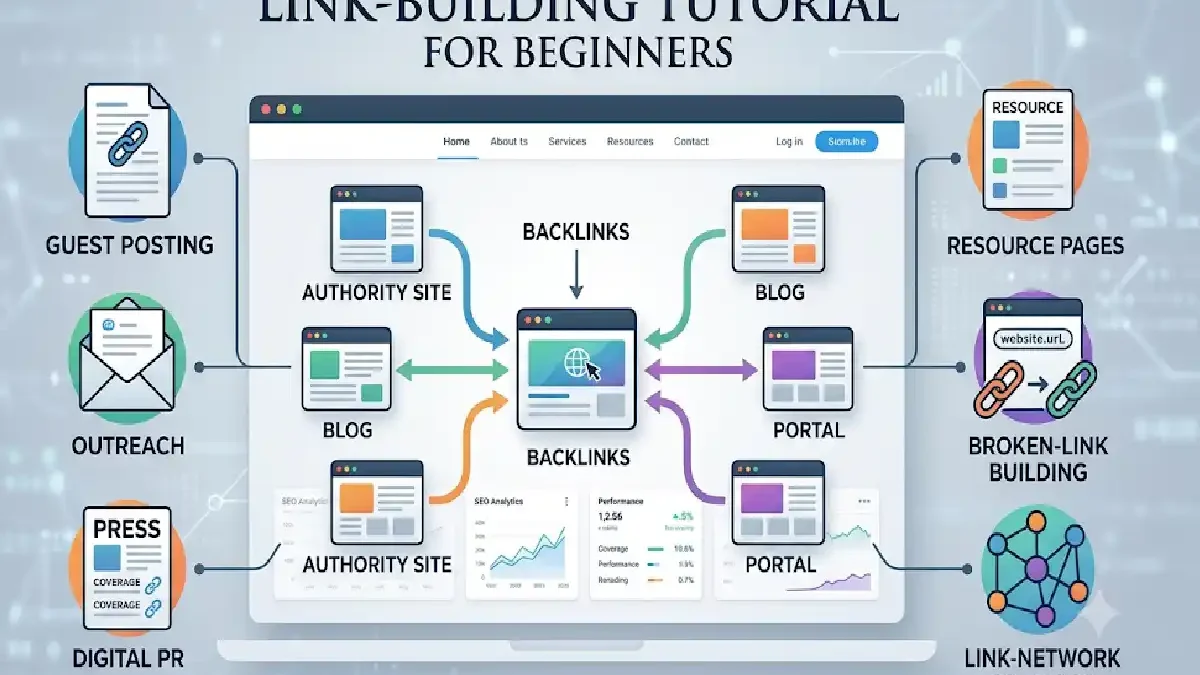

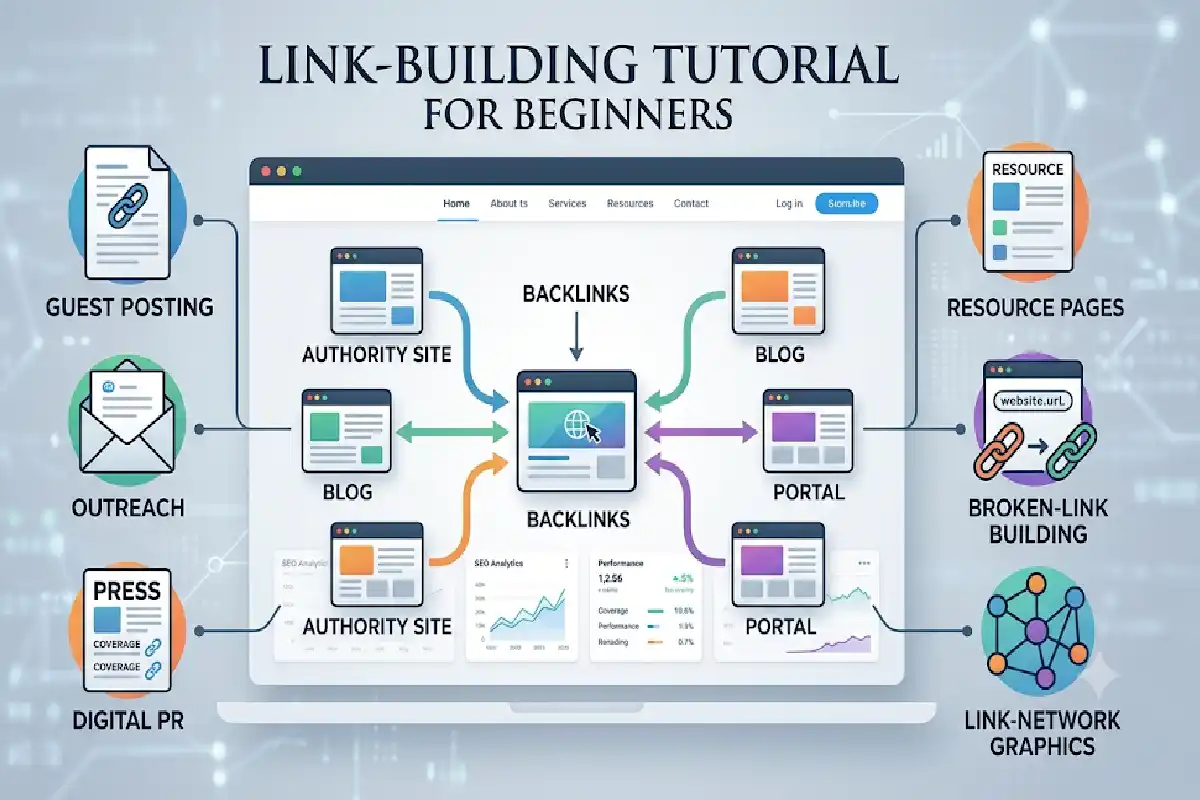


Link building is a fundamental aspect of SEO, yet it is also an area where beginners are frequently misunderstood.
You may hear that you need hundreds, even thousands, of backlinks to achieve top ranking. That is not a helpful frame of reference when building links.
A more effective way is to comprehend the purpose of links, value and importance of links, how to obtain relevant links, and the kind of link building that might prove problematic.
In this link building tutorial, you will cover the basics including backlinks, link quality, relevance, guest posting, digital PR, resource-page links, broken-link building, anchor text and mistake.
Table of Contents
What Is Link Building?
Link building refers to obtaining links from other websites to your own website.
A backlink, or inbound link is a hyperlink that points to your website from another website.
An example of this would be, a technology website writing a post on SEO, and providing a link back to your SEO guide as an informative resource.
That hyperlink on the external site links back to your site.
Links can have many benefits; they can be used for discoverability of content, to drive referral traffic and to provide search engines with further context about the relationship between pages and web sites.
However, not all backlinks are made equal.
A well-chosen, naturally linking text is more valuable than many non-relevant or high-quality links.
Why Are Backlinks Important for SEO?
There are various ways a search engine uses links; finding pages and making sense of relationships between them.
Links also work as an indicator that one web page believes the other web page is useful or relevant.
Although, simply having a backlink will not automatically achieve the desired rankings.
However there are many other factors that search engines evaluate; these can be divided into content related (relevance, quality) and technical related (accessibility) along with user‘s intentions (which is where search terms are analyzed).
The goal of link building should be about acquiring valuable and relevant mentions, not a mere increase in backlink numbers.
A Simple Example
Assume that you produce a comprehensive guide of how to buy a laptop.
A tech publication publishes a helpful guide on selecting a laptop and links naturally to your guide as a source.
This backlink shows strong thematic relatedness.
Now compare this with a random site about some other unrelated topic that produces a terrible quality page with a dozen totally random links.
From the viewpoint of relevance and audience, the first link is far more valuable.
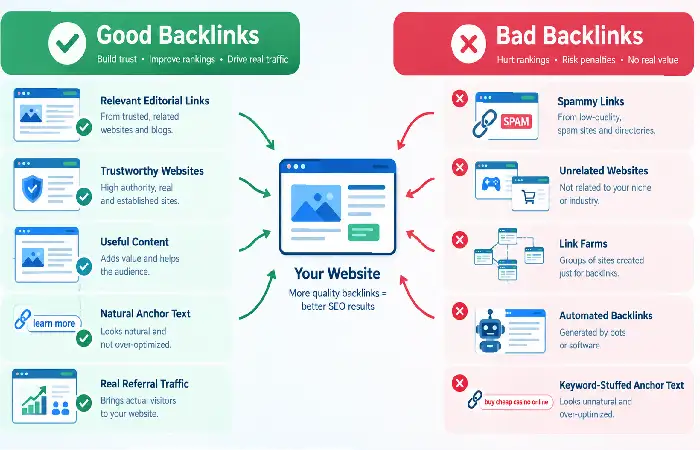
What Makes a Good Backlink?
Don‘t just focus on the metrics of the entire website when assessing a backlink.
Important considerations include:
Relevance
The site or page linking to you should make some kind of sense in terms of the subject matter.
An appropriate link is more understandable for the users and the search engines.
Editorial Context
Natural links are naturally part of a beneficial site and are typically worth more than links that are created to artificially increase search engine rankings.
Website Quality
Observe whether the linking website contains valuable information, possesses a true readership, and demonstrates a legitimate reason for being online.
Don’t get caught up in one particular SEO factor when it comes to rating a website.
Potential Referral Traffic
A quality backlink may even send real traffic.
Even if SEO is not your primary concern, a link that attracts the right audience to your website may have value.
Natural Placement
It should fit logically in the place.
The contextual matter should give support to the surrounding, not to have it only as a place for a hyperlink back.
Relevance Matters More Than Link Quantity
One of the most common mistakes novice website builders make, in an attempt to boost their search engine rankings, is to think that more links are better.
It‘s not how you do that.
Imagine you have:
10 highly relevant links from useful websites
versus:
500 unrelated links from low-quality pages
The former profile could potentially be of much greater use.
The website itself needs to attract links, in that the content is good enough to link to.
Different Types of Links
It will be simple to do the link building if you know the various kind of link building.
Internal Links
Links between pages on the same website.
For example, this article can link to our:
Internal links allow people to navigate from one page on your site to another relevant page. They can also give search engines a greater understanding of your website‘s structure.
External Links
Links to another website from your own web page are external links.
Such things can be helpful to you when you would like to refer to something official or additional
Backlinks
A backlink goes from a website to your website.
These are what most people are referring to when talking about link building.
How to Build Backlinks
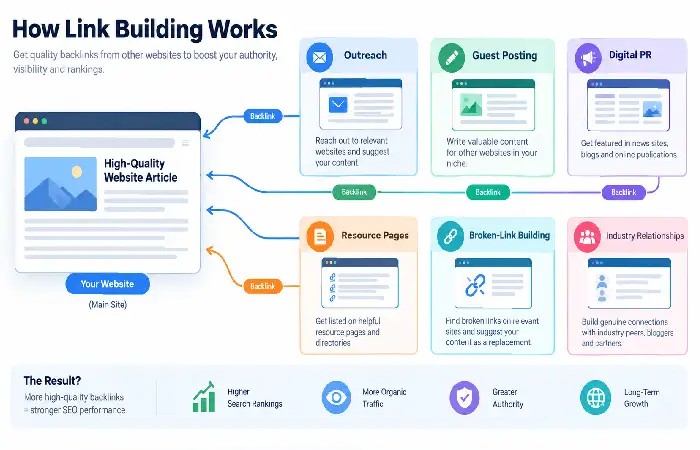
Backlinks can be earned by so many methods, however the best way, the safest way, involves good content and real connections.
Here are some practical methods.
Create Link-Worthy Content
A link is simplest to grasp where another site is intending to link.
Examples include:
- Original research
- Detailed tutorials
- Industry statistics
- Useful tools
- Original data
- Comprehensive guides
- Checklists
- Case studies
- Free resources
Well-written on SEO checklist, could likely to gain links from the bloggers writing about SEO.
Content must give someone a real reason to cite this content.
Guest Posting
Guest posting means writing helpful content for other web sites.
Where possible the article will link back to your website.
The most vital element is the quality of the contribution.
Good guest posting means:
- Choosing relevant websites
- Writing original content
- Providing useful information
- Following the publication’s guidelines
- Using links naturally
It is when the intention of guest posting is merely to obtain a large number of artificial back-links that it can prove controversial.
Don‘t just publish the same poor quality article on many different websites in an effort to get links.
Digital PR
Through digital PR, sites can achieve mentions and links from the media, journalists, bloggers and industry sites.
Possible tactics include:
- Publishing original research
- Sharing expert commentary
- Creating useful reports
- Responding to relevant media requests
- Providing original data
- Producing newsworthy resources
Digital PR really shines when there‘s actually something you want to tell people.
Resource-Page Links
There are also some web pages which list resources which can provide useful help, information, or education
If you have a useful resource that‘s highly relevant to the site you can inform the owner of the site/editor and propose it to them.
Your resource should be one that adds value.
Don‘t spam hundreds of websites with exactly the same message, without first confirming that you are being shown in a context that‘s actually relevant.
Broken-Link Building
The waybroken-link building works is that you find a broken link on another website and offer to submit something related.
For example:
The website is listing resources that are relevant to SEO on a particular page.
It has a broken outbound link
That would be a useful source to consult, and covers the same material.
You could inform the owner about the broken link and provide a reference to your own page.
This works well when the resource you‘re using is the same, or better than the missing page.
Build Relationships in Your Industry
You don‘t have to have an enormous outreach effort every time.
A writer relationship, business relationship, community relationship, publisher relationship or relationship with industry professionals can lead to mentions.
Being a member of your industry and providing valuable information may lead people to find you.
Effort should be made on acquiring credibility rather than accumulation of links.
Anchor Text Best Practices
Anchor text is the text in a hyperlink.
For example:
Read our technical SEO tutorial.
In this context, “technical SEO tutorial” is the anchor text.
Decent anchor text should let a user know what is they are going to get if they click.
Useful examples include:
- technical SEO tutorial
- keyword research guide
- SEO basics for beginners
Don‘t try to shove the same exact match keyword into every backlink.
There can be many varieties of anchor text in a natural backlink profile.
Common Anchor Text Types
Branded
Uses the name of the company or a website.
Example:
TechiesExpress
Exact Match
Uses the exact target keyword.
Example:
link-building tutorial
Partial Match
Part of what you are looking for.
Example:
beginner’s guide to link building
Naked URL
Uses the URL itself.
Example:
https://example.com
Generic
Uses general text.
Example:
learn more
You don‘t have to be able to control every anchor text that links to your website.
It is a natural part of variation.
Link Building Outreach
This means that you‘re reaching out to website owners, editors, journalists, or publishers to inform them of your content.
A simple outreach email should be:
- Relevant
- Short
- Personal
- Specific
- Focused on the recipient’s audience
Review the target‘s website before you reach out. Make sure your content is relevant.
A Simple Outreach Process
1: Find a relevant website.
2: Identify a useful page or opportunity.
3: Create or identify a resource that adds value.
4: Contact the right person.
5: Explain the connection briefly.
6: Let them decide whether the resource is useful.
Don‘t send a blanket, mass email that has nothing to do with the website.
Link Building for New Websites
New sites very frequently have very few, if any, backlinks
This is quite common.
Don‘t rush into trying to build dozens of links straight away, focus on developing some pages that are genuinely helpful and will therefore gain references.
A simple process is:
Create useful content → Promote it → Build relationships → Earn relevant mentions → Continue publishing
Alternatively you can begin with partnerships, appropriate trade publications, resource pages, expert pieces, and digital PR opportunities.
Quality and relevance should guide the process.
Link-Building Methods to Avoid
There is a very wide range of link building strategies available to people, but by no means all are safe and effective.
Steer clear of tactics that are developed with the goal of manipulating search positions.
Buying Links for Rankings
Links that you only bought to have a rank credit might violate spam rules of the search engines.
Be especially cautious of sites selling big bulk packages of links.
Link Farms
Link farms (sometimes called link farms) are sets of websites or pages that exist solely to create links.
Seldom provide actual worth.
Automated Link Building
Automated systems for the production of large numbers of links often result in an unnatural profile and the generation of poor quality pages.
Stay away from any tools offering thousands of backlinks overnight.
Spammy Comments
Posting on unrelated blog comments, forums or communities just to get back-links isn‘t going to be useful for too long.
Engage fully and add links only if the addition is actually relevant.
Private Blog Networks
Networks of sites designed primarily to influence search results pose serious risks.
A good SEO plan should not rely on false link farms.
How to Check Your Backlinks
Using SEO tools, you can analyze your site backlink profile.
Popular tools include:
- Google Search Console
- Ahrefs
- Semrush
- Moz
- Majestic
These tools can help you identify:
- Linking websites
- Referring pages
- Anchor text
- New backlinks
- Lost backlinks
- Potentially suspicious patterns
Don‘t freak out at each unknown backlink.
There is no need to do anything about low quality links.
Concentrate on significant patterns and relationships, which are the source of potential difficulties.
Internal Linking vs Link Building
Confused frequently by laypersons.
This involves linking to other sites on your own site.
Typically link building means obtaining other web sites to link to your own.
They both help in SEO.
For example, you can build a strong internal structure like:
SEO Tutorials → Keyword Research → On-Page SEO → Technical SEO → Link Building
This is to allow users to transition between guides where it would be sensible to do so.
For more information, see our Search Engine Optimization Tutorials pillar page.
Simple Link-Building Strategy for Beginners
When you start off, it‘s fine to have a basic campaign
Follow this process:
Step 1: Create Useful Content
Create pages that answer the questions that people want to refer to or provide resources that people actually want to find.
Step 2: Identify Relevant Websites
Look at web sites that are already publishing articles on topics similar to yours.
Step 3: Look for Real Opportunities
Look at guest posts, resources pages, digital PR, broken links, interviews, and opportunities for editorial.
Step 4: Do Personal Outreach
Communicate your information in an appropriate way to the appropriate person in the correct manner.
Step 5: Track Your Results
Keep track of new incoming links, referral traffic and the type of sites that link to you.
Step 6: Keep Improving
Produce better materials and keep relationships developing.
Link-Building Checklist
Before starting a link-building campaign, ask:
- Is my content genuinely useful?
- Is the target website relevant?
- Would its readers benefit from my resource?
- Is the link likely to be editorial and natural?
- Am I focusing on quality rather than quantity?
- Am I avoiding paid links intended to manipulate rankings?
- Is my outreach personalized?
- Am I tracking meaningful results?
If it is yes, then you are heading the correct way.
Common Link-Building Mistakes
Chasing High Domain Metrics
Do not decide on a website based purely on their DR, DA, or a similar third-party score.
Check relevance, quality, real traffic, content and audience.
Getting Links From Unrelated Websites
A link to a Web site with no relevance whatsoever may have little value
Select applicable opportunities.
Using the Same Anchor Text Everywhere
Natural link profiles inherently involve variation.
Don‘t shove the same keyword down every backlink‘s throat.
Sending Mass Outreach
Large lists of generic emails often produce poor results.
Personal, relevant outreach is more effective.
Focusing Only on Backlinks
Links are only one part of SEO.
Strong content, keyword research, on-page SEO, technical SEO, and a good website structure also matter.
Final Thoughts
The main lesson from this link-building tutorial is simple: do not build links just to increase a number.
Build content that deserves to be referenced.
Look for relevant websites, contribute useful information, build industry relationships, and use outreach when there is a genuine reason to contact someone.
Guest posting, digital PR, resource pages, broken-link building, and other methods can all work when they are based on relevance and value.
Avoid shortcuts such as link farms, automated spam, and manipulative paid links.
A smaller number of useful, relevant links can be more meaningful than a large collection of low-quality backlinks.
Continue learning with our Google Search Console Tutorial to understand how to monitor your website’s search performance.