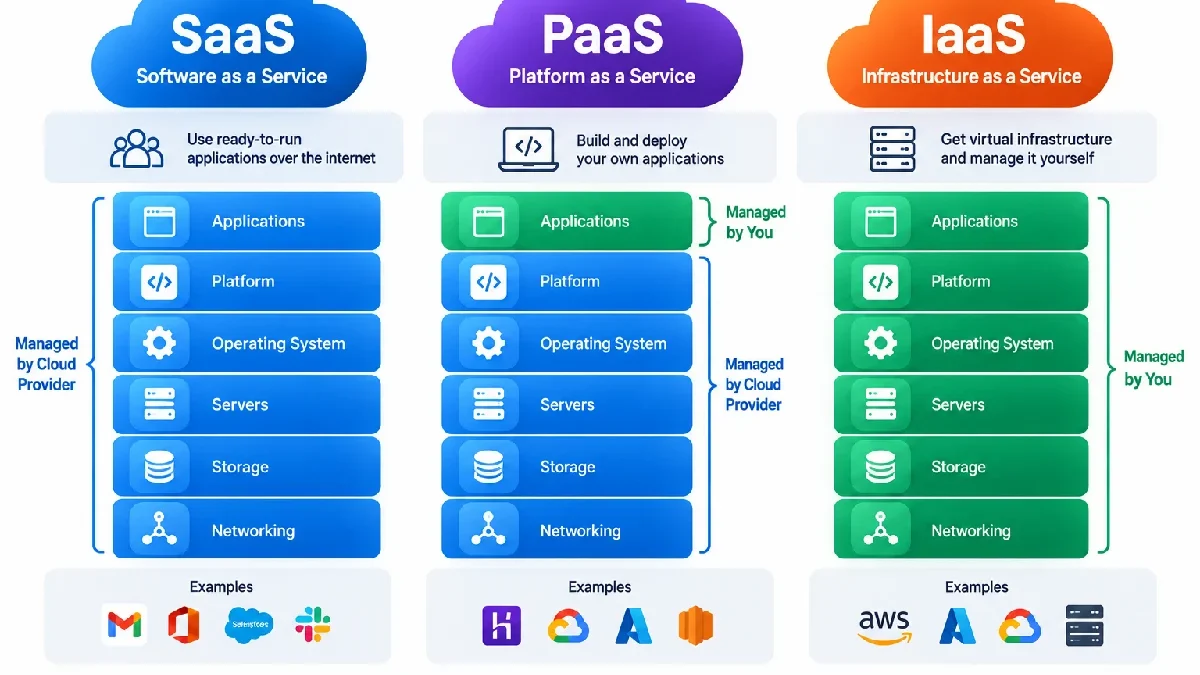

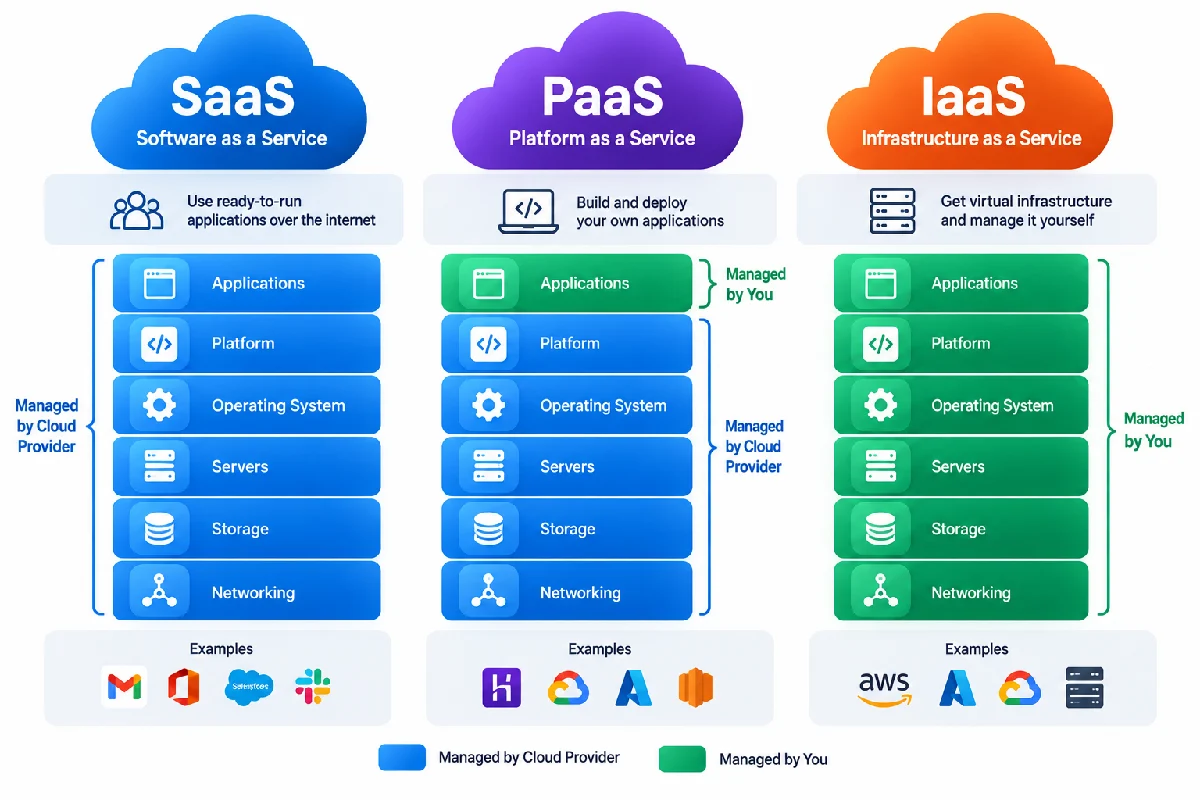


There are many service models in cloud computing, and the three most common ones are SaaS, PaaS, and IaaS.
The primary distinction lies in the extent to which the cloud provider oversees the technology stack and the level of influence the customer retains.
15 December 20215 minutes of reading Share on linkedin Share on twitter Share on facebook Having only 25 minutes in due to a company meeting I thought I would quickly shoot out a few quick posts one today on understanding the difference.
Table of Contents
What Is SaaS?
SaaS is an abbreviation of Software as a Service.
In the SaaS environment, the entire software application is offered directly to the customer.
The provider generally manages:
- Infrastructure
- Servers
- Operating systems
- Application
- Updates
- A significant part of the maintenance
The application is predominantly configured by the customer.
Cloud based applications such as – CRM CRMar, Online email, project management tools, an example of an IS.
What Is PaaS?
Platform as a Service (PaaS)1160 is mentioned twice on the webpage.
With PaaS, a developer accesses an environment where they can create, test and deploy software applications without needing to manage the underlying infrastructure.
In most cases, the cloud provider is responsible for the infrastructure and platform components.
Then developers can optimize the application code and deployment.
A PaaS is helpful when a development team needs a managed environment but does not want to design and develop the full server stack and platform.
What Is IaaS?
What does IaaS mean? IaaS = Infrastructure as a Service.
IaaS is provision of the most basic infrastructure services, including virtual server, storage space and network connectivity.
In comparison to SaaS or PaaS, however, there‘s significantly more oversight on the part of the customer, as well as more accountability.
Depending on what service the customer may manage:
- Operating systems
- Applications
- Configurations
- Data
- Security settings
SaaS vs PaaS vs IaaS Comparison
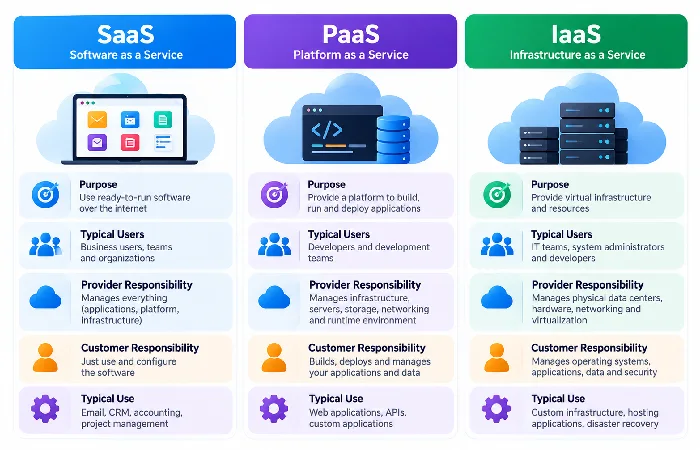
| Area | SaaS | PaaS | IaaS |
|---|---|---|---|
| Main purpose | Use software | Build applications | Use infrastructure |
| Customer control | Lower | Medium | Higher |
| Provider management | Highest | High | Lower |
| Main users | End users | Developers | IT teams and developers |
| Infrastructure work | Minimal | Reduced | Greater |
| Typical goal | Use an application | Develop and deploy | Build and manage systems |
A Simple Way to Understand the Difference
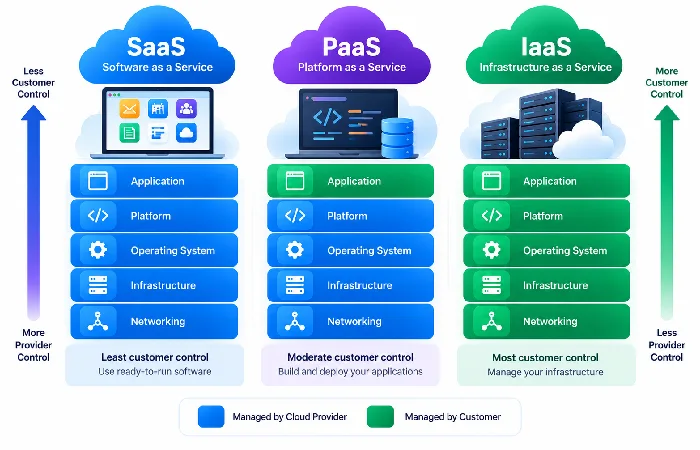
Let‘s take the three approaches as categorising various levels of the responsibility to why it‘s why.
SaaS
The application is used by you.
PaaS
You open up your application to an existing managed platform.
IaaS
You rent only the underlying infrastructure and should assume responsibility to maintain more of the software environment on your own.
The more control you require, the more responsibilities you usually acquire.
When SaaS Makes Sense
SaaS makes sense if what you want is to play with an app without delivery the whole technology stack.
For example, a business might adopt a SaaS for accounting, CRM, project management, communication.
When PaaS Makes Sense
PaaS may be convenient for software developers.
It can minimize some OT but let the developer retain full control of its application code.
When IaaS Makes Sense
IaaS is effective if the organisation requires more control of their infrastructure and software environment.
This may be better suited for loads that have custom configurations or require operating-system and network settings.
Which Model Requires More Management?
Generally:
SaaS → minimum management from customers
PaaS → medium management
IaaS greater customer-side administration
It does not follow that one model is always the best fit. The ‘best’ Model is the one that gives the level of control needed and recognises what a nature of technical work the organisation is willing to undertake.
Final Thoughts
SaaS, PaaS and IaaS address different issues.
SaaS offers you complete applications. PaaS gives you a control of an operating platform where you can build your own applications. IaaS (more control over) provides a computing host infrastructure.
Having an understanding of these differences are relevant when selecting a cloud service model the business, development or technical workload.