




Machine Learning Application Development: Complete Guide
Machine learning is here and everyone is using it. No longer confined to research institutions or high tech companies, businesses are deploying ML applications to predict outcomes, identify problems, improve recommendations or just make smarter digital products.
Building an application using machine learning is defining the application that uses machine learning model(s) to solve a real business or user problem. The application may use a pre-existing model, or a newly trained one, or a combination of both.
This tutorial explains what applications for machine learning are, how they are created, where they are used and what companies should take into account before opening a project.
Table of Contents
What Is Machine Learning Application Development?
Developing an application of machine learning refers to developing an application which employs using machine learning techniques to do the work which normally needs analysis or prediction based on data.
An application in a traditional sense generally has its own rigid rules.
For example, a basic ordering system may follow a rule such as:
Creates a line in the cart for the product the customer bought.
Another way a machine learning application can work is to remember what a customer has previously bought and suggest other products they may be interested in purchasing.
This makes machine learning useful for applications that need:
- Prediction
- Classification
- Recommendations
- Pattern detection
- Personalization
- Anomaly detection
- Decision making assistance without human intervene (shorter version of automation of decision support).
Machine learning can be incorporated into websites, mobile applications, business applications, customer platforms, healthcare. systems, financial applications, and many other products.
How Machine Learning Applications Work
Usually, a typical machine learning application consists of various related components.
Introduction. Application gathers or receives data. The data may be taken from users, transactions, devices, databases, other applications, API, documents and so on.
Then, we get the data ready for the machine learning model. It may be necessary to clean, extract and select relevant features, transform values, and eliminate problem records.
Analyzes it and produces a result of some sort, such as a prediction, classification, score, recommendation, et cetera.
Finally, applying that result is when the application is used.
For example, an ecommerce application could work like this:
Customer activity > data processing > ML model >product prediction–>personalized recommendation.
So, the machine learning model is only one piece of the overall application. A complete solution would also include a front end, back end, data processing; public (APIs), security, testing, monitoring and many other aspects.
Common Types of Machine Learning Applications
There are numerous types of application machine learning can be used for.
Recommendation Applications
Recommendation systems are algorithms for recommending products, video, articles, music, courses, or other content, based on past behavior.
Online retailers can use therecommendations models to sell related products. Media players can use the recommendations models to get them recommend videos that their audience might like.
Predictive Applications
Predicting Applications Predictive applications look to determine what might happen in the future based on past data.
Examples include:
- Sales forecasting
- Demand prediction
- Predicting customer churn. The challenge is to predict the likelihood that a customer will discontinue their shop within the next three months.
- Failure prediction of equipment.
- Financial risk scoring
These applications can help teams make decisions using patterns in their existing data.
Classification Applications
Classification models place information into predefined groups.
A business could use machine learning to classify:
- Emails as spam or legitimate
- Customers by risk level
- Images by category
- Support requests by issue type
- Transactions as normal or suspicious
Computer Vision Applications
Computer vision is the enables us to have a computer analyze images or video.
This is applied to quality testing, object detection, document mining, face recognition, Medical imaging support, and security surveillance.
Natural Language Applications
Machine learning can be applied to human language as well.
Examples include:
- Customer support assistants, also referred to as customer service agents.
- Document classification
- Sentiment analysis
- Text summarization
- Search systems
- Content categorization
They operate as part of larger AI application development projects.
Machine Learning Application Development Process
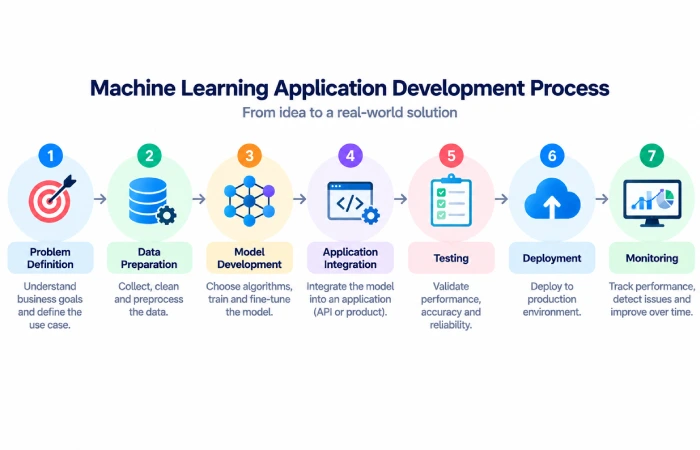
Developing an application that uses ML is not only about training a model. Developing this application generally begins with the business problem and through data, modeling, application development, testing, deployment and monitoring.
1. Define the Problem
The initial step is determining exactly what the application should attempt to solve.
A generic goal, like “we want to use AI”, is not enough.
A better goal could be:
- Lower the level of customer attrition.
- Improve product recommendations
- Identify phony transactions
- Automating the classification of documents
- Know inventory demand PMID: Method to estimate inventory requirements supplied from trends and predictive analysis.
The problem should have a well defined outcome.
2. Collect and Prepare Data
Data quality is crucial for Machine learning.
Developers and data teams find data sources that will be of use and get the data ready.
This can include:
- Cleaning duplicate records. Duplicate records can occur when author name, journal, or date of publication are not correctly captured or combined. When a publication is referred to more than once in a search extraction, there tends to be some duplicate entries; therefore, these cannot be used when constructing the ontology.
- Dealing with missing values. Missing or evident data which often are to be replaced with indicators values. In the literature, it is also known as coding with sources. When the software allows it, taking real or complete values as initial estimates makes sense, since they are based on the proximity of a source.
- The contrast between relevant and irrelevant information functions to separate the useful from the useless.
- Some (dark art). Labeling training data. Perhaps one of the commonest forms of external human interaction in any statistical program. Program; formulate hypothesis/test;enter data; analyze results; go to infinity. Prompting, fixing, sorting, and cataloging data can make of one mystic ritual.
- Choosing informative features
- The division between training data and test data.
Low-quality data can hold back the performance of even a good model.
3. Choose or Build the Model
The next step is deciding on an appropriate machine learning technique.
The team could use an existing model, train a model using business data, or, pit it against a more suitable model.
It depends on the task, the available data, the required accuracy, the cost and the technical requirements.
4. Build the Application
We now need this model to go into a live product.
Developers hook the model into the backend, API‘s, database and front end of the application.
For example, a customer support application can pass a message from a user to a ML classifier server, receive an intent or classification result back and then direct the request to the proper workflow.
5. Test the Complete System
Evaluation cannot simply stop at obtaining the model and inspecting what it outputs.
The application should also be tested for:
- Response time
- Reliability
- Security
- API performance
- Data handling
- User experience
- Failure conditions
It is possible that a model that is working well in a test environment may cause problem when connected to an application.
6. Deploy and Monitor
Once the application is complete it can be deployed to the desired environment.
Monitoring is needed as the data and properties of users might change over time. A model that worked while started might need to be changed later.
Always monitor performance, errors, data quality and behavior of a model.
Benefits of Machine Learning Application Development
Businesses choose machine learning applications for several reasons.
Better Automation
ML applications can automate repetitive analysis and decision-support tasks, reducing the amount of manual work required.
More Personalized Experiences
Applications can adapt recommendations, content, offers, and workflows based on user behavior.
Faster Decisions
Instead of manually reviewing large amounts of information, businesses can use models to identify patterns and generate useful results quickly.
Better Use of Business Data
Machine learning can turn existing business data into predictions, classifications, and insights that are difficult to produce using simple rules.
New Product Opportunities
Machine learning can also become part of a new digital product rather than simply improving an existing one.
Machine Learning Application Development Use Cases
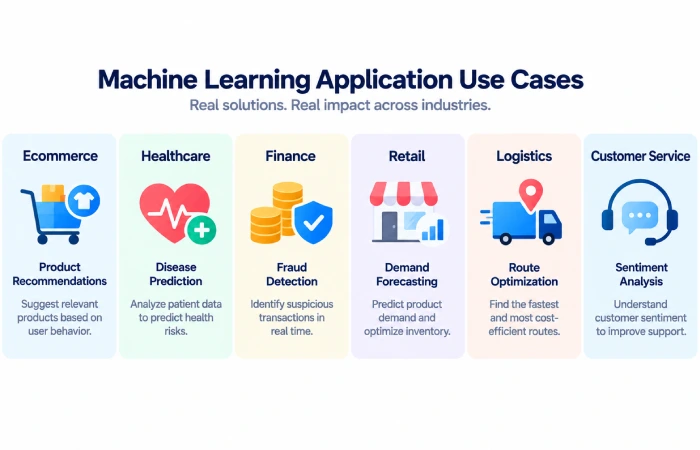
The right use case depends on the business and available data.
| Industry | Example ML Application |
|---|---|
| Ecommerce | Product recommendations and demand forecasting |
| Healthcare | Image analysis and prediction support |
| Finance | Fraud detection and risk scoring |
| Manufacturing | Predictive maintenance |
| Retail | Customer segmentation and sales forecasting |
| Marketing | Lead scoring and personalization |
| Logistics | Route and demand prediction |
| Customer Service | Ticket classification and intelligent assistants |
Not every process needs machine learning. A simple rule-based system may be cheaper and easier when the problem is straightforward.
Machine Learning Application Development vs Traditional Software
Traditional software follows explicitly programmed rules. Machine learning applications can learn patterns from data and use those patterns to produce predictions or decisions.
This difference also makes ML applications more demanding to build.
A normal software project may focus mainly on application logic, databases, interfaces, and integrations.
A machine learning project must also consider data quality, model performance, training, evaluation, monitoring, and model updates.
That is why machine learning application development usually requires a combination of software engineering, data engineering, and machine learning skills.
How Much Does Machine Learning Application Development Cost?
An exact forward price of an ML application does not exist.
The price will be depending on the extent and complexity of the project.
Important factors include:
- Application size
- Counts of Resources uNumber of users: the total count of the using users In this context, the sum of all the users of resources available on the intranet encompasses researchers, customers, vendors, and people.
- Data availability
- Model complexity
- Training requirements
- Cloud infrastructure
- Third-party APIs
- Security requirements
- Integration work
- Testing and maintenance
A small application using an existing model may be simple. A large enterprise system with custom models, large data pipelines, multiple integrations, and ongoing monitoring system can cost orders of magnitude more.
Therefore it is essential that, when possible, the business define its specification and the technical requirements before estimating the final project budget.
Common Challenges
The development of applications using machine learning can be very useful, but also comes with issues such as:
Data Quality
Inaccurate, incomplete, biased or old data can affect the usefulness of the model.
Integration Complexity
A model with existing software, databases, APIs, and workflows is a great idea that could still take a lot of backend work.
Model Maintenance
Models will need re-trained or possibly re-developed as business environment and user behaviors change.
Security and Privacy
Systems that process customer or business information may require access control, data protection and security measures.
Performance
A model that is effective in a development environment may need to be tweaked when it is being accessed by thousands or millions of people.
How to Choose a Machine Learning Development Team
Choosing the right development team is important because ML projects combine several technical disciplines.
Look for a team that understands both machine learning and application engineering.
Check whether they can explain:
- How your data will be used
- Why a particular model is appropriate
- How the model will integrate with your application
- How performance will be measured
- How the system will be monitored
- How future model updates will be handled
It is also useful to review previous projects, technical experience, development practices, and post-launch support.
For broader guidance, see our main guide on machine learning development services.
You can also explore machine learning model development to understand the model-building stage in more detail.
Final Thoughts
Develop the software product that integrates the machine learning algorithms discovered through the research process.The most meaningful projects start with a real business problem, not just that AI is well-loved at the time.
The application, however, needs sound data, the right model, good software architecture, testing, security, and constant monitoring.As far as businesses are concerned, it should not be about keeping the most complex machine learning system. It should be to build an application that solves the real problem, adds quantifiable value and can be scale-up as the business scales.